Full Text (PDF)
Indian Journal of Obstetrics and Gynecology 11(1):p 15-19, January-March 2023. | DOI: https://doi.org/10.21088/ijog.2321.1636.11123.4
Original Article
A Prospective Observational Study of Maternal Perception of Reduced Fetal Movements and Fetal Outcome
Author Information
Licence:
Attribution-Non-commercial 4.0 International (CC BY-NC 4.0)License Description - This license enables reusers to distribute, remix, adapt, and build upon the material in any medium or format for noncommercial purposes only, and only so long as attribution is given to the creator.
Indian Journal of Obstetrics and Gynecology 11(1):p 15-19, January-March 2023. | DOI: https://doi.org/10.21088/ijog.2321.1636.11123.4
How Cite This Article:
Anisha Singh, Col. S.k. Singh/A Prospective Observational Study of Maternal Perception of Reduced Fetal Movements And Fetal Outcome/Indian J Obstet Gynecol. 2023;11(1):15-19.Timeline
Received : March 06, 2023
Accepted : March 28, 2023
Published : March 30, 2023
Abstract
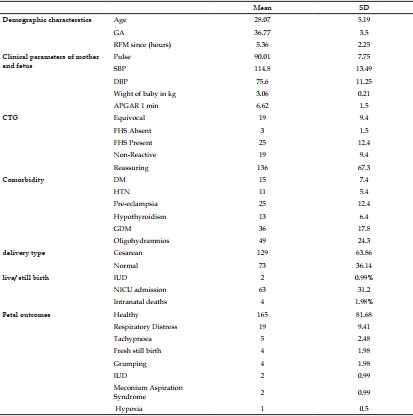
Background: Maternal perception of reduced fetal movements (RFM) is associated with increased risk of still birth, preterm labor & fetal growth restriction. RFM is thought to represent fetal compensation to conserve energy due to insufficient oxygen & nutrient transfer resulting from placental insufficiency. Intrauterine fetal death is preceded by RFM for 24 hours in up to 50% cases. In infants who are alive at presentation, RFM is associated with increased incidence of still birth, fetal growth restriction & feto-maternal hemorrhage. However RFM is may also occur in non pathological conditions such as anterior placental site, increased maternal activity & standing position. Inadequate clinician response to complaint of RFM is important contributory factor to still birth. Aims and objectives: To assess association between maternal perceptions of reduced fetal movements and fetal outcome. Methodology: Study was conducted in Department of Obstetrics and Gynecology at Bharati hospital, Pune. It was a prospective observational study of fetal outcomes in mothers perceiving reduced fetal movements. Women after 28 weeks of pregnancy presenting with reduced fetal movements out of that 202 pregnant women were included. Study was conducted from October 2020 to October 2022. Results: Majority of the fetuses were healthy. There was strong association between reduced fetal movements and Oligohydramnios. We found significant association between NICU admission, birth weight, APGAR, and RFM category, while no significant association between RFM category and status at birth and type of delivery. There were 2 IUD’s noted. Conclusion: Fetal movements monitoring is necessary during antenatal period, after 28 weeks of pregnancy, it is a good predictor of fetal outcome, and helps in timely intervention.
References
- 1. Martin JA, Hoyert DL. The national fetal death file. Semin Perinatol. 2002;26:3–11.
- 2. Dutton PJ, Warrander LK, Roberts SA, Bernatavicius G, Byrd LM, Gaze D, Kroll J, Jones RL, Sibley CP, Frøen JF, Heazell AE. Predictors of poor perinatal outcome following maternal perception of reduced fetal movements--a prospective cohort study. PLoS One. 2012;7(7):e39784.
- 3. Stillbirth Collaborative Research Network Writing Group. Association between stillbirth and risk factors known at pregnancy confirmation. JAMA. 2011;306:2469–79.
- 4. Huang C, Han W, Fan Y. Correlation study between increased fetal movement during the third trimester and neonatal outcome. BMC Pregnancy Childbirth. 2019;19:467.
- 5. Jakes AD, Whybrow R, Spencer C, Chappell LC. Reduced fetal movements. BMJ. 2018;360:k570.
- 6. de Bernis L, Kinney MV, Stones W, et al. Stillbirths: ending preventable deaths by 2030. Lancet. 2016;387(10019):703–16.
- 7. Neldam S. Fetal movements as an indicator of fetal well-being. Dan Med Bull. 1983;30:274–8.
- 8. Valentin L, Maršál K. Subjective recording of fetal movements. II. Screening of a pregnant population; methodological aspects. Acta Obstet Gynecol Scand. 1986;65:639–44.
- 9. O’Sullivan O, Stephen G, Martindale E, Heazell AEP. Predicting poor perinatal outcome in women who present with decreased fetal movements. J Obstet Gynaecol. 2009;29(8):705–10.
- 10. James DK, Telfer FM, Keating NA, Blair ME, Wilcox MA, Chilvers C. Reduced fetal movements and maternal medication – new pregnancy risk factors for neurodevelopmental disability in childhood. J Obstet Gynaecol. 2000;20(3):226–34.
Data Sharing Statement
There are no additional data available. All raw data and code are available upon request.
Funding
This research received no funding.
Author Contributions
All authors contributed significantly to the work and approve its publication.
Ethics Declaration
This article does not involve any human or animal subjects, and therefore does not require ethics approval.
Acknowledgements
We would like to express our gratitude to the patients, their families, and all those who have contributed to this study.
Conflicts of Interest
No conflicts of interest in this work.
About this article

Cite this article
Anisha Singh, Col. S.k. Singh/A Prospective Observational Study of Maternal Perception of Reduced Fetal Movements And Fetal Outcome/Indian J Obstet Gynecol. 2023;11(1):15-19.
Licence:
Attribution-Non-commercial 4.0 International (CC BY-NC 4.0)License Description - This license enables reusers to distribute, remix, adapt, and build upon the material in any medium or format for noncommercial purposes only, and only so long as attribution is given to the creator.
| Received | Accepted | Published |
|---|---|---|
| March 06, 2023 | March 28, 2023 | March 30, 2023 |
DOI: https://doi.org/10.21088/ijog.2321.1636.11123.4
Keywords
Reduced fetal movementsOligohydramniosSearch for Similar Articles
Similar Articles
- Fibromyoma: A Clinical Dilemma
- Optimizing Obstetric Care: A Review of Indications and Outcomes for First-Time C...
- A Rare Case of Geriatric Endometrial Adenocarcinoma Presenting with Nonpuerperal...
- Relationship between Hypothyroidism and Gestational Diabetes Mellitus: A Prospec...
- Influence of Maternal Anthropometry and Hemoglobin on Neonatal Anthropometry
Article Level Metrics
Last UpdatedTuesday 08 September 2026, 18:06:43 (IST)
3506
Accesses
16
580
00
Citations
NA
NA
NA
Download citation
Article Keywords
Keyword Highlighting
Highlight selected keywords in the article text.
Timeline
| Received | March 06, 2023 |
| Accepted | March 28, 2023 |
| Published | March 30, 2023 |
licence
Attribution-Non-commercial 4.0 International (CC BY-NC 4.0)
License Description - This license enables reusers to distribute, remix, adapt, and build upon the material in any medium or format for noncommercial purposes only, and only so long as attribution is given to the creator.