Full Text (PDF)
Indian Journal of Surgical Nursing 14(2):p 43-53, May-August 2025. | DOI: 10.21088/ijsn.2277.467X.14225.1
Original Article
A Descriptive Study to assess Effectiveness of Structured Teaching Programme on Knowledge Regarding Complications of Alcoholism among H.S.C. Students in Selected Schools in Nagpur
Author Information
Licence:
Attribution-Non-commercial 4.0 International (CC BY-NC 4.0)This license enables reusers to distribute, remix, adapt, and build upon the material in any medium or format for noncommercial purposes only, and only so long as attribution is given to the creator.
Indian Journal of Surgical Nursing 14(2):p 43-53, May-August 2025. | DOI: 10.21088/ijsn.2277.467X.14225.1
How Cite This Article:
Vivek Dilip Jamnik. A Descriptive Study to assess Effectiveness of Structured Teaching Programme on Knowledge Regarding Complications of Alcoholism among H.S.C. Students in Selected Schools in Nagpur. J Surg. Nurs. 2025; 14(2): 43-53.Timeline
Received : May 02, 2025
Accepted : July 30, 2025
Published : August 25, 2025
Abstract
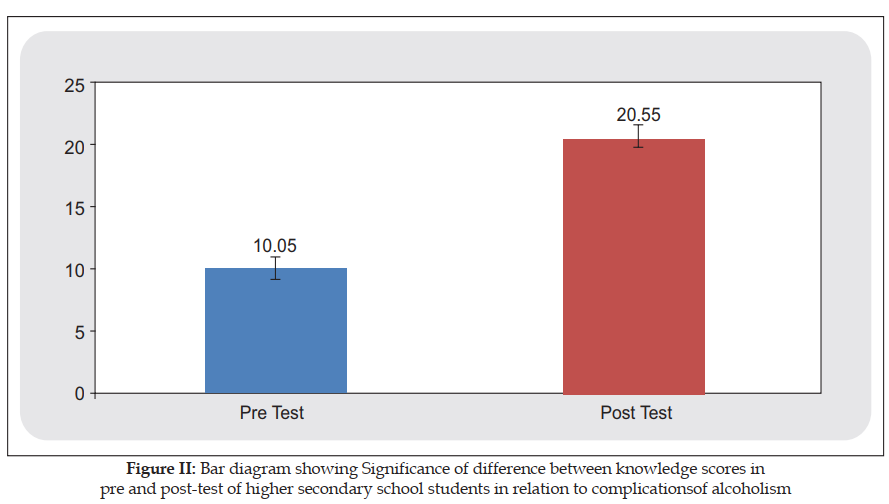
Background of the study: Alcoholism is one of the major global health problems. From a public health perspective, alcohol consumption has become a major burden both in terms of morbidity and mortality in most parts of the world, alcohol consumption has health and social consequences via intoxication, alcohol dependence, and other biochemical effects of alcohol, which lead to traumatic outcomes that kill or disable the individual at a young age. Impairment may involve physiological, psychological or social dysfunction. psychologically speaking, alcoholism has less to do with “how much” someone is drinking and more to do with what happens when they drink. If you have problems when you drink, you have drinking problem. Aim of the study: The study aims to find the Knowledge on Selected Psychotropic Drugs Among H.S.C. Students in Selected school in Nagpur. with A View to Develop an Information Booklet on Psychotropic Drugs Objectives: To assess the pretest knowledge regarding complication of alcoholism among H.S.C. Students in Selected school in Nagpur. To assess the posttest knowledge regarding complication of alcoholism among H.S.C. Students in Selected school in Nagpur. To assess Effectiveness of Structured teaching program on knowledge regarding complications of alcoholism among H.S.C. Students in Selected school in Nagpur. To associate the knowledge scores with selected demographic variable. Methodology: The research design refers to the researcher’s overall plan for ob- taining answers to the research questions and for testing the research hypothesis. The research design spells out the strategies that the researcher adopts to develop information that is accurate, objective and interpretable. The research designs provide an overall blueprint to carry out the study. For the present study the design was a Descriptive design, which includes Manipulation, Descriptive and no Randomization. Results: In the study, Distribution of higher secondary school students according to their age in years shows that 23.3% of them were belonging to the age of 12-13 years, 41.7% in the age group of 14-15 years and 35% were belonging to the age of 16-18 years respectively. Conclusion: The data were analyzed and interpreted in terms of objectives formulated descriptive and inferential statistics were used for data analysis. The result of this study shows that the statistical Student’s paired t test implies that the difference in the pretest and posttest knowledge score found to be 18.77 statistically significant at 0.05% level. Hence it is statistically interpreted that structured teaching programme on knowledge regarding complications of alcoholism was effective. Thus, H1 is accepted and H0 is rejected.
References
- 1. Sreevani R. A guideline to mental health psychiatric nursing. 4th edition. New Delhi: The health sciences Publisher; 2016, page no. 242-243.
- 2. http;//www.xenos.org/essays/introductionalcoholism.
- 3. Townsend Mary C. psychiatric mental health nursing. 6th Indian edition. new Delhi: Jaypee brothers medical publishers; 2010; page no.273.
- 4. Testino G, Alcoholic diseases in hepatogastroenterology: a point of view. Hepatogastroenterology. 2008. 55 (82–83): 371–7.
- 5. The Hindu, Tuesday, Dec 07, 2010, http:// www.hindu.com/pda.
- 6. The Hindu, Tuesday, Dec 07, 2010, http:// www.hindu.com/pda.
- 7. http://www.greenfacts.org/en/alcohol/l- 2/01-number-people-affected.htm.
- 8. Walter H, Gutierrez, K. Rams Kogler, K, Hertling, I, Dvorak, A, Lesch, OM. (Nov 2003), Gender-specific differences in alcoholism: implications for treatment. Archives of Women’s Mental Health 6 (4): 253–8. doi: 10.1007/s00737-003-0014.
- 9. Middleton Fillmore K, Chikritzhs T, Stockwell T, Bostrom A, Pascal R, Reviews about Alcohol use and prostate cancer: a meta-analysis, Mol Nutra Food Res. 2009, Feb;53(2):240-55.
- 10. Alcohol/rehab.com/alcoholism/alcoholismin-India.
- 11. http://www.mapsofindia.com/my-india/ india/alcohol-consumption-in-india.
- 12. Oxford English Dictionary, Indian Edition. New Delhi: Oxford University Press; p 2011.25.
- 13. Bouchery EE1, Harwood HJ, Sacks JJ, Simon CJ, Brewer RD. Economic costs of excessive alcohol consumption in the U.S., 2006.Am J Prev Med. 2011 Nov;41(5):516-24. doi: 10.1016/j.amepre.2011.06.045.
- 14. Owens DK1, Lohr KN, Atkins D, Treadwell JR, Reston JT, Bass EB, Chang S, Helfand M. AHRQ series paper 5: grading the strength of a body of evidence when comparing medical interventions--agency for healthcare research and quality and the effective health-care program, JClinEpidemiol. 2010 May;63(5):513-23. doi: 10.1016/j. jclinepi.2009.03.009.
Data Sharing Statement
There are no additional data available.
Funding
Self, no external source of funding received.
Author Contributions
All authors contributed significantly to the work and approve its publication.
Ethics Declaration
This study titled“A Descriptive Study To Assess Effectiveness of Structured Teaching Programme On Knowledge Regarding Complications of Alcoholism Among H.S.C. Students in Selected Schools In Nagpur.” was conducted with strict adherence to ethical research practices. The research protocol was reviewed and approved by an appropriate institutional ethics committee. Participants were informed about the purpose, procedure, and expected outcomes of the study. Informed consent was obtained from participants and their guardians, ensuring confidentiality and voluntary participation. The study was designed to avoid any physical or psychological harm to participants and followed all ethical guidelines for research involving human subjects.
Acknowledgements
Information not provide.
Conflicts of Interest
The authors of this study declare no conflict of interest in the execution, analysis, or publication of this research. No financial, professional, or personal affiliations influenced the study’s outcomes or the structured teaching program’s effectiveness. This research was conducted solely for academic purposes to enhance knowledge of higher secondary school students regarding alcoholism.
About this article

Cite this article
Vivek Dilip Jamnik. A Descriptive Study to assess Effectiveness of Structured Teaching Programme on Knowledge Regarding Complications of Alcoholism among H.S.C. Students in Selected Schools in Nagpur. J Surg. Nurs. 2025; 14(2): 43-53.
Licence:
Attribution-Non-commercial 4.0 International (CC BY-NC 4.0)This license enables reusers to distribute, remix, adapt, and build upon the material in any medium or format for noncommercial purposes only, and only so long as attribution is given to the creator.
| Received | Accepted | Published |
|---|---|---|
| May 02, 2025 | July 30, 2025 | August 25, 2025 |
DOI: 10.21088/ijsn.2277.467X.14225.1
Keywords
KnowledgeRegardingComplication of alcoholismHigher secondary schoolStudentsSearch for Similar Articles
Similar Articles
Article Level Metrics
Last UpdatedFriday 24 July 2026, 06:49:03 (IST)
1071
Accesses
18
216
00
Citations
NA
NA
NA
Download citation
Article Keywords
Keyword Highlighting
Highlight selected keywords in the article text.
Timeline
| Received | May 02, 2025 |
| Accepted | July 30, 2025 |
| Published | August 25, 2025 |
licence
Attribution-Non-commercial 4.0 International (CC BY-NC 4.0)
This license enables reusers to distribute, remix, adapt, and build upon the material in any medium or format for noncommercial purposes only, and only so long as attribution is given to the creator.