Full Text (PDF)
Journal of Dermatology 9(1):p 19-22, January–June 2024. | DOI: na
Original Article
Wound Infection Prediction Score
Ravi Kumar Chittoria, Vaibhav Shukla, Jacob Antony Chakiath, Amrutha J S
Author Information
Licence:
Attribution-Non-commercial 4.0 International (CC BY-NC 4.0)This license enables reusers to distribute, remix, adapt, and build upon the material in any medium or format for noncommercial purposes only, and only so long as attribution is given to the creator.
Journal of Dermatology 9(1):p 19-22, January–June 2024. | DOI: na
How Cite This Article:
Vaibhav Shukla, Ravi Kumar Chittoria, Jacob Antony Chakiath et al. Wound Infection Prediction Score. RFP Jr of Drea 2024;9(1):19–22.Timeline
Received : March 21, 2024
Accepted : April 22, 2024
Published : June 25, 2024
Abstract
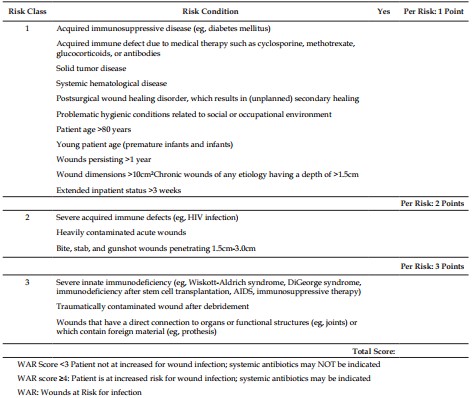
There are currently no clear cut guidelines available to help clinicians discern whether a chronic wound is infected or prone to infection. Similarly, there are no established guidelines to assist in determining when systemic antibiotics are necessary or how long they should be administered. This absence of widely recognized guidelines may result in the overuse and misuse of systemic antibiotics, potentially leading to adverse drug reactions and the emergence of multidrug-resistant bacteria. Introducing a straightforward tool for assessing infection risk in patients with chronic wounds could aid clinicians in deciding when systemic antibiotics are warranted and in ensuring their appropriate use, ultimately possibly curbing the overreliance on such medications. This study highlights the role of W.A.R. score as a wound infection prediction score.
References
- 1. Reitan RL, McBroom RM, Gilder RE. The Risk of Infection and Indication of Systemic Antibiotics in Chronic Wounds. Wounds. 2020 Jul;32(7):186-194.
- 2. Chan BC. Economic Burden of Chronic Ulcers. Doctoral thesis. University of Toronto; 2017. http://hdl.handle.net/1807/78940.
- 3. Turi GK, Donovan V, DiGregorio J, et al. Major histopathologic diagnoses of chronic wounds. Adv Skin Wound Care. 2016;29(8):376–382.
- 4. Rüttermann M, Maier-Hasselmann A, NinkGrebe B, Burckhardt M. Local treatment of chronic wounds: in patients with peripheral vascular disease, chronic venous insufÀciency, and diabetes. DtschArztebl Int. 2013;110(3):25– 31.
- 5. Gurgen M. Excess use of antibiotics in patients with non-healing ulcers. EWMA J. 2014;14(1):17–22.
- 6. Dissemond J, Assadian O, Gerber V, et al. ClassiÀcation of wounds at risk and their antimicrobial treatment with polihexanide: a practice-oriented expert recommendation. Skin Pharmacol Physiol. 2011;24(5):245–255.
- 7. Lipsky BA, Dryden M, Gottrup F, Nathwani D, Seaton RA, Styrja J. Antimicrobial stewardship inwound care:a position paper fromtheBritish Society for Antimicrobial Chemotherapy and European Wound Management Association. J AntimicrobChemother. 2016;71(11):3026– 3035.
- 8. Lipsky BA, Berendt AR, Cornia PB, et al. 2012 Infectious Disease Society of America clinical practice guideline for the diagnosis and treatment of diabetic foot infections. Clin Infect. 2012;54(12):e132–e173.
- 9. Game FL, Apelqvist J, Attinger C, et al. Effectiveness of interventions to enhance healing of chronic ulcers of the foot in diabetes: a systematic review. Diabetes Metab Res Rev. 2016;32(1):154–168.
- 10. Torkington-Stokes R, Metcalf D, Bowler P. Management of diabetic foot ulcers: evaluation of case studies. Br J Nurs. 2016;25(15):S27–S33.
Data Sharing Statement
There are no additional data available. All raw data and code are available upon request.
Funding
This research received no funding.
Author Contributions
All authors contributed significantly to the work and approve its publication.
Ethics Declaration
This article does not involve any human or animal subjects, and therefore does not require ethics approval.
Acknowledgements
We would like to express our gratitude to the patients, their families, and all those who have contributed to this study.
Conflicts of Interest
No conflicts of interest in this work.
About this article

Cite this article
Vaibhav Shukla, Ravi Kumar Chittoria, Jacob Antony Chakiath et al. Wound Infection Prediction Score. RFP Jr of Drea 2024;9(1):19–22.
Licence:
Attribution-Non-commercial 4.0 International (CC BY-NC 4.0)This license enables reusers to distribute, remix, adapt, and build upon the material in any medium or format for noncommercial purposes only, and only so long as attribution is given to the creator.
| Received | Accepted | Published |
|---|---|---|
| March 21, 2024 | April 22, 2024 | June 25, 2024 |
DOI: na
Keywords
W.A.R.ScoreWoundPredictionInfectionSearch for Similar Articles
Similar Articles
- Delving into Wolf’s Isotopic Phenomenon: Tale of Two Cases of Psoriasis Localize...
- Pachydermoperiostosis, Complete Form: A Case Report of Rare Occurrence
- Role of Cyclical Negative Pressure Wound Therapy in Thermal Burns
- Behcets Disease in an Immunocompromised Female
- Tale of an Atypical Herpes Zoster Mimicking Ecthyma and Perforating Dermatosis i...
Article Level Metrics
Last UpdatedWednesday 21 October 2026, 06:21:13 (IST)
1725
Accesses
6
194
00
Citations
NA
NA
NA
Download citation
Article Keywords
Keyword Highlighting
Highlight selected keywords in the article text.
Timeline
| Received | March 21, 2024 |
| Accepted | April 22, 2024 |
| Published | June 25, 2024 |
licence
Attribution-Non-commercial 4.0 International (CC BY-NC 4.0)
This license enables reusers to distribute, remix, adapt, and build upon the material in any medium or format for noncommercial purposes only, and only so long as attribution is given to the creator.