Full Text (PDF)
Journal of Global Medical Education and Research 9(1):p 22-30, Jan -June 2026. | DOI: n.a
Original Article
What Textbooks Taught Me - and What I Learnt Later
Vivekanshu Verma, Promod Kohli
Author Information
Licence:
Attribution-Non-commercial 4.0 International (CC BY-NC 4.0)This license enables reusers to distribute, remix, adapt, and build upon the material in any medium or format for noncommercial purposes only, and only so long as attribution is given to the creator.
Journal of Global Medical Education and Research 9(1):p 22-30, Jan -June 2026. | DOI: n.a
How Cite This Article:
Promod Kohli1, Vivekanshu Verma. What Textbooks Taught Me - and What I Learnt Later. Jr of Glob Med Edu and Res. 2026;9(1): 22-30.Timeline
Received : January 16, 2026
Accepted : February 20, 2026
Published : June 30, 2026
Abstract
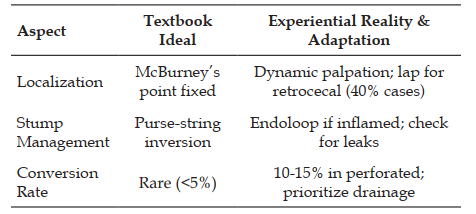
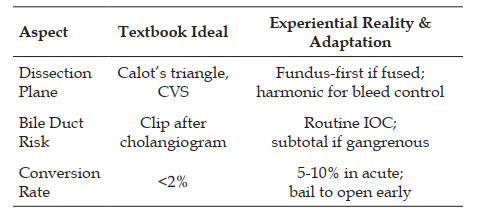
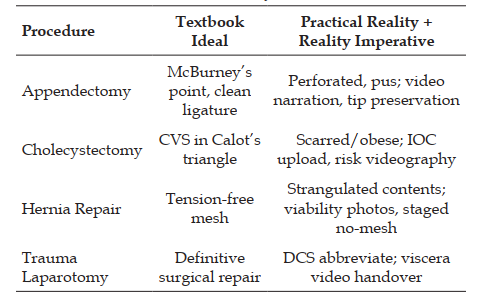
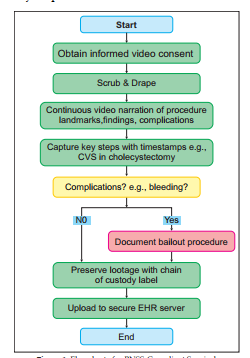
Surgical education relies heavily on textbooks, yet operating room realities reveal critical gaps in practical application, decision-making, and medico-legal compliance under India’s new criminal laws (BNS, BNSS, BSA 2023). This interview-based review captures reflections from an experienced surgeon on common procedures appendectomy, cholecystectomy, hernia repair, and trauma laparotomy highlighting experiential lessons in tNumber handling, complications, and clinical bedside documentation. Emphasis falls on BNSS §183 (mandatory videography) and §176A (viscera protocols), transforming surgeons into evidentiary stewards. Comparative tables juxtapose textbook ideals against practice realities, advocating simulationintegrated curricula to minimize litigation risks and enhance outcomes. These insights equip trainees for the art-science-humanity triad of surgery. Medical education provides a strong scientific and clinical foundation; however, the realities of medical practice often reveal important gaps between what is taught during undergraduate and postgraduate training and what is required for effective, compassionate patient care in practice. Drawing on reflections from a lifetime of surgical practice in India, this article examines two broad domains of learning: aspects of medical training that later prove inadequate or incomplete, and the essential professional competencies that are rarely taught but gradually acquired through experience. These include managing atypical clinical presentations, decision-making under uncertainty, caring for patients with multiple comorbidities, effective ommunication, expectation management, documentation, ethical dilemmas, grievance redressal, teamwork, and emotional resilience. Through illustrative clinical anecdotes, the interview dialogue highlights the “unwritten curriculum” of medicine that shapes doctors long after formal education ends. Recognising and integrating these lessons into medical training may help prepare future generations of Indian doctors to be not only clinically competent but also ethically grounded, communicatively skilled, and better equipped to navigate the complexities of contemporary medical practice.
References
- 1. Slotnick HB; How Doctors Learn: Education and Learning across the
- 2. Medical-school-to-practice Trajectory; Acad. Med. 2001;76:1013–1026.
- 3. Ignite Clinical Institute; From Perfect Diagrams to Real Patients: Why Textbook Knowledge Falls Short; Blog: https://www. igniteclinicalinstitute.com/blog/from-perfectdiagrams-to-real-patients-why-textbookknowledge-falls-short
- 4. Agusti A. The disease model: implications for clinical practice. Eur Respir J 2018; 51:1800188 [https://doi.org/10.1183/13993003.00188- 2018].
- 5. Open Horizons; God in the Operating Room. Process Theology and Surgery; Blog: https://www.openhorizons.org/god-inthe-operating-room-process-theology-andsurgery.html
- 6. Guardian Church Goods; In the Operating Room: Prayer While in Surgery; Blog: h t t p s : / / w w w . g u a r d i a n c h u r c h g o o d s . com/2025/10/08/in-the-operating-roomprayer-while-in-surgery
Data Sharing Statement
There are no additional data available. All raw data and code are available upon request.
Funding
This research received no funding.
Author Contributions
All authors contributed significantly to the work and approve its publication.
Ethics Declaration
This article does not involve any human or animal subjects, and therefore does not require ethics approval.
Acknowledgements
We would like to express our gratitude to the patients, their families, and all those who have contributed to this study.
Conflicts of Interest
No conflicts of interest in this work.
About this article

Cite this article
Promod Kohli1, Vivekanshu Verma. What Textbooks Taught Me - and What I Learnt Later. Jr of Glob Med Edu and Res. 2026;9(1): 22-30.
Licence:
Attribution-Non-commercial 4.0 International (CC BY-NC 4.0)This license enables reusers to distribute, remix, adapt, and build upon the material in any medium or format for noncommercial purposes only, and only so long as attribution is given to the creator.
| Received | Accepted | Published |
|---|---|---|
| January 16, 2026 | February 20, 2026 | June 30, 2026 |
DOI: n.a
Keywords
Medical CurriculumMedical EducationClinical PracticeTextbook PatientArt of Medical PracticeCholecystectomyHernia RepairAppendectomySearch for Similar Articles
Similar Articles
- Knowledge of Antenatal Mothers on Breastfeeding: A Descriptive CrossSectional St...
- Consumer Law and the Medical Profession in India: Post–CPA Inclusion and the Tr...
- Establishing the Pain Management Effect of Marma Tantra in Janu Sandhigatavata...
- Autologous Platelet Rich Plasma as an Adjunct for Enhanced Thermal Burn Wound He...
- Role of Functional Regenerative Four Layered Scaffold Dressing in Wound Bed Pre...
Article Level Metrics
Last UpdatedSunday 06 September 2026, 18:40:30 (IST)
722
Accesses
14
93
00
Citations
NA
NA
NA
Download citation
Article Keywords
Keyword Highlighting
Highlight selected keywords in the article text.
Timeline
| Received | January 16, 2026 |
| Accepted | February 20, 2026 |
| Published | June 30, 2026 |
licence
Attribution-Non-commercial 4.0 International (CC BY-NC 4.0)
This license enables reusers to distribute, remix, adapt, and build upon the material in any medium or format for noncommercial purposes only, and only so long as attribution is given to the creator.