Full Text (PDF)
Indian Journal of Research in Anthropology 9(2):p 101-110, July-December 2023. | DOI: 10.21088/ijra.2454.9118.9223.6
Review Article
Village Studies: As a Dimension of Anthropological Tradition in India
Author Information
Licence:
Attribution-Non-commercial 4.0 International (CC BY-NC 4.0)This license enables reusers to distribute, remix, adapt, and build upon the material in any medium or format for noncommercial purposes only, and only so long as attribution is given to the creator.
Indian Journal of Research in Anthropology 9(2):p 101-110, July-December 2023. | DOI: 10.21088/ijra.2454.9118.9223.6
How Cite This Article:
Chakraborty P. Village studies: As a dimension of anthropological tradition in India. Indian J Res Anthropol. 2023;9(2):101–110.Timeline
Received : August 04, 2023
Accepted : September 30, 2023
Published : October 30, 2023
Abstract
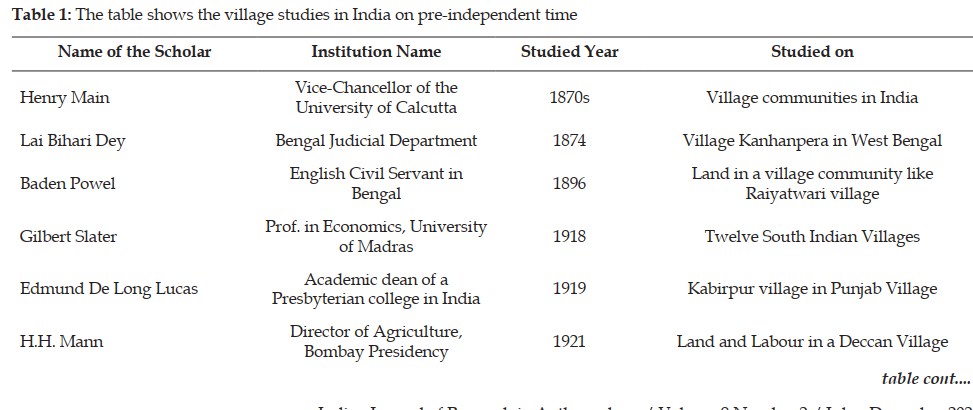
In India, Village occupies an essential place in the social as well as cultural landscape. Indian village had a substantial unit of diversity. In the history of Indian social sciences, village continuously treated as the basic unit of Indian society. Village studies were for long more or less the stock-in trade of social anthropologists of India. After reviewing number of literatures, it has drawn that the idea of village studies in India started in post-colonial period. Therefore, the present paper aims to illustrate the tradition of village studies in Anthropology from preindependent phase to post-independent phase.
References
- 1. Alexander, K. C. (2000). Rural development studies in the eighties. In Third survey of research in sociology and social anthropology (Vol. 2, pp. 184–327). Manak Publications (for Indian Council of Social Science Research).
- 2. Atal, Y. (2003). The studies of the village in India. In Indian sociology from where to where: Footnotes to the history of the discipline (pp. 159–185). Rawat Publications.
- 3. Baden-Powell, B. H. (1896). The Indian village community. Swan Sonnenschein & Co.
- 4. Baden-Powell, B. H. (1899). The origin and growth of village communities in India. Swan Sonnenschein & Co.
- 5. Béteille, A. (1980). The Indian village: Past and present. In E. J. Hobsbawm, W. Kula, A. Mitra, K. N. Raj, & I. Sachs (Eds.), Peasants in history: Essays in honour of Daniel Thorner (pp. 107–120). Oxford University Press.
- 6. Béteille, A. (1996). Caste, class and power: Changing patterns of stratification in a Tanjore village. Oxford University Press.
- 7. Connell, J., & Lipton, M. (1977). Assessing village labour situations in developing countries. Village Studies Programme, Institute of Development Studies, Sussex.
- 8. Dasgupta, B. (1975). A typology of village socio-economic systems: From Indian village studies. Economic and Political Weekly, 10(33–35), 1395–1414.
- 9. Dasgupta, B. (1978). Village studies in the Third World. Hindustan Publishing Corporation.
- 10. Dube, S. C. (1955a). A Deccan village. In M. N. Srinivas (Ed.), India's villages (pp. 202–215). Asia Publishing House.
- 11. Dube, S. C. (1955b). Indian village. Routledge and Kegan Paul.
- 12. Dube, S. C. (1969). The study of Indian village communities. In A. R. Desai (Ed.), Rural sociology in India (pp. 790–795). Popular Prakashan.
- 13. Dumont, L. (1959). Village studies. Contributions to Indian Sociology, 3, 9–39.
- 14. Durkheim, E. (1897). The Indian village community. L'Année Sociologique, 1, 359–363.(Note: Corrected year from 1879 to 1897, as L'Année Sociologique was first published in 1898 covering 1896-1897).
- 15. Epstein, T. S., Suryanarayana, A. P., & Thimmegowda, T. (1998). Village voices: Forty years of rural transformation in South India. Sage Publications.
- 16. Gough, K. (1989). Rural change in Southeast India: 1950s to 1980s. Oxford University Press.
- 17. Harriss, J. (2008, December 21–24). Notes on village studies: From an anthropological perspective [Paper presentation]. Conference on Studying Village Economies in India: A Colloquium on Methodology, Indian Statistical Institute, Chalsa, India.
- 18. Himanshu, Jha, P., & Rodgers, G. (Eds.). (2016). The changing village in India: Insights from longitudinal research. Oxford University Press.
- 19. Hoben, A., & Timberg, T. (1980). Micro and macro data in village India: A note. Economic and Political Weekly, 15(48), 2019–2022.
- 20. Hockings, P. (1999). Replication in village-level studies. Economic and Political Weekly, 34(40), 2867–2874.
- 21. Indian Council of Social Science Research. (1974). A survey of research in sociology and social anthropology (Vols. 1–2). Popular Prakashan.
- 22. Jayaraman, R., & Lanjouw, P. (1999). The evolution of poverty and inequality in Indian villages. The World Bank Research Observer, 14(1), 1–30.
- 23. Jodhka, S. S. (1998). From ‘book view’ to ‘field view’: Social anthropological constructions of the Indian village (Working Paper No. 5). Department of Sociology, University of Hyderabad.(Note: Identified the likely institution for Working Paper No. 5).
- 24. Jodhka, S. S. (2002). Nation and village: Images of rural India in Gandhi, Nehru and Ambedkar. Economic and Political Weekly, 37(32), 3343–3353.
- 25. Majumdar, D. N. (Ed.). (1955). Rural profiles I. Ethnographic and Folk Culture Society.
- 26. Majumdar, D. N. (Ed.). (1960). Rural profiles II. Ethnographic and Folk Culture Society.
- 27. Mandelbaum, D. G. (1972). Society in India (Vols. 1–2). Popular Prakashan.
- 28. Marriott, M. (Ed.). (1955). Village India. University of Chicago Press.
- 29. Mayer, A. C. (1960). Caste and kinship in Central India: A village and its region. Routledge and Kegan Paul.
- 30. Mukherjee, R. (1916). The foundations of Indian economics. Longmans Green and Company.
- 31. Mukherjee, R. (1969). On village studies. In A. R. Desai (Ed.), Rural sociology in India (pp. 805–816). Popular Prakashan.
- 32. Mukherjee, R. (1976). The value-base of social anthropology: The context of India in particular. Current Anthropology, 17(1), 71–95.
- 33. Nagaraj, K. (2008, December 21–24). Selecting a study village [Paper presentation]. Conference on Studying Village Economies in India: A Colloquium on Methodology, Indian Statistical Institute, Chalsa, India.
- 34. Ramakrishna, T. (1891). Life in an Indian village. T. Fisher Unwin.
- 35. Ranade, V. G. (1926). A social and economic survey of a Konkan village. The Provincial Co-operative Institute of Bombay.
- 36. Singer, M., & Cohn, B. S. (Eds.). (1968). Structure and change in Indian society. Aldine Publishing Company.
- 37. Slater, G. (1918). Economic studies: Vol. 1. Some South Indian villages. Oxford University Press.
- 38. Srinivas, M. N. (1955a). Introduction. In M. N. Srinivas (Ed.), India's villages (pp. 1–9). Asia Publishing House.
- 39. Srinivas, M. N. (1955b). The social structure of a Mysore village. In M. N. Srinivas (Ed.), India's villages (pp. 21–35). Asia Publishing House.
- 40. Srinivas, M. N. (1955c). The social system of a Mysore village. In M. Marriott (Ed.), Village India: Studies in the little community (pp. 1–35). University of Chicago Press.
- 41. Srinivas, M. N. (1957). Caste in modern India. The Journal of Asian Studies, 16(4), 529–548.
- 42. Vidyarthi, L. P. (1977). Rise of anthropology in India: The rural-urban and other orientation (Vol. 2). Concept Publishing Company.
Data Sharing Statement
There are no additional data available. All raw data and code are available upon request.
Funding
This research received no funding.
Author Contributions
Whether all authors contributed significantly to the work and approve its publication.
Ethics Declaration
This article does not involve any human or animal subjects, and therefore does not require ethics approval.
Acknowledgements
We would like to express our gratitude to the patients, their families, and all those who have contributed to this study.
Conflicts of Interest
The authors report no conflicts of interest in this work.
About this article

Cite this article
Chakraborty P. Village studies: As a dimension of anthropological tradition in India. Indian J Res Anthropol. 2023;9(2):101–110.
Licence:
Attribution-Non-commercial 4.0 International (CC BY-NC 4.0)This license enables reusers to distribute, remix, adapt, and build upon the material in any medium or format for noncommercial purposes only, and only so long as attribution is given to the creator.
| Received | Accepted | Published |
|---|---|---|
| August 04, 2023 | September 30, 2023 | October 30, 2023 |
DOI: 10.21088/ijra.2454.9118.9223.6
Keywords
Cultural LandscapeIndian SocietyVillage StudiesSocial AnthropologistsSearch for Similar Articles
Similar Articles
- Indigenous Knowledge System in Formal Education
- Contemporary Issues and Challenges in Women’s Weavers in the Varanasi Silk Sare...
- Understanding through Traversing the Corridors of History: Richness of Indian He...
- Challenges and Opportunities in Digital Preservation of Intangible Culture Herit...
- Assessment of Nutritional Indicators: A Comparative Study among Pre-School Child...
Article Level Metrics
Last UpdatedMonday 22 June 2026, 06:27:21 (IST)
761
Accesses
8
221
00
Citations
NA
NA
NA
Download citation
Article Keywords
Keyword Highlighting
Highlight selected keywords in the article text.
Timeline
| Received | August 04, 2023 |
| Accepted | September 30, 2023 |
| Published | October 30, 2023 |
licence
Attribution-Non-commercial 4.0 International (CC BY-NC 4.0)
This license enables reusers to distribute, remix, adapt, and build upon the material in any medium or format for noncommercial purposes only, and only so long as attribution is given to the creator.