Full Text (PDF)
Indian Journal of Research in Anthropology 11(2):p 165-173, July - Dec 2025. | DOI: DOI: /10.21088/ijra.2454.9118.11225.9
Original Article
Assessment of Nutritional Indicators: A Comparative Study among Pre-School Children of Birhor and Kawar Tribe of Korba District, Chhattisgarh, India
Swapan Kumar Kolay, Dhansay1, A.N. Sharma, Sarvendra Yadav, Sonia Kaushal
Author Information
Licence:
Attribution-Non-commercial 4.0 International (CC BY-NC 4.0)This license enables reusers to distribute, remix, adapt, and build upon the material in any medium or format for noncommercial purposes only, and only so long as attribution is given to the creator.
Indian Journal of Research in Anthropology 11(2):p 165-173, July - Dec 2025. | DOI: DOI: /10.21088/ijra.2454.9118.11225.9
How Cite This Article:
Dhansay, Sharma AN, Yadav S, et al. Assessment of nutritional indicators: a comparative study among pre-school children of Birhor and Kawar tribe of Korba District, Chhattisgarh, India. Ind J Res Anthropol. 2025;11(2):165-73.Timeline
Received : July 21, 2025
Accepted : October 22, 2025
Published : December 30, 2025
Abstract
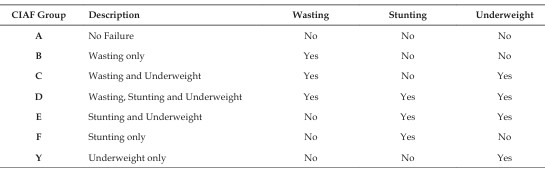
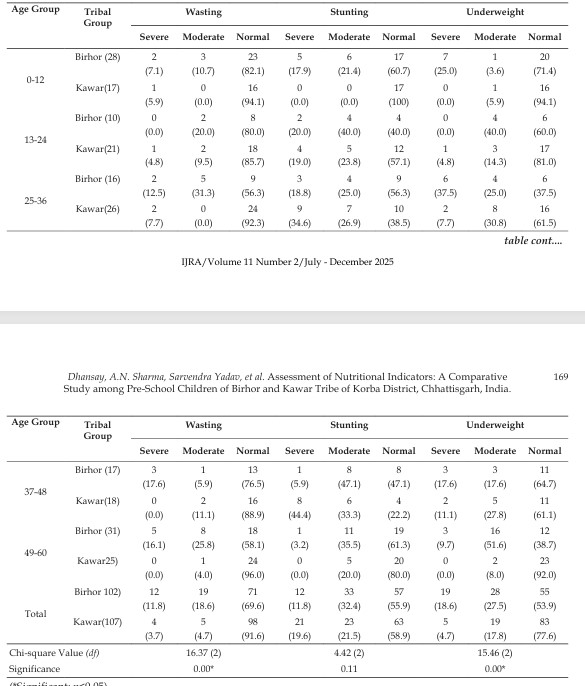
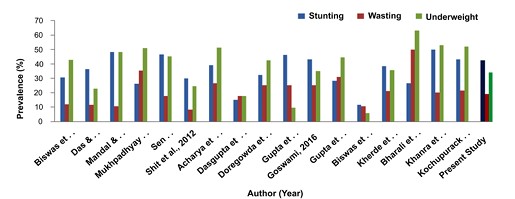
The future strength of every developing country is judged by the wealth and health of its people. Nutritional inequality leads to other forms of social inequalities. Hence nutritional inequalities have great importance in the public health dimension to identify the more underprivileged communities. Thus, the study aims to evaluate the prevalence of nutritional indicators i.e., stunting, wasting, underweight and anthropometric failure among preschool children of two tribal communities of Korba district, Chhattisgarh, India. A total of 209 [102 Birhor (PVTG) and 107 Kawar (non-PVTG)] preschool children were randomly selected and anthropometrically measured through standard procedure and techniques. The nutritional indicators i.e., wasting, stunting and underweight were assessed by WHO (2006) classification, then categorised into different anthropometric failures (Nandy et al., 2005). The age, sex and tribe combined prevalence of wasting; stunting and underweight were 19.2%, 42.6% and 34.0% respectively. Similarly, the prevalence of one or more types of anthropometric failure (B-Y) was 56% among studied children. The prevalence of nutritional indicators [wasting (χ2=16.37; p<0.05) and underweight (χ2=15.46; p<0.05)] and anthropometric failure (χ2=24.52; p<0.05) was found significantly higher among Birhor children than Kawar children. The study concluded that the nutritional status of studied children was disastrous and the primitive tribal group are more deprived, facing severe nutrition insecurity.
References
No records found.
Data Sharing Statement
There are no additional data available.
Funding
This research received no funding.
Author Contributions
All authors contributed significantly to the work and approve its publication.
Ethics Declaration
This article does not involve any human or animal subjects, and therefore does not require ethics approval
Acknowledgements
Information Not Provided
Conflicts of Interest
No conflicts of interest in this work.
About this article

Cite this article
Dhansay, Sharma AN, Yadav S, et al. Assessment of nutritional indicators: a comparative study among pre-school children of Birhor and Kawar tribe of Korba District, Chhattisgarh, India. Ind J Res Anthropol. 2025;11(2):165-73.
Licence:
Attribution-Non-commercial 4.0 International (CC BY-NC 4.0)This license enables reusers to distribute, remix, adapt, and build upon the material in any medium or format for noncommercial purposes only, and only so long as attribution is given to the creator.
| Received | Accepted | Published |
|---|---|---|
| July 21, 2025 | October 22, 2025 | December 30, 2025 |
DOI: DOI: /10.21088/ijra.2454.9118.11225.9
Keywords
Composite Index of Anthropometric FailureNutritional IndicatorParticularly Vulnerable Tribal GroupStuntingUnderweightWastingetcSearch for Similar Articles
Similar Articles
- Indigenous Knowledge System in Formal Education
- Contemporary Issues and Challenges in Women’s Weavers in the Varanasi Silk Sare...
- Understanding through Traversing the Corridors of History: Richness of Indian He...
- Challenges and Opportunities in Digital Preservation of Intangible Culture Herit...
- Prenatal and Postnatal Health-Seeking Behaviour among the Muria Tribe of Bastar...
Article Level Metrics
Last UpdatedWednesday 17 June 2026, 15:03:07 (IST)
757
Accesses
8
221
00
Citations
NA
NA
NA
Download citation
Article Keywords
Keyword Highlighting
Highlight selected keywords in the article text.
Timeline
| Received | July 21, 2025 |
| Accepted | October 22, 2025 |
| Published | December 30, 2025 |
licence
Attribution-Non-commercial 4.0 International (CC BY-NC 4.0)
This license enables reusers to distribute, remix, adapt, and build upon the material in any medium or format for noncommercial purposes only, and only so long as attribution is given to the creator.