Full Text (PDF)
Community and Public Health Nursing 4(1):p 17-20, January-June 2019. | DOI: https://doi.org/10.21088/cphn.2455.8621.4119.3
Original Article
Variation in Vitamin E Levels between Day and Night Shift Nursing Staff of Indoor Patient Wards
Bholanath Maji, Assistant Professor, Dept. of Biochemistry, Burdwan Medical College, Burdwan, West Bengal 713101, India. null, Soma Ghosh1 null, Bholanath Maji2 null
Author Information
Licence:
Community and Public Health Nursing 4(1):p 17-20, January-June 2019. | DOI: https://doi.org/10.21088/cphn.2455.8621.4119.3
How Cite This Article:
Timeline
Received : January 02, 2019
Accepted : January 31, 2019
Published : April 01, 2019
Abstract
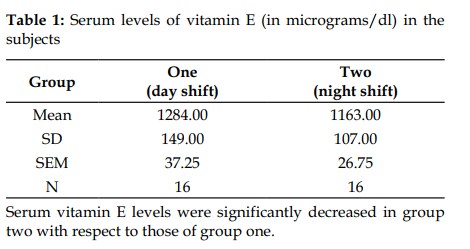
Context: The only staffs that are present always in any hospital, with or without the presence of other staff, are the nursing staff. Obviously, nursing staff are the backbones of hospitals. To perform duties properly, they should maintain physical and mental wellbeing, because any deterioration of their health would, in turn, affect the health of the patients they are attending to. So, assessment of the health of nursing staff is essential. Aims: Assessment of health of nursing staff can be done in many ways, for example, by measurement of status of the important antioxidant, vitamin E. So, aim of the work described here was to evaluate whether there was any change in serum vitamin E levels in nursing staff of different shifts, and if so, to determine the degree of significance in the change. Settings and Design: The study included sixteen nursing staff from the day shift, and age and sex-matched sixteen staff from the night shift, from the indoor patient departments. Methods and Material: Serum vitamin E levels were assayed in all subjects. Statistical analysis used: Comparison of two groups was undertaken using SPSS. Results: Serum vitamin E levels were significantly decreased in night shift nursing staff with respect to those of day shift. Conclusions: The results suggest that decrease of vitamin E levels in serum may be related to night shift duty and stress. Vitamin E may be considered as a useful biomarker of antioxidant status in night shift duty and stress, and can help in monitoring and possible remedial strategy.
References
No records found.
Data Sharing Statement
There are no additional data available. All raw data and code are available upon request.
Funding
This research received no funding.
Author Contributions
All authors contributed significantly to the work and approve its publication.
Ethics Declaration
Provide information related to the Ethics Committee approval with approval number OR write This article does not involve any human or animal subjects, and therefore does not require ethics approval.
Acknowledgements
We would like to express our gratitude to the patients, their families, and all those who have contributed to this study.
Conflicts of Interest
The authors report no conflicts of interest in this work.
About this article

Cite this article
Licence:
| Received | Accepted | Published |
|---|---|---|
| January 02, 2019 | January 31, 2019 | April 01, 2019 |
DOI: https://doi.org/10.21088/cphn.2455.8621.4119.3
Keywords
Nursing staff; stress; vitamin E.Search for Similar Articles
Similar Articles
- A Study to assess the Impact of Structured Teaching Programme on Knowledge of Pl...
- Effectiveness of Nurse Led Intervention on Knowledge and Practice of Food Borne...
- Effectiveness of a Structured Teaching Programme on Knowledge, Attitude, and Pra...
- A Study to assess the Effectiveness of Video Assisted Teaching on Knowledge Rega...
- Effectiveness of Planned Teaching Programme on Knowledge and Skill Regarding BLS...
Article Level Metrics
Last UpdatedTuesday 29 September 2026, 13:47:02 (IST)
7593
Accesses
8
1522
00
Citations
NA
NA
NA
Download citation
Article Keywords
Keyword Highlighting
Highlight selected keywords in the article text.
Timeline
| Received | January 02, 2019 |
| Accepted | January 31, 2019 |
| Published | April 01, 2019 |