Full Text (PDF)
New Indian Journal of Surgery 13(3):p 123-126, July-September 2022. | DOI: https://doi.org/10.21088/nijs.0976.4747.13322.5
Original Article
To Compare the Outcomes of Dartos Flap and Tunica Vaginalis Flap as Secondary Cover after Second Stage Durham Smith Repair in Reducing Post-Operative Complications
Shasanka Shekhar Panda, Nitin Jain, Simmi K Ratan, Parveen Kumar, Sujoy Neogi, Aparajita Mitra, Chiranjiv Kumar
Author Information
Licence:
Attribution-Non-commercial 4.0 International (CC BY-NC 4.0)This license enables reusers to distribute, remix, adapt, and build upon the material in any medium or format for noncommercial purposes only, and only so long as attribution is given to the creator.
New Indian Journal of Surgery 13(3):p 123-126, July-September 2022. | DOI: https://doi.org/10.21088/nijs.0976.4747.13322.5
How Cite This Article:
Nitin Jain, Shasanka Shekhar Panda, Simmi K Ratan, et al./To Compare the Outcomes of Dartos Flap and Tunica Vaginalis Flap as Secondary Cover after Second Stage Durham Smith Repair in Reducing Post-Operative Complications/New Indian J Surg. 2022;13(3):123–126.Timeline
Received : March 17, 2022
Accepted : April 18, 2022
Published : September 30, 2022
Abstract
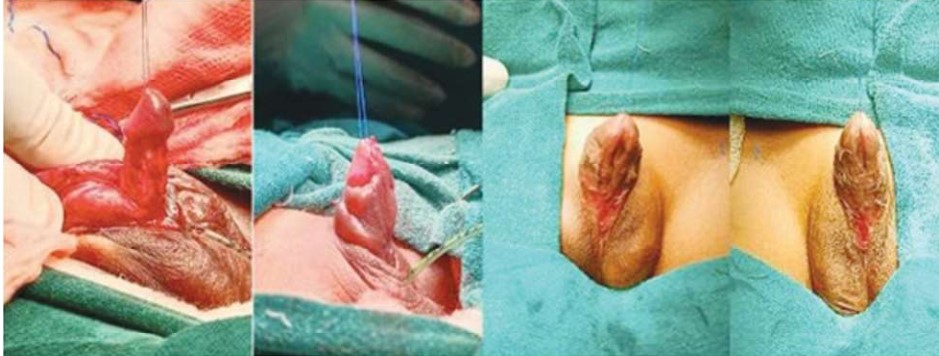
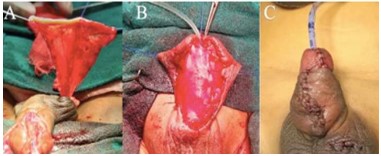
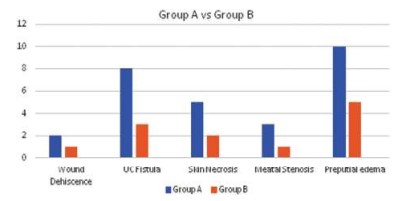
Background: The repair of severe hypospadias is always a major challenge to an operating surgeon. Two-stage repair is a good option that can be applied to almost any degree of deformity. Here in our study during the first stage, chordee correction was done and Durham smith first stage repair was carried out and during second stage after about 6 months, tabularisation was accomplished. This study aimed to compare the outcomes of lateral dartos flap (DF) and tunica vaginalis flap (TVF) as secondary intermediate layer after second stage Durham smith repair. Aim: To compare the outcomes of dartos flap (DF) and tunica vaginalis flap (TVF) as secondary cover after second stage Durham smith repair in reducing post-operative complications. Materials and Methods: It is a retrospective study where we obtained the data of 52 patients who had undergone Durham smith first stage repair and chordee correction initially and later preputial flap tabularisation with interposition of either Dartos or Tunica Vaginalis flap during second stage was done and data was collected over the duration for 2 years (2017-2019) and analyzed. Patients were divided in two groups with 26 patients in each group. Indications for staged repair included mid-penile (12 patients), proximal meatus (20 patients), penoscrotal (18 patients) or perineal (2 patients), moderate or severe chordee and poor glans groove. Patients in Group A underwent Durham smith second stage repair with lateral Dartos soft tissue cover while Group B consisted of patients with TVF as soft tissue cover. We compared between these two groups regarding complications viz. wound dehiscence, Urethrocutaneous fistula, Meatal stenosis, skin necrosis and preputial edema. Result: In group A wound dehiscence is seen in 2 (7.6%) patients, Urethro-Cutaneous Fistula in 8(30.7%), skin necrosis in 5(19.2%), meatal stenosis in 3(11.5%) and preputial edema in 10(38.4%) patients while in group B wound dehiscence is seen in 1(3.8%) patient, Urethro-Cutaneous Fistula in 3(11.5%), skin necrosis in 2(7.6%), meatal stenosis in 1(3.8%) and preputial edema in 5(19.2%) patients. We observed that tunica vaginalis flap was better than dartos flap especially in fistula formation and the difference was statistically significant. Conclusion: We have seen in our study that TV flap is a good option as second cover with lesser complications as compare to Dartos flap.
References
- 1. Duckett JW. Successful hypospadias repair. Contemp Urol. 1992;4:42–55.
- 2. Baskin LS, Ebbers MB. Hypospadias: Anatomy, etiology, and technique. J Pediatr Surg. 2006;41:463–72.
- 3. Smith D. A de-epithelialised overlap flap technique in the repair of hypospadias. Br J Plast Surg.1973;26:106–14.
- 4. Duckett JW. Hypospadias. In: Welsh PC, Retik AB, Vaughan ED, Wein AJ, editors. Campbell’s Urology. 7th ed. Vol 2. Philadelphia: WB Saunders Co; 1998. pp. 2093–123.
- 5. Haxhirexha KN, Castagnetti M, Rigamonti W, Manzoni GA. Two-stage repair in hypospadias. Indian J Urol. 2008;24(2):226-232. doi:10.4103/0970- 1591.40620
- 6. Durham Smith. E. Durham Smith Repair of Hypospadias. Urologic Clinics of North America- 1981 Oct; 8(3)
- 7. Mohajerzadeh L, Khaleghnejad Tabri A, Noroozi H, Lotfollahzadeh S, Atqiaee Kh. Results of Onlay Flap Versus Durham Smith in Proximal Hypospadias. Iranian Journal of Pediatric Surgery 2017,3(1):33-38.
- 8. Holland, A.J.A., Abubacker, M., Smith, G.H.H. et al. Management of urethrocutaneous fistula following hypospadias repair. Pediatr Surg Int 24, 1047 (2008)
Data Sharing Statement
There are no additional data available. All raw data and code are available upon request.
Funding
This research received no funding.
Author Contributions
All authors contributed significantly to the work and approve its publication.
Ethics Declaration
This article does not involve any human or animal subjects, and therefore does not require ethics approval.
Acknowledgements
We would like to express our gratitude to the patients, their families, and all those who have contributed to this study.
Conflicts of Interest
No conflicts of interest in this work.
About this article

Cite this article
Nitin Jain, Shasanka Shekhar Panda, Simmi K Ratan, et al./To Compare the Outcomes of Dartos Flap and Tunica Vaginalis Flap as Secondary Cover after Second Stage Durham Smith Repair in Reducing Post-Operative Complications/New Indian J Surg. 2022;13(3):123–126.
Licence:
Attribution-Non-commercial 4.0 International (CC BY-NC 4.0)This license enables reusers to distribute, remix, adapt, and build upon the material in any medium or format for noncommercial purposes only, and only so long as attribution is given to the creator.
| Received | Accepted | Published |
|---|---|---|
| March 17, 2022 | April 18, 2022 | September 30, 2022 |
DOI: https://doi.org/10.21088/nijs.0976.4747.13322.5
Keywords
HypospadiasDartos flap(DF)Tunica vaginalis flap(TVF)urethrocutaneous fistula (UCF)Durham Smith RepairSearch for Similar Articles
Similar Articles
- Role of Bates-Jenson Wound Assessment Tool (BJWAT) in Wound Management
- Role of New Antimicrobial Solution in the Management of a Chronic Left Foot Woun...
- Laparoscopic Excision of a Giant Retroperitoneal Benign Mesenteric Cyst Encasing...
- Endoscopic-Assisted Sural Nerve and Biceps Femoris Muscle Biopsy in a Young Woma...
- Amniotic Membrane in Wound Healing: Biological Basis, Clinical Evidence and Futu...
Article Level Metrics
Last UpdatedTuesday 24 November 2026, 17:34:57 (IST)
9671
Accesses
12
883
00
Citations
NA
NA
NA
Download citation
Article Keywords
Keyword Highlighting
Highlight selected keywords in the article text.
Timeline
| Received | March 17, 2022 |
| Accepted | April 18, 2022 |
| Published | September 30, 2022 |
licence
Attribution-Non-commercial 4.0 International (CC BY-NC 4.0)
This license enables reusers to distribute, remix, adapt, and build upon the material in any medium or format for noncommercial purposes only, and only so long as attribution is given to the creator.