Full Text (PDF)
New Indian Journal of Surgery 13(3):p 127-129, July-September 2022. | DOI: https://doi.org/10.21088/nijs.0976.4747.13322.6
Original Article
Role of Indigenous Cost Effective Two Layer Regenerative Scaffold in Wound Bed Preparation
Ravi Kumar Chittoria, K Sriharsha Reddy, Nishad K, Neijo Thomas
Author Information
Licence:
Attribution-Non-commercial 4.0 International (CC BY-NC 4.0)This license enables reusers to distribute, remix, adapt, and build upon the material in any medium or format for noncommercial purposes only, and only so long as attribution is given to the creator.
New Indian Journal of Surgery 13(3):p 127-129, July-September 2022. | DOI: https://doi.org/10.21088/nijs.0976.4747.13322.6
How Cite This Article:
K Sriharsha Reddy, Ravi Kumar Chittoria, Nishad K, Neijo Thomas/Role of Indigenous Cost Effective Two Layer Regenerative Scaffold in Wound Bed Preparation/New Indian J Surg. 2022;13(3): 127–129.Timeline
Received : March 02, 2022
Accepted : April 19, 2022
Published : September 30, 2022
Abstract
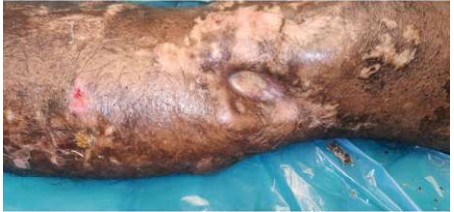
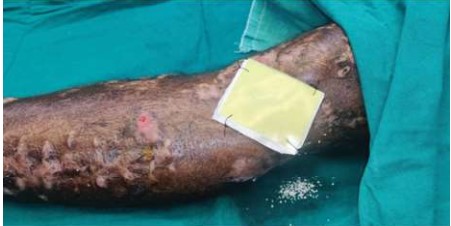
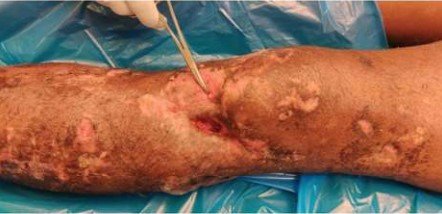
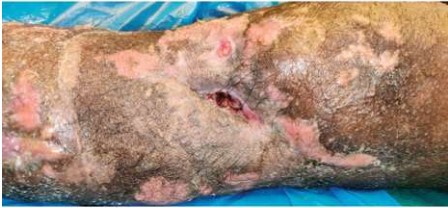
The quality of skin wound healing can be improved by the application of collagen scaffolds as biological dermal substitutes. Dermal extract helps to improves wound healing and quality of the scars. They serve as a scaffold into which cells can migrate and repair the injury. In the current scenario where in many biological and cellular engineering skin substitutes are available, wound management is a multimodality treatment with use of multiple available methods to augment wound healing at various levels. An excellent dermal substitute should be affordable, long-lasting, ready-to-use, analgesic, durable, flexible, non-antigenic, stops water loss, conforms to uneven wounds, anti-microbial, and may be applied in one sitting. In this study, we attempted to mimic the same technique in our two-layered regenerative scaffold, which is created locally and is cost-effective.
References
- 1. Shahrokhi S, Anna A, Jeschke M. The use of dermal substitutes in burn surgery: Acute phase. Wound Repair Regen. 2014 Jan-Feb;22(1):14-22.
- 2. Divya Sree D, Saranya D. Artificial skin scaffold to treat burn scars and its other applications. IJPBS 2015 Apr-Jun;5(2):11-24.
- 3. Yannas IV, Burke JF. Design of an artificial skin. I.Basic design principles. J Biomed Mater Res. 1980;14(1):65–81.
- 4. Ryssel H, Gazyakan E, Germann G, Ohlbauer M. The use of MatriDerm in early excision and simultaneous autologous skin grafting in burns- a pilot study. Burns 2008 Feb;34(1):93-7.Epub 2007 Jul 17.
- 5. Mathangi R K, Babu M, Mathivanan, Jayaraman V, Shankar J. Advantages of collagen based biological dressings in the management of superficial andsuperficial partial thickness burns in children. Ann Burns Fire Disasters. 2013 Jan 30;26(2):98-104.
- 6. Supp M.D. (2011) Skin substitutes for burn wound healing: Current and future approaches. Expert review of dermatology. 6(2):217-227.
- 7. Schiavon M, Francescon M, Drigo D et al. (2016) The use of Integra. Dermal Regeneration Template versus flaps for Reconstruction of Full thickness scalp defect including the calvaria: A cost benefit analysis. Aesthetic Plast Surg; 40(6):901-907.
- 8. Burke JF, Yannas IV, Quinby WC, Jr, Bondoc CC, Jung WK. (1981) Successful use of a physiologically acceptable artificial skin in the treatment of extensive burn injury. Ann Surg; 194 (4):413–428.
- 9. Frame JD, Still J, Lakhel-LeCoadou A, Carstens MH, Lorenz C, Orlet H, (2004) Spence R, Berger AC, Dantzer E, Burd A. Use of dermal regeneration template in contracture release procedures: a multicentre evaluation. Plast Reconstr Surg; 113(5):1330–1338.
- 10. Moiemen NS, Staiano JJ, Ojeh NO, Thway Y, Frame JD. (2001) Reconstructive surgery with a dermal regeneration template: clinical and histologic study. Plast Reconstr Surg; 108(1):93–103.
Data Sharing Statement
There are no additional data available. All raw data and code are available upon request.
Funding
This research received no funding.
Author Contributions
All authors contributed significantly to the work and approve its publication.
Ethics Declaration
This article does not involve any human or animal subjects, and therefore does not require ethics approval.
Acknowledgements
We would like to express our gratitude to the patients, their families, and all those who have contributed to this study.
Conflicts of Interest
No conflicts of interest in this work.
About this article

Cite this article
K Sriharsha Reddy, Ravi Kumar Chittoria, Nishad K, Neijo Thomas/Role of Indigenous Cost Effective Two Layer Regenerative Scaffold in Wound Bed Preparation/New Indian J Surg. 2022;13(3): 127–129.
Licence:
Attribution-Non-commercial 4.0 International (CC BY-NC 4.0)This license enables reusers to distribute, remix, adapt, and build upon the material in any medium or format for noncommercial purposes only, and only so long as attribution is given to the creator.
| Received | Accepted | Published |
|---|---|---|
| March 02, 2022 | April 19, 2022 | September 30, 2022 |
DOI: https://doi.org/10.21088/nijs.0976.4747.13322.6
Keywords
Two-layered scaffoldRegenerative scaffoldKnee defectSearch for Similar Articles
Similar Articles
- Role of Bates-Jenson Wound Assessment Tool (BJWAT) in Wound Management
- Role of New Antimicrobial Solution in the Management of a Chronic Left Foot Woun...
- Laparoscopic Excision of a Giant Retroperitoneal Benign Mesenteric Cyst Encasing...
- Endoscopic-Assisted Sural Nerve and Biceps Femoris Muscle Biopsy in a Young Woma...
- Amniotic Membrane in Wound Healing: Biological Basis, Clinical Evidence and Futu...
Article Level Metrics
Last UpdatedTuesday 24 November 2026, 17:34:37 (IST)
9671
Accesses
10
883
00
Citations
NA
NA
NA
Download citation
Article Keywords
Keyword Highlighting
Highlight selected keywords in the article text.
Timeline
| Received | March 02, 2022 |
| Accepted | April 19, 2022 |
| Published | September 30, 2022 |
licence
Attribution-Non-commercial 4.0 International (CC BY-NC 4.0)
This license enables reusers to distribute, remix, adapt, and build upon the material in any medium or format for noncommercial purposes only, and only so long as attribution is given to the creator.