Full Text (PDF)
International Journal of Pediatric Nursing 11(1):p 07-13, Jan -April 2025. | DOI: https://doi.org/1021088/ijpen.2454.9126.11125.1
Original Article
The Effectiveness of Teaching Program on Communication Skills and Quality Nursing Care among Pediatric Nurses in Selected Hospitals
Author Information
Licence:
Attribution-Non-commercial 4.0 International (CC BY-NC 4.0)This license enables reusers to distribute, remix, adapt, and build upon the material in any medium or format for noncommercial purposes only, and only so long as attribution is given to the creator.
International Journal of Pediatric Nursing 11(1):p 07-13, Jan -April 2025. | DOI: https://doi.org/1021088/ijpen.2454.9126.11125.1
How Cite This Article:
Feba Stanley. The Effectiveness of Teaching Program on Communication Skills and Quality Nursing Care among Pediatric Nurses in Selected Hospitals Int J Pediatr Nurs. 2025; 11(1): 07–13.Timeline
Received : January 07, 2025
Accepted : March 06, 2025
Published : April 30, 2025
Abstract
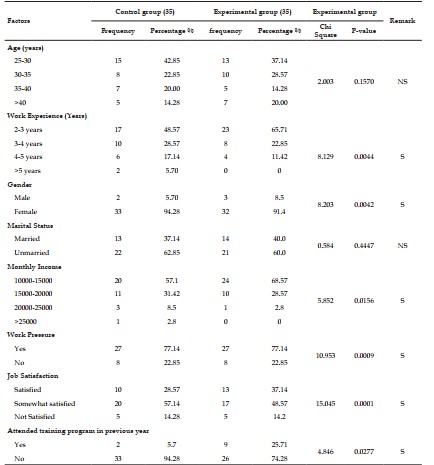
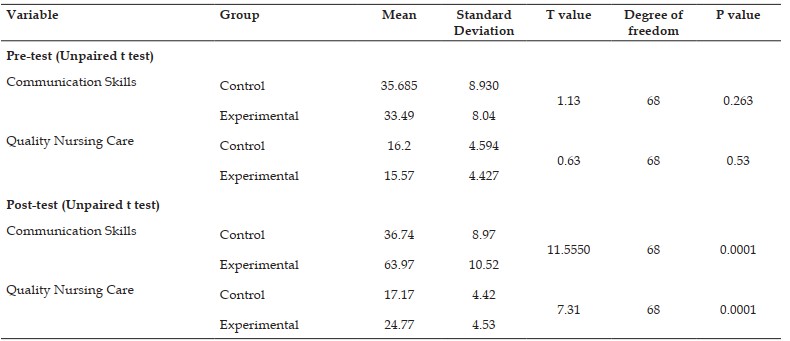
Background: Nurses play a multiple role in hospital but the major role is promotion of health, prevention of disease and relieving pain. Developing good relationship of a nurse with the patients for providing comprehensive nursing care is essential. Nurses should have communication skills to maintain therapeutic relationship with patients. This study has assessed the effectiveness of teaching program on communication skills and quality nursing care among pediatric nurses. Aims & Objectives: To assess the communication practices and factors affecting communication among pediatric nurses. To provide teaching program to nurses so that quality health care can be provided to the patients admitted in the pediatric hospitals. Material & Methods: This study was an Experimental study (Pretest- Posttest control group design) done to assess the communication skills and quality of health care among pediatric nurses in selected hospitals. The total of 70 pediatric nurses were selected through convenient sampling technique, then they were divided into control (35) and experimental group (35). Pretest and posttest was conducted in both the groups but intervention was given only to the experimental group. The intervention was planned teaching program and educational pamphlet was given. Result: The results showed that there is association between socio-demographic variables and communication skill scores in Experimental Group. There is a statistically significant difference in communication skills between control group and experimental group after the intervention. There is a statistically significant difference in communication skills in experimental group before and after intervention. There is a significant difference in quality nursing care in patients of control and experimental group after the intervention. Conclusion: Therefore, in order to improve the quality of nursing care, training should be given to all nurses to enhance communication skills so that a good relationship between patients and their parents can be developed.
References
- 1. Elizabeth oldland. (2020). A framework of nurses’ responsibilities for quality healthcare — Exploration of content validity. Elsevier. https://doi.org/10.1016/j.colegn.2019.07.007
- 2. Encyclopedia.com. (n.d.). Interpersonal communication. https://www.encyclopedia. com/media/encyclopedias-almanacst r a n s c r i p t s - a n d - m a p s / i n t e r p e r s o n a l - communication(Google Scholar)
- 3. Spitzberg B.H. (2000). A model of intercultural communication competence. In Samovar L.A., Porter R.E. (Eds.), Intercultural communication: A reader (pp. 375-387). http://www.communicationcache.com/ uploads/1/0/8/8/10887248/a__model_of_ intercultural_communication_competence. pdf(Google Scholar)
- 4. van Rosse F., de Bruijne M., Suurmond J., EssinkBot M.L., Wagner C. (2016). Language barriers and patient safety risks in hospital care: A mixed methods study. International Journal of Nursing Studies, 54 (February), 45-53. https:// doi.org/10.1016/j.ijnurstu.2015.03.012(Google Scholar)
- 5. Wiseman R.L., Hammer M.R., Nishida H. (1989). Predictors of intercultural communication competence. International Journal of Intercultural Relations, 13(3), 349-370. https://doi.org/10.1016/0147- 1767(89)90017-5(Google Scholar)
- 6. Dorothy afriyie. (2020). Effective communication between nurses and patients: an evolutionary concept analysis. National Library of Medicine.25(9): 438-445.doi: 10.12968/bjcn.2020.25.9.438 (Pub Med)
- 7. P vermeir. (2015). Communication in healthcare: a narrative review of the literature and practical recommendations; 69(11) 1257- 67.doi: 10.1111/ijcp.12686. (PubMed)
- 8. Elaine Bramball. (2024). Effective communication skills in nursing practice. National Library of Medicine; 29(14) 53-9.doi: 10.7748/ns.29.14.53.e9355(PubMed)
- 9. Julie Gregory. (2024). Understanding the communication skills that support nurses to provide person-centre; 39(2): 61-66.doi: 10.7748/ns. 2024.e12132. Epub 2024 Jan2. (PubMed)
- 10. Ae young Kim, (2020). Communication Skills, Problem-Solving Ability, Understanding of Patients’ Conditions, and Nurse’s Perception of Professionalism among Clinical Nurses: A Structural Equation Model Analysis; 17(13): 4896. doi: 10.3390/ijerph17134896(PubMed)
- 11. McCabe C. (2004) Nurse-patient communication: An exploration of patients’ experiences. J Clin Nurs; 13(1): 41–9. doi: 10.1111/j.1365-2702.2004.00817.x. [DOI] [PubMed] [Google Scholar]
- 12. McGilton K., Irwin-Robinson H, Boscart V., Spanjevic L. (2006). Communication enhancement: nurse and patient satisfaction outcomes in a complex continuing care facility. J Adv Nurs; 54(1): 35–44. doi: 10.1111/j.1365- 2648.2006.03787.x. [DOI] [PubMed] [Google Scholar]
- 13. Chant S., Tim Tim, Randle J., Russell G., Webb C. (2002). Communication skills training in healthcare: A review of the literature. Nurse Educ Today; 22(3): 189–202. doi: 10.1054/ nedt.2001.0690. [DOI] [PubMed] [Google Scholar]
- 14. Namdar H., Rahmani A., Ebrahimi H. (2009). The effect of a skill-training model on nursing students’ skills in communicating with mental patients. Iranian Journal of Medical Education; 8(2): 323–332. [Google Scholar]
- 15. Keivani S. (2000). The evaluation of communication and interactional skills in above 18 old psychotic patients [Master Thesis]. Tehran: School of Occupational Therapy, University of Rehabilitation and Welfare Sciences. (Persian).
- 16. Chauhan G., Long A. Chauhan G., Long A (2000). Communication is the essence of nursing care1: Breaking bad news. Br J Nurs; 9(14): 931–8. doi: 10.12968/bjon.2000.9.14.931. [DOI] [PubMed] [Google Scholar]
- 17. Humphris GM. (2002). Communication skills knowledge, understanding and OSCE performance in medical trainees: a multivariate prospective study using structural equation modelling. Med Educ; 36(9): 842–52. doi: 10.1046/j.1365-2923.01295.x. [DOI] [PubMed] [Google Scholar]
- 18. Parry R. (2002). Are interventions to enhance communication performance in allied health professionals effective, and how should they be delivered? Direct and indirect evidence. Patient Educ Couns; 73(2): 186–95. doi: 10.1016/j.pec.05.029. [DOI] [PubMed] [Google Scholar]
- 19. Greene J.O. (2013). Models of adult communication skill acquisition: Practice and the course of performance improvement. In: Greene J.O., Burleson B.R., Editors. Handbook Communicate. Social interaction skills. London: Routledge.
- 20. Gunther M., Alligood M.R. (2002). A discipline-specific determination of high quality nursing care. J Adv Nurs; 38(4): 353–9. doi: 10.1046/j.1365-2648.2002.02201.x. [DOI] [PubMed] [Google Scholar]
- 21. Neishabory M., Raeisdana N., Ghorbani R., Sadeghi T. (2011). Nurses’ and patients’ viewpoints regarding quality of nursing care in the teaching hospitals of Semnan University of Medical Sciences. Koomesh; 12(2): 134–43. [Persian] [Google Scholar]
- 22. Rhezaii Rhezaii, Sh Sh, Hosseini A.M., Fallahi M. (2008). Evaluating impact of communication skills training on level of job stress among nursing personnel working at rehabilitation centers in cities: Ray- Tehran- Shemiranat. Tehran University Medical Journal; 64(1): 21– 26. [Persian] [Google Scholar]
- 23. Rowan K.E. Monthly communication skill coaching for healthcare staff. Patient Educ Couns. 2008; 71(3): 402–4. doi: 10.1016/j. pec.2008.02.016. [DOI] [PubMed] [Google Scholar]
Data Sharing Statement
There are no additional data available. All raw data and code are available upon request.
Funding
This research received no funding.
Author Contributions
All authors contributed significantly to the work and approve its publication.
Ethics Declaration
This article does not involve any human or animal subjects, and therefore does not require ethics approval.
Acknowledgements
We would like to express our gratitude to the patients, their families, and all those who have contributed to this study.
Conflicts of Interest
No conflicts of interest in this work.
About this article

Cite this article
Feba Stanley. The Effectiveness of Teaching Program on Communication Skills and Quality Nursing Care among Pediatric Nurses in Selected Hospitals Int J Pediatr Nurs. 2025; 11(1): 07–13.
Licence:
Attribution-Non-commercial 4.0 International (CC BY-NC 4.0)This license enables reusers to distribute, remix, adapt, and build upon the material in any medium or format for noncommercial purposes only, and only so long as attribution is given to the creator.
| Received | Accepted | Published |
|---|---|---|
| January 07, 2025 | March 06, 2025 | April 30, 2025 |
DOI: https://doi.org/1021088/ijpen.2454.9126.11125.1
Keywords
Communication SkillsQuality Nursing CarePatients/Parentsediatric NursesPediatric NursesSearch for Similar Articles
Similar Articles
- Craniosynostosis with Midfacial Hypoplasia and Bilateral Choanal Atresia Present...
- Pediatric Bone Disorders: Interpretation Challenges of Vitamin D and Calcium
- Care of Neonates Under Phototherapy: A Narrative Review on the Impact of Phototh...
- Effectiveness of Structured Teaching Program on Knowledge Regarding Text Neck Sy...
- Hemostatic Testing in Critically Ill Infants and Children
Article Level Metrics
Last UpdatedTuesday 29 September 2026, 08:42:46 (IST)
1494
Accesses
8
286
00
Citations
NA
NA
NA
Download citation
Article Keywords
Keyword Highlighting
Highlight selected keywords in the article text.
Timeline
| Received | January 07, 2025 |
| Accepted | March 06, 2025 |
| Published | April 30, 2025 |
licence
Attribution-Non-commercial 4.0 International (CC BY-NC 4.0)
This license enables reusers to distribute, remix, adapt, and build upon the material in any medium or format for noncommercial purposes only, and only so long as attribution is given to the creator.