Full Text (PDF)
International Journal of Pediatric Nursing 12(2):p 91-98, May-August 2026. | DOI: https://doi.org/1021088/ijpen.2454.9126.12226.3
Review Article
Pediatric Bone Disorders: Interpretation Challenges of Vitamin D and Calcium
Rajathisakthivel null, Madhumitha null, D.K. Sriram
Author Information
Licence:
Attribution-Non-commercial 4.0 International (CC BY-NC 4.0)This license enables reusers to distribute, remix, adapt, and build upon the material in any medium or format for noncommercial purposes only, and only so long as attribution is given to the creator.
International Journal of Pediatric Nursing 12(2):p 91-98, May-August 2026. | DOI: https://doi.org/1021088/ijpen.2454.9126.12226.3
How Cite This Article:
Madhumitha, Rajathisakthivel, D.K. Sriram. Pediatric Bone Disorders: Interpretation Challenges of Vitamin D and Calcium. Int J Pediatr Nurs. 2026; 12(2): 91–98.Timeline
Received : July 14, 2026
Accepted : August 07, 2026
Published : August 25, 2026
Abstract
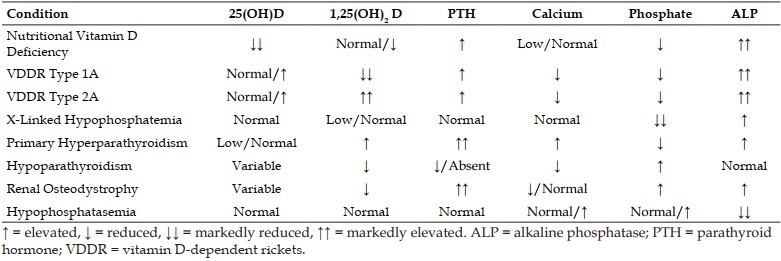
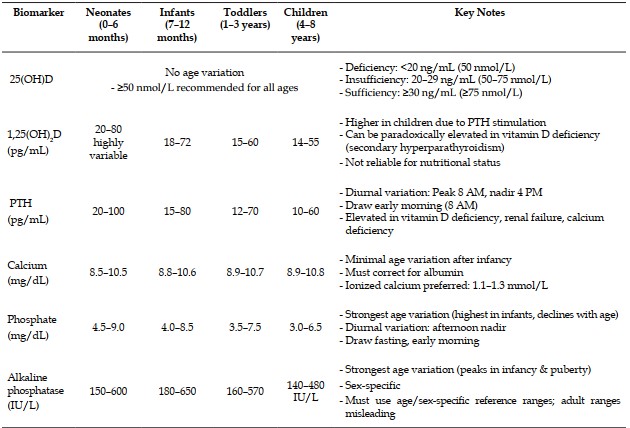
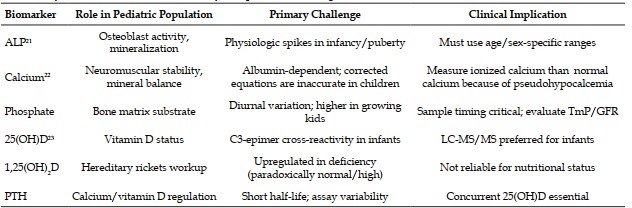
Vitamin D and calcium metabolism are central to skeletal growth, mineralisation, and metabolic bone homeostasis in childhood, making laboratory assessment of these nutrients critical in pediatric bone disorders such as nutritional rickets, osteomalacia, metabolic bone disease of prematurity, chronic kidney diseaserelated mineral bone disorder, and selected inherited or malabsorptive conditions. Interpretation of laboratory markers in children is more difficult than in adults because normal values vary with age, growth velocity, pubertal stage, dietary intake, sun exposure, and underlying disease, while available diagnostic thresholds are not uniformly standardized across pediatric populations. Serum 25-hydroxyvitamin D is the preferred marker of vitamin D status. Still, its clinical meaning depends on simultaneous interpretation of calcium, phosphate, alkaline phosphatase, parathyroid hormone, renal function, and radiologic findings, particularly when bone disease is suspected. Additional complexity arises from assay variability, age-specific differences in reference intervals, and the overlap between calciopenic and phosphopenic disorders. This review summarizes the physiology of vitamin D-calcium-phosphate regulation, outlines key biochemical patterns in common pediatric bone disorders, analyzes major laboratory interpretation pitfalls, and summarizes practical strategies for more accurate diagnosis and monitoring in children.
References
- 1. Moon, R. J., Harvey, N. C., Davies, J. H., & Cooper, C. (2014). Vitamin D and skeletal health in infancy and childhood. Osteoporosis international: a journal established as result of cooperation between the European Foundation for Osteoporosis and the National Osteoporosis Foundation of the USA, 25(12), 2673–2684. https://doi.org/10.1007/s00198- 014-2783-5
- 2. Palacios, C., & Gonzalez, L. (2014). Is vitamin D deficiency a major global public health problem?. The Journal of steroid biochemistry and molecular biology, 144 Pt A, 138–145. https://doi.org/10.1016/j.jsbmb.2013.11.003
- 3. Gupta, P., Dabas, A., Seth, A., Bhatia, V. L., Khadgawat, R., Kumar, P., Balasubramanian, S., Khadilkar, V., Mallikarjuna, H. B., Godbole, T., Krishnamurthy, S., Goyal, J. P., Bhakhri, B. K., Ahmad, A., Angadi, K., Basavaraj, G. V., Parekh, B. J., Kurpad, A., Marwaha, R. K., Shah, D., … Sachdev, H. P. S. (2022). Indian Academy of Pediatrics Revised (2021) Guidelines on Prevention and Treatment of Vitamin D Deficiency and Rickets. Indian pediatrics, 59(2), 142–158.
- 4. Kamboj, P., Dwivedi, S., & Toteja, G. S. (2018). Prevalence of hypovitaminosis D in India & way forward. The Indian journal of medical research, 148(5), 548–556. https://doi. org/10.4103/ijmr.IJMR_1807_18
- 5. Munns, C. F., Shaw, N., Kiely, M., Specker, B. L., Thacher, T. D., Ozono, K., Michigami, T., Tiosano, D., Mughal, M. Z., Mäkitie, O., RamosAbad, L., Ward, L., DiMeglio, L. A., Atapattu, N., Cassinelli, H., Braegger, C., Pettifor, J. M., Seth, A., Idris, H. W., Bhatia, V., … Högler, W. (2016). Global Consensus Recommendations on Prevention and Management of Nutritional Rickets. Hormone research in paediatrics, 85(2), 83–106. https://doi.org/10.1159/000443136
- 6. Vitamin D deficiency in children: An update on its prevalence, therapeutics and knowledge gaps. (n.d.). https://www. opensciencepublications.com/fulltextarticles/ IJN-2395-2326-4-167.pdf
- 7. Pettifor J. M. (2014). Calcium and vitamin D metabolism in children in developing countries. Annals of nutrition & metabolism, 64 Suppl 2, 15–22. https://doi.org/10.1159/000365124
- 8. Allgrove, J. (2015). Calcium and bone disorders in children and adolescents. In Endocrine development. https://doi.org/10.1159/ isbn.978-3-318-05467-5
- 9. Uday, S., & Högler, W. (2020). Nutritional rickets & osteomalacia: A practical approach to management. The Indian journal of medical research, 152(4), 356–367. https://doi. org/10.4103/ijmr.IJMR_1961_19
- 10. Rustico, S. E., Calabria, A. C., & Garber, S. J. (2014). Metabolic bone disease of prematurity. Journal of clinical & translational endocrinology, 1(3), 85–91. https://doi. org/10.1016/j.jcte.2014.06.004
- 11. Patel P, Hashmi MF. Chronic Kidney DiseaseMineral Bone Disorder (CKD-MBD) [Updated 2024 Apr 3]. In: StatPearls [Internet]. Treasure Island (FL): StatPearls Publishing; 2026 Jan-. Available from: https://www.ncbi.nlm.nih. gov/books/NBK560742/
- 12. Abseyi, S. N., & Şıklar, Z. (2023). Approach to Rickets: Is It Calciopenic or Phosphopenic?. Turkish archives of pediatrics, 58(5), 458–466. https://doi.org/10.5152/TurkArchPediatr. 2023.23050
- 13. Alsaif, S., Aljarbou, T., Alrahili, M., Alsherbini, L., Maghoula, M., Alluwaymi, A., Alsenani, M., Altuwaym, A., Alamer, F., Mandurah, A., Baylon, B., Alsehli, F., Ali, I., & Ali, K. (2025). Biochemical markers for metabolic bone disease in preterm infants: insights from a structured Bone Health Programme in the Middle East. BMJ paediatrics open, 9(1), e003927. https:// doi.org/10.1136/bmjpo-2025-003927.
- 14. Corsello, A., Spolidoro, G. C. I., Milani, G. P., & Agostoni, C. (2023). Vitamin D in pediatric age: Current evidence, recommendations, and misunderstandings. Frontiers in medicine, 10, 1107855. https://doi.org/10.3389/ fmed.2023.1107855.
- 15. Liju Yang, Vijaylaxmi Grey, Pediatric reference intervals for bone markers, Clinical Biochemistry, Volume 39, Issue 6, 2006, Pages 561-568, ISSN 0009-9120, https://doi. org/10.1016/j.clinbiochem.2005.11.015.
- 16. Shao, J., Zhou, S. S., Qu, Y., Liang, B. B., Yu, Q. H., & Wu, J. (2020). Correlation between bone turnover and metabolic markers with age and gender: a cross-sectional study of hospital information system data. BMC musculoskeletal disorders, 21(1), 603. https://doi.org/10.1186/ s12891-020-03610-w
- 17. Weitzmann, M. N., & Ofotokun, I. (2016). Physiological and pathophysiological bone turnover - role of the immune system. Nature reviews. Endocrinology, 12(9), 518–532. https://doi.org/10.1038/nrendo.2016.91
- 18. Sempos, C. T., & Binkley, N. (2020). 25-Hydroxyvitamin D assay standardisation and vitamin D guidelines paralysis. Public health nutrition, 23(7), 1153–1164. https://doi. org/10.1017/S1368980019005251
- 19. Hu, Z. D., Huang, Y. L., Wang, M. Y., Hu, G. J., & Han, Y. Q. (2018). Predictive accuracy of serum total calcium for both critically high and critically low ionized calcium in critical illness. Journal of clinical laboratory analysis, 32(9), e22589. https://doi.org/10.1002/jcla.22589
- 20. Binkovitz, L. A., & Henwood, M. J. (2007). Pediatric DXA: technique and interpretation. Pediatric radiology, 37(1), 21–31. https://doi. org/10.1007/s00247-006-0153-y
- 21. Jacqueline-Michéle Strauch, Mandy Vogel, Christof Meigen, Uta Ceglarek, Jürgen Kratzsch, Anja Willenberg, Wieland Kiess, Pediatric reference values of alkaline phosphatase: Analysis from a German population-based cohort and influence of anthropometric and blood parameters, Bone, Volume 174, 2023, 116809, ISSN 8756-3282, https://doi.org/10.1016/j.bone.2023.116809.
- 22. Bharill, S., & Wu, M. (2023). Hypocalcemia and Hypercalcemia in Children. Pediatrics in review, 44(9), 533–536. https://doi. org/10.1542/pir.2022-005578
- 23. Singh, R. J., Taylor, R. L., Reddy, G. S., & Grebe, S. K. (2006). C-3 epimers can account for a significant proportion of total circulating 25-hydroxyvitamin D in infants, complicating accurate measurement and interpretation of vitamin D status. The Journal of clinical endocrinology and metabolism, 91(8), 3055– 3061. https://doi.org/10.1210/jc.2006-0710
- 24. ICMR-NIN Expert Committee, Dietary Guidelines for Indians-2024.
- 25. Prevention and treatment of vitamin D and calcium deficiency in children and adolescents: Indian Academy of Pediatrics (IAP) guidelines. (n.d.). https://www.indianpediatrics.net/ july2017/july-567-573.htm
- 26. Event. (2026, May 22). Early signs of rare bone conditions in children and adults. Dr. Umesh Jadhav. https://drumeshjadhav.com/earlysigns-of-rare-bone-conditions-in-childrenand-adults/
- 27. Rodd, C., Kirouac, N., Orkin, J., & Grimes, R. (2022). Evaluating and optimizing bone health in children with chronic health conditions. Paediatrics & child health, 27(4), 232–242. https://doi.org/10.1093/pch/pxac036
Data Sharing Statement
There are no additional data available. All raw data and code are available upon request.
Funding
This research received no funding.
Author Contributions
All authors contributed significantly to the work and approve its publication.
Ethics Declaration
This article does not involve any human or animal subjects, and therefore does not require ethics approval.
Acknowledgements
We would like to express our gratitude to the patients, their families, and all those who have contributed to this study.
Conflicts of Interest
No conflicts of interest in this work.
About this article

Cite this article
Madhumitha, Rajathisakthivel, D.K. Sriram. Pediatric Bone Disorders: Interpretation Challenges of Vitamin D and Calcium. Int J Pediatr Nurs. 2026; 12(2): 91–98.
Licence:
Attribution-Non-commercial 4.0 International (CC BY-NC 4.0)This license enables reusers to distribute, remix, adapt, and build upon the material in any medium or format for noncommercial purposes only, and only so long as attribution is given to the creator.
| Received | Accepted | Published |
|---|---|---|
| July 14, 2026 | August 07, 2026 | August 25, 2026 |
DOI: https://doi.org/1021088/ijpen.2454.9126.12226.3
Keywords
PeadiatricBone DisordersCalciumVitamin DSerum 25-Hydroxyvitamin DOsteomalaciaCalciopenic DisordersDiagnostic ThresholdsSearch for Similar Articles
Similar Articles
- Craniosynostosis with Midfacial Hypoplasia and Bilateral Choanal Atresia Present...
- Care of Neonates Under Phototherapy: A Narrative Review on the Impact of Phototh...
- Effectiveness of Structured Teaching Program on Knowledge Regarding Text Neck Sy...
- Hemostatic Testing in Critically Ill Infants and Children
- A Quasi Experimental Study to assess the Effectiveness of structured Teaching Pr...
Article Level Metrics
Last UpdatedSunday 18 October 2026, 07:46:17 (IST)
1635
Accesses
16
294
00
Citations
NA
NA
NA
Download citation
Article Keywords
Keyword Highlighting
Highlight selected keywords in the article text.
Timeline
| Received | July 14, 2026 |
| Accepted | August 07, 2026 |
| Published | August 25, 2026 |
licence
Attribution-Non-commercial 4.0 International (CC BY-NC 4.0)
This license enables reusers to distribute, remix, adapt, and build upon the material in any medium or format for noncommercial purposes only, and only so long as attribution is given to the creator.