Full Text (PDF)
Physiotherapy and Occupational Therapy Journal 15(4):p 167-171, October-December 2022. | DOI: https://doi.org/10.21088/potj.0974.5777.15422.3
Original Article
The Effect of Proprioception Training with and without Visual Input on Single Limb Standing Balance Time in Deaf Students: A Pilot Study
Amit S. Patel, Divya S. Ahir, Heli Y. Kansara, Sneha S. Rajput, Karuna B. Valiyaveettil
Author Information
Licence:
Attribution-Non-commercial 4.0 International (CC BY-NC 4.0)This license enables reusers to distribute, remix, adapt, and build upon the material in any medium or format for noncommercial purposes only, and only so long as attribution is given to the creator.
Physiotherapy and Occupational Therapy Journal 15(4):p 167-171, October-December 2022. | DOI: https://doi.org/10.21088/potj.0974.5777.15422.3
How Cite This Article:
Amit S. Patel, Divya S. Ahir, Heli Y. Kansara, et al./The Effect of Proprioception Training with and without Visual Input on Single Limb Standing Balance Time in Deaf Students: A Pilot Study/Physiotherapy and Occupational Therapy Journal. 2022;15(4): 167-171.Timeline
Received : October 12, 2022
Accepted : December 08, 2022
Published : December 25, 2022
Abstract
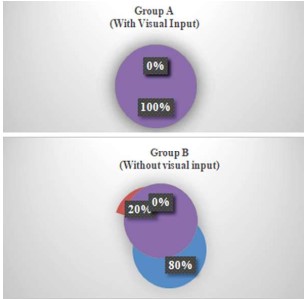
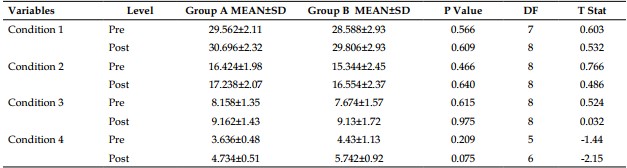
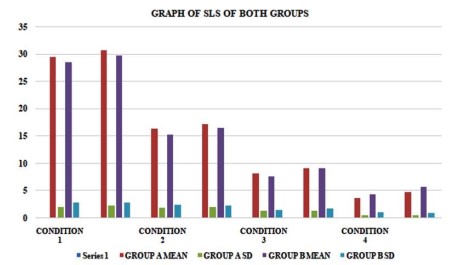
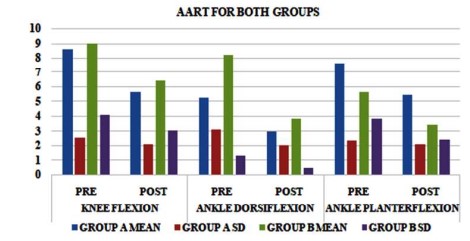
Background: Proprioception and balance are the key and inseparable components of daily activities and exercises. Hence this study was undertaken to find out the effect of proprioception training on single limb standing balance time in deaf students of Navsari by measuring their activated angle reconstruction test and the single limb standing test. Purpose of The Study: Aim of this study was to examine the effectiveness of 4 weeks proprioception training with and without visual input on single limb standing balance time in deaf students and objective is to examine the effect of proprioception training with and without visual input in deaf students, to examine how the proprioception training with and without visual input affects proprioception of the knee joint, ankle and single limb standing balance in deaf students, to examine how the rehabilitation programs improve postural control and balance in the deaf on restricting vision and engaging other senses. Methods: A pilot study was conducted in a local school in Gujarat (Shri Chimanlal Laxmichand Parikh Mamta Mandir, Manav Kalyan Trust, Dist. Navsari) from which 15 students were volunteered for this study including both male and female of Navsari district based on inclusion and exclusion criteria, out of which 5 were excluded. Outcome of the study that is the activated angle reconstruction test and the single limb standing test were assessed for each student with prior informed consent form signed by the guardian of the student. Effect of proprioception training is done statistically. Outcome Measure: The angle reconstruction test and The Single Limb Standing Test. Statistical Analysis: Statistical analysis was done using Microsoft Office Excel 2007. Results: Study was done among 10 students who completed the full training protocol in which 5 students were undergone with proprioception training with visual input and other 5 students were undergone with proprioception training without visual input. The balance and proprioception were improved in both the groups. So, proprioception training with as well as without visual input is very effective to improve balance and proprioception in deaf students. Conclusion: The present study showed that both the treatment groups attained significant improvement in SLS and AART after 4 weeks of proprioception training (p < 0.05). However, there was no significant difference in SLS and AART between Group A and Group B after 4 weeks of proprioception training (p > 0.05).
References
- 1. Zarei, H., Norasteh, A.A., The effect of 8 weeks proprioception training without visual input on single-limb standing balance time in deaf students: A Randomized Controlled Trial, Volume 24, Issue 2,, Journal of Bodywork & Movement Therapies, April 2020, Pages 6 3 -6 8 htt p s : //d o i. org /1 0 .10 1 6 /j . jb m t . 2019.09.002.
- 2. Mahdi Majlesi a, Nader Farahpour b , Elaheh Azadian a, Mahdi Amini, The effect of interventional proprioceptive training on static balance and gait in deaf children,Volume 35, Issue 12, Research in Developmental Disabilities, December 2014, Pages 3562-3567.
- 3. Mohammad Hedayatjoo, Mehdi Rezaee, Mehdi Alizadeh Zarei, Navid Mirzakhany 3, Ahmadreza Nazeri 3, Alireza Akbarzadeh Baghban 4, Zahra Hedayatjoo 5, Razieh Mokhber Dezfoly 6, Effect of Balance Training on Balance Performance, Motor Coordination, and Attention in Children with Hearing Deficits, Arch Neurosci. 2020 January; 7(1) :e84869.
- 4. VedranaSember, JanjaGrošelj and MajaPajek, Balance Tests in Pre Adolescent Children: Retest Reliability, Construct Validity, and Relative Ability, Received: 7 July 2020; Accepted: 22 July 2020; Published: 29 July 2020,Int. J. Environ. Res. Public Health 2020, 17, 5474.
- 5. S K Effgen, Effect of an exercise program on the static balance of deaf children,, Volume 61, Issue 6, Physical Therapy, 1 June 1981, Pages 873–877.
- 6. Zahra Soori, Ali Heyran, Forouzan Rafe, Exercise effects on motor skills in hearingimpaired children, 15, Sport Sciences for Health, pages 635–639 (2019).
- 7. Renato de Souza Melo, Polyanna Waleska A. da Silva, Rafael Miranda Tassitano, Carla Fabiana S. T. Macky, Lícia Vasconcelos C. da Silva, Balance and gait evaluation: comparative study between deaf and hearing students, 30(3) Rev Paul Pediatr: 385-91, 2012.
- 8. Jalpa Shah, Keerthi Rao, MandarMalawade and Subhash Khatri, Effect of Motor Control Program in Improving Gross Motor Function and Postural Control in Children with Sensorineural Hearing Loss-A Pilot Study,Volume 3 • Issue 1 • PediatTherapeut 1000141.
- 9. Nurcan Demirel Correspondence: Atatürk University, Faculty of Sport Sciences, Department of Sport Health Sciences, Erzurum, Turkey. Received: January 30, 2018 Accepted: February 11, 2018 Online Published: February 22, 2018. The Impact of Therapeutic Recreational Gymnastic Exercise on Basic Motor Skills of Hearing Impaired Children Aged Between 6 and 9 Years. v6 n3, Journal of Education and Training Studies, p147-151 Mar 2018.
- 10. Venkadesan Rajendran, Finita Glory Roy, Deepa Jeevanantham, Effect of exercise intervention on vestibular related impairments in hearing-impaired children,Vol. 49 No. 1, Alexandria Journal of Medicine (2013).
- 11. Antonio Marti´nez-Amat, Fidel Hita-Contreras, Rafael Lomas-Vega, 1isabel Caballeromarti´nez, Pablo J. Alvarez, and Emilio Marti´nez-LO´ PEZ, effects of 12-week proprioception training program on postural stability, gait, and balance in older adults: a controlled clinical trial, Volume 27-Issue 8, Journal of Strength and Conditioning Research National Strength and Conditioning Association, p 21802188(2013).
- 12. Fatemeh Yaghoubi Hamraz, et al, Comparing Gait Variability Between Deaf and NormalHearing Children After Proprioception Training, Journal of Sport Biomechanics. 2020; 5(4):262-271.
- 13. Cara Carpenter, Pacific University, et al., A Comparison of Eyes Open Versus Eyes Closed Balance Training, (2001). School of Physical Therapy. 161. https://commons.pacificu.edu/ pt/161.
- 14. BMI and BMI-for-Age Look-Up Tables for Children and Adolescents 5–18 Years of Age and BMI Look-Up Tables for Non-Pregnant, Non-Lactating Adults ≥ 19 Years of Age, Revised January 2013.
- 15. Janet Collins, et al. Age-Related Balance Changes in Hearing-Impaired Children Physical Therapy /Volume 71, Number 3 / March 1991.
- 16. Huihui Wang, PhD, et al., Correlation among proprioception, muscle strength, and balance, J. Phys. Ther. Sci. 28: 3468–3472, 2016.
Data Sharing Statement
There are no additional data available. All raw data and code are available upon request.
Funding
This research received no funding.
Author Contributions
All authors contributed significantly to the work and approve its publication.
Ethics Declaration
This article does not involve any human or animal subjects, and therefore does not require ethics approval.
Acknowledgements
We would like to express our gratitude to the patients, their families, and all those who have contributed to this study.
Conflicts of Interest
No conflicts of interest in this work.
About this article

Cite this article
Amit S. Patel, Divya S. Ahir, Heli Y. Kansara, et al./The Effect of Proprioception Training with and without Visual Input on Single Limb Standing Balance Time in Deaf Students: A Pilot Study/Physiotherapy and Occupational Therapy Journal. 2022;15(4): 167-171.
Licence:
Attribution-Non-commercial 4.0 International (CC BY-NC 4.0)This license enables reusers to distribute, remix, adapt, and build upon the material in any medium or format for noncommercial purposes only, and only so long as attribution is given to the creator.
| Received | Accepted | Published |
|---|---|---|
| October 12, 2022 | December 08, 2022 | December 25, 2022 |
DOI: https://doi.org/10.21088/potj.0974.5777.15422.3
Keywords
Single Limb Standing balance TimeDeaf studentsNavsariProprioception trainingSearch for Similar Articles
Similar Articles
- Leadership in Physiotherapy: A Narrative Review
- Effectiveness of Low Level Laser Theapy in the Management of Temporomandibular J...
- The Impact of Air Pollution on Cardiopulmonary Health: Molecular Mechanisms, Pre...
- Efectiveness of Physiotherapy in Postpartum Women with Diastasis Recti: A Review
- Pain Neuroscience Education: Transforming Physiotherapy Practice
Article Level Metrics
Last UpdatedFriday 23 October 2026, 16:18:44 (IST)
4358
Accesses
8
739
00
Citations
NA
NA
NA
Download citation
Article Keywords
Keyword Highlighting
Highlight selected keywords in the article text.
Timeline
| Received | October 12, 2022 |
| Accepted | December 08, 2022 |
| Published | December 25, 2022 |
licence
Attribution-Non-commercial 4.0 International (CC BY-NC 4.0)
This license enables reusers to distribute, remix, adapt, and build upon the material in any medium or format for noncommercial purposes only, and only so long as attribution is given to the creator.