Full Text (PDF)
Indian Journal of Emergency Medicine 12(3):p 139-144, July - Sept. 2026. | DOI: https://doi.org/10.21088/ijem.2395.311X.12326.3
Case Report
The Compression Conundrum: A Case of May-Thurner Syndrome
Author Information
Licence:
Attribution-Non-commercial 4.0 International (CC BY-NC 4.0)This license enables reusers to distribute, remix, adapt, and build upon the material in any medium or format for noncommercial purposes only, and only so long as attribution is given to the creator.
Indian Journal of Emergency Medicine 12(3):p 139-144, July - Sept. 2026. | DOI: https://doi.org/10.21088/ijem.2395.311X.12326.3
How Cite This Article:
Deepali Dhawan. The Compression Conundrum: A Case of May-Thurner Syndrome. Ind J Emerg Med. 2026; 12(3): 139-144.Timeline
Received : July 20, 2026
Accepted : August 24, 2026
Published : September 30, 2026
Abstract
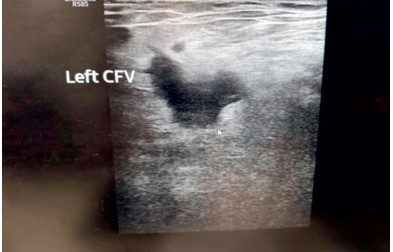
Pregnancy is a physiologic hypercoagulable state characterized by increased clotting factors, reduced fibrinolytic activity, and venous stasis, all of which contribute to an elevated risk of venous thromboembolism. Pregnancy is associated with a gradual increase in thrombotic risk that culminates during the third trimester and extends into the postpartum period owing to physiological changes in coagulation and venous circulation. Among these stages, the puerperium is the most vulnerable, with epidemiological studies demonstrating that women are at least five times more likely to experience VTE during the first two to six weeks after delivery than during pregnancy.Among the less common causes of iliofemoral deep vein thrombosis is May-Thurner syndrome, an anatomical venous compression disorder characterized by impaired iliac venous drainage due to chronic extrinsic compression. The resulting venous stasis predisposes patients to venous stenosis, obstruction, chronic venous insufficiency, and thrombosis. Recognition of this condition is particularly important in patients with unexplained left-sided iliofemoral DVT. I present you a case of a 30 years old,5 weeks’ post-partum lactating mother [P1L1] who came to ED with complaints of generalised weakness, pain in lower abdomen radiating towards lower back, and medial side of left thigh and ipsilateral groin since 7 to 10 days, associated with swelling of the thigh. After careful examination, an immediate bilateral lower limb DVT scan was ordered which suggested echogenic thrombus within CIV, EIV, CFV, left femoral vein and popliteal vein, which were distended and non-compressible. A vascular surgeon was approached and a plan to insert fluoroscopic guided IVC filter via right IJV percutaneous approach followed by a mechanical thrombus aspiration via left popliteal vein was made and performed. Most VTE can be treated with oral or injectable anticoagulants however, the case of limb or life threatening VTE requires consideration of thrombolysis and other reperfusion therapies. Early recognition of atypical symptoms, prompt diagnosis and timely intervention are crucial to prevent serious morbidity and mortality. This case highlights the importance of maintaining a high index of suspicion for VTE in post-partum women. While anticoagulants with LMWH remains the cornerstone of treatment, advanced intervention such as thrombus aspiration and IVC filer placement may be required in selected patient with extensive or limb threatening thrombosis.
References
- 1. Lin F, Khan A, Mohammed H, et al. (April 23, 2026) Recurrent Pregnancy Loss Despite Therapeutic Anticoagulation in a Patient With May-Thurner Syndrome: A Case Report. Cureus 18(4): e107577. doi:10.7759/ cureus.107577
- 2. Marie Didembourg, Laure Morimont, Emilie De Gottal, Jonathan Douxfils The maternal hemostatic shift: Understanding VTE risk in pregnancy and postpartum,Thrombosis Research,Volume 257,2026,109561,ISSN 0049-3848-https://doi.org/10.1016/j. thromres.2025.109561.
- 3. J.A. Heit, C.E. Kobbervig, A.H. James, T.M. Petterson, K.R. Bailey, J.M. III Trends in the incidence of venous thromboembolism during pregnancy or postpartum: a 30-year population-based study.Am. Coll. Physicians, 143 (2005), pp. 697-706
- 4. B. Andersen, F. Steffensen, H. Sørensen, G. Nielsen, J. Olsen The cumulative incidence of venous thromboembolism during pregnancy and puerperium Acta Obstet. Gynecol. Scand., 77 (2) (1998), pp. 170-173
- 5. E.L. Simpson, R.A. Lawrenson, A.L. Nightingale, R.D.T. Farmer Venous thromboembolism in pregnancy and the puerperium: incidence and additional risk factors from a London perinatal database Br. J. Obstet. Gynaecol., 108 (2001), pp. 56-60
- 6. Mangla A, Hamad H. May-Thurner Syndrome. Updated 2024 Mar 11. In: StatPearls Internet. Treasure Island (FL): StatPearls Publishing; 2026 Jan-. Available from: https://www.ncbi. nlm.nih.gov/books/NBK554377/
- 7. Poyyamoli S, Mehta P, Cherian M, Anand RR, Patil SB, Kalva S, Salazar G. May-Thurner syndrome. Cardiovasc Diagn Ther. 2021 Oct;11(5):1104-1111.
- 8. Brinegar KN, Sheth RA, Khademhosseini A, Bautista J, Oklu R. Iliac vein compression syndrome: Clinical, imaging and pathologic findings. World J Radiol. 2015 Nov 28;7(11): 375-81.
- 9. Meissner MH, Gloviczki P, Comerota AJ, Dalsing MC, Eklof BG, Gillespie DL, Lohr JM, McLafferty RB, Murad MH, Padberg F, Pappas P, Raffetto JD, Wakefield TW., Society for Vascular Surgery. American Venous Forum. Early thrombus removal strategies for acute deep venous thrombosis: clinical practice guidelines of the Society for Vascular Surgery and the American Venous Forum. J Vasc Surg. 2012 May;55(5):1449-62
- 10. Mousa AY, AbuRahma AF. May-Thurner syndrome: update and review. Ann Vasc Surg. 2013 Oct;27(7):984-95.
Data Sharing Statement
There are no additional data available. All raw data and code are available upon request.
Funding
This research received no funding.
Author Contributions
All authors contributed significantly to the work and approve its publication.
Ethics Declaration
This article does not involve any human or animal subjects, and therefore does not require ethics approval.
Acknowledgements
We would like to express our gratitude to the patients, their families, and all those who have contributed to this study.
Conflicts of Interest
No conflicts of interest in this work.
About this article

Cite this article
Deepali Dhawan. The Compression Conundrum: A Case of May-Thurner Syndrome. Ind J Emerg Med. 2026; 12(3): 139-144.
Licence:
Attribution-Non-commercial 4.0 International (CC BY-NC 4.0)This license enables reusers to distribute, remix, adapt, and build upon the material in any medium or format for noncommercial purposes only, and only so long as attribution is given to the creator.
| Received | Accepted | Published |
|---|---|---|
| July 20, 2026 | August 24, 2026 | September 30, 2026 |
DOI: https://doi.org/10.21088/ijem.2395.311X.12326.3
Keywords
May Thurner SyndromeDeep Venous ThrombosisIVC FiltersPost-Partum and PregnancySearch for Similar Articles
Similar Articles
- Inherited Thrombophilia as a Cause of Post-Partum Massive Pulmonary Embolism: A...
- ATAK Complex Presenting as Hypertensive Pulmonary Edema Following Meropenem-Indu...
- When Infection Triggers Thrombosis: A Case of Extensive DVT in a Young Male
- Case Report: Diagnostic Dilemma in 69-Year-Old Male with Radiating Right Shoulde...
- The Silent Gallbladder, The Slowing Heart: Cope’s Sign in Acute Calculous Cholec...
Article Level Metrics
Last UpdatedThursday 22 October 2026, 08:42:09 (IST)
6117
Accesses
15
1020
00
Citations
NA
NA
NA
Download citation
Article Keywords
Keyword Highlighting
Highlight selected keywords in the article text.
Timeline
| Received | July 20, 2026 |
| Accepted | August 24, 2026 |
| Published | September 30, 2026 |
licence
Attribution-Non-commercial 4.0 International (CC BY-NC 4.0)
This license enables reusers to distribute, remix, adapt, and build upon the material in any medium or format for noncommercial purposes only, and only so long as attribution is given to the creator.