Full Text (PDF)
Indian Journal of Emergency Medicine 12(3):p 162-168, July - Sept. 2026. | DOI: https://doi.org/10.21088/ijem.2395.311X.12326.8
Case Report
Inherited Thrombophilia as a Cause of Post-Partum Massive Pulmonary Embolism: A Case Report
Kamal Preet Palta, Yash Krishna, Bibhash Roy, Mahima Nautiyal
Author Information
Licence:
Attribution-Non-commercial 4.0 International (CC BY-NC 4.0)This license enables reusers to distribute, remix, adapt, and build upon the material in any medium or format for noncommercial purposes only, and only so long as attribution is given to the creator.
Indian Journal of Emergency Medicine 12(3):p 162-168, July - Sept. 2026. | DOI: https://doi.org/10.21088/ijem.2395.311X.12326.8
How Cite This Article:
Yash Krishna, Kamal Preet Palta, Bibhash Roy et. al, Inherited Thrombophilia as a Cause of Post-Partum Massive Pulmonary Embolism: A Case Report. Ind J Emerg Med. 2026; 12(3): 162-168.Timeline
Received : February 24, 2026
Accepted : March 26, 2026
Published : September 30, 2026
Abstract
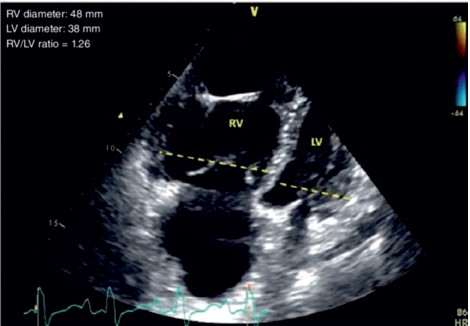
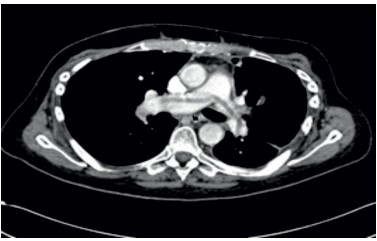
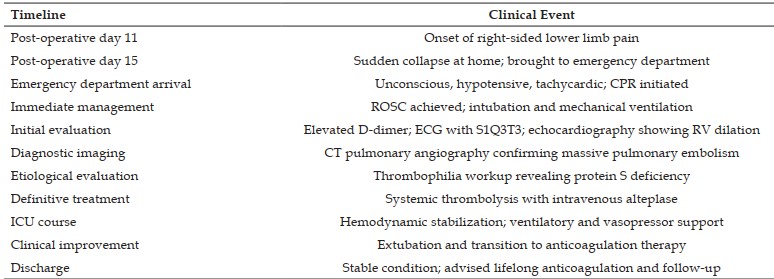
Introduction: Pulmonary embolism (PE) is a life-threatening manifestation of venous thromboembolism (VTE) and remains one of the leading causes of maternal morbidity and mortality worldwide. The post-partum period is associated with a heightened hypercoagulable state, which may be further amplified by inherited thrombophilia such as protein S deficiency. Early recognition is challenging due to the non-specific clinical presentation and the overlap of symptoms with physiological post-partum changes. Case Report: We report the case of a 28-year-old female who presented to the emergency department in an unconscious state following sudden collapse, 15 days after an uncomplicated lower segment caesarean section. The patient had a preceding history of unilateral leg pain. Initial resuscitation was successful, and subsequent investigations revealed massive pulmonary embolism with right ventricular strain. Laboratory evaluation demonstrated markedly elevated D-dimer levels and significantly reduced free protein S levels, consistent with protein S deficiency. The patient was managed with systemic thrombolysis followed by intensive care support and long-term anticoagulation. Conclusion: Pulmonary embolism should be considered in all post-partum patients presenting with sudden collapse or unexplained hemodynamic instability. Early diagnosis, prompt thrombolytic therapy in appropriate cases, and evaluation for underlying thrombophilia are essential to reduce mortality and guide longterm management strategies. Key Message: • Pulmonary embolism is a catastrophic yet potentially reversible cause of sudden collapse in post-partum patients. • In young individuals with massive PE, inherited thrombophilia such as protein S deficiency should be actively investigated, as identification significantly influences acute management, duration of anticoagulation, and future pregnancy counselling
References
- 1. Heit JA, Spencer FA, White RH. The epidemiology of venous thromboembolism. J Thromb Thrombolysis. 2016;41(1):3–14.
- 2. James AH. Venous thromboembolism in pregnancy. Arterioscler Thromb Vasc Biol. 2009;29(3):326–331.
- 3. Dahlbäck B. Advances in understanding pathogenic mechanisms of thrombophilic disorders. Blood. 2008;112(1):19–27.
- 4. Rezende SM, Simmonds RE, Lane DA. Coagulation, inflammation, and apoptosis: different roles for protein S and the protein S–C4b binding protein complex. Blood. 2004;103(4):1192–1201.
- 5. Goldhaber SZ. Echocardiography in the management of pulmonary embolism. Ann Intern Med. 2002;136(9):691–700.
- 6. Konstantinides SV, et al. ESC guidelines for the diagnosis and management of acute pulmonary embolism. Eur Heart J. 2019;41(4):543–603.
- 7. Kearon C, et al. Antithrombotic therapy for VTE disease: CHEST guideline and expert panel report. Chest. 2016;149(2):315–352.
Data Sharing Statement
There are no additional data available. All raw data and code are available upon request.
Funding
This research received no funding.
Author Contributions
All authors contributed significantly to the work and approve its publication.
Ethics Declaration
This article does not involve any human or animal subjects, and therefore does not require ethics approval.
Acknowledgements
We would like to express our gratitude to the patients, their families, and all those who have contributed to this study.
Conflicts of Interest
No conflicts of interest in this work.
About this article

Cite this article
Yash Krishna, Kamal Preet Palta, Bibhash Roy et. al, Inherited Thrombophilia as a Cause of Post-Partum Massive Pulmonary Embolism: A Case Report. Ind J Emerg Med. 2026; 12(3): 162-168.
Licence:
Attribution-Non-commercial 4.0 International (CC BY-NC 4.0)This license enables reusers to distribute, remix, adapt, and build upon the material in any medium or format for noncommercial purposes only, and only so long as attribution is given to the creator.
| Received | Accepted | Published |
|---|---|---|
| February 24, 2026 | March 26, 2026 | September 30, 2026 |
DOI: https://doi.org/10.21088/ijem.2395.311X.12326.8
Keywords
Pulmonary EmbolismProtein S DeficiencyPost-PartumVenous ThromboembolismThrombolysisEmergency MedicineSearch for Similar Articles
Similar Articles
- ATAK Complex Presenting as Hypertensive Pulmonary Edema Following Meropenem-Indu...
- When Infection Triggers Thrombosis: A Case of Extensive DVT in a Young Male
- Case Report: Diagnostic Dilemma in 69-Year-Old Male with Radiating Right Shoulde...
- The Silent Gallbladder, The Slowing Heart: Cope’s Sign in Acute Calculous Cholec...
- The Compression Conundrum: A Case of May-Thurner Syndrome
Article Level Metrics
Last UpdatedThursday 22 October 2026, 07:37:32 (IST)
6117
Accesses
14
1020
00
Citations
NA
NA
NA
Download citation
Article Keywords
Keyword Highlighting
Highlight selected keywords in the article text.
Timeline
| Received | February 24, 2026 |
| Accepted | March 26, 2026 |
| Published | September 30, 2026 |
licence
Attribution-Non-commercial 4.0 International (CC BY-NC 4.0)
This license enables reusers to distribute, remix, adapt, and build upon the material in any medium or format for noncommercial purposes only, and only so long as attribution is given to the creator.