Full Text (PDF)
New Indian Journal of Surgery 13(3):p 105-110, July-September 2022. | DOI: https://doi.org/10.21088/nijs.0976.4747.13322.2
Original Article
Study of Surgical Emergenices in Tertiary Care Hospital
Abhishek Chhabara, Navin Choudhary, Sunder Kishor, Manohar L Dawan, Samridh Kumar, Irene Halam
Author Information
Licence:
Attribution-Non-commercial 4.0 International (CC BY-NC 4.0)This license enables reusers to distribute, remix, adapt, and build upon the material in any medium or format for noncommercial purposes only, and only so long as attribution is given to the creator.
New Indian Journal of Surgery 13(3):p 105-110, July-September 2022. | DOI: https://doi.org/10.21088/nijs.0976.4747.13322.2
How Cite This Article:
Navin Choudhary, Abhishek Chhabara, Sunder Kishor et al./Study of Surgical Emergenices in Tertiary Care Hospital/New Indian J Surg. 2022;13(3):105–110.Timeline
Received : February 14, 2022
Accepted : March 15, 2022
Published : September 30, 2022
Abstract
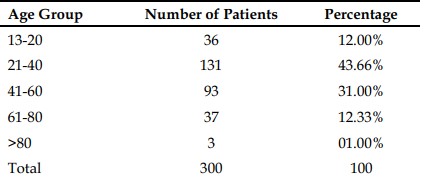
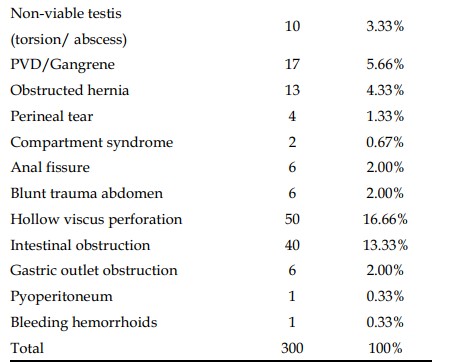
Introduction: In a country like ours, the increased number of surgical emergencies presenting to a hospital diverts majority of the resources towards the emergency department. Understanding this growing need makes it important to study and evaluate the distribution of these patients which shall help in developing a more efficient department. Material and Methods: We conducted a prospective study of patients undergoing emergency surgeries from December 2019 to November 2021. Total 300 patients included and study was carried out in the Department of Surgery, S.P. Medical College and P.B.M Hospital, Bikaner. Results: Majority of patients were from 21 to 40 years age group (43.66%). There were 208 males and 92 females. The male to female ration in our study was 2.26:1. Out of 300 patients, 82 patients (21.33%) had acute appendicitis 50 patients (16.66%) had hollow viscus perforation and 40 patients (13.33%) had intestinal obstruction. Most common surgical intervention done was exploratory laparotomy followed by appendectomy. The average hospital stay in our study was 6.6 days. Surgical site infection (n=23, 7.66%) and wound dehiscence (n=8, 2.66%) were the commonest postoperative complication noted in our study. Overall mortality rate in our study is 8.33%. Most common cause of death in our study population was septicemia. Majority of patients in our study were from low socioeconomic group. Conclusion: Early diagnosis, aggressive resuscitation and timely deÀnitive treatment is essential in order to decrease the mortality in patients undergoing emergency surgeries. It highlights the required positive change in current surgical and aesthesia practice that may be extrapolated to other such establishments.
References
- 1. Campbell WB, Lee EJ, Van de Sijpe K, Goodicz J, Cooper MJ. A 25 years study of emergency surgical admissions. Ann R Coll Surg Eng. 2002;84 :273-7.
- 2. Adesunkanmi A R, Agbakwuru E A. 1996. “Changing Pattern of Acute Intestinal Obstruction in a Tropical African Population.” East African Medical Journal 73 (11): 727–31.
- 3. Afsana K. 2004. “The Tremendous Cost of Seeking Hospital Obstetric Care in Bangladesh.” Reproductive Health Matters 12 (24): 171–80.
- 4. Kluger Y, Ben-Ishay O, Sartelli M et al. World society of emergency surgery study group initiative on Timing of Acute Care Surgery classiÀcation (TACS). World J Emerg Surg 2013;8: 17.
- 5. Mahak Kakkar, Surbhi Priya, Charu Bamba, Swati Jain. Audit of emergency surgical cases in a tertiary care hospital in Urban India. International Journal of Contemporary Medical Research 2020;7(8):H1-H6.
- 6. Onyemaechi NO, Urube SU, Ekenze SO. Pattern of surgical emergencies in a Nigerian tertiary hospital. African Health Sciences. 2019 Apr 23;19(1):1768-77.
- 7. Parray AM, Mwendwa P, Mehrotra S, Mangla V, Lalwani S, Mehta N, Yadav A, Nundy S. A Review of 2255 Emergency Abdominal Operations Performed over 17 years (1996– 2013) in a Gastrointestinal Surgery Unit in India. Indian Journal of Surgery. 2018 Jun;80(3):221-6.
- 8. Verma, Anjali. (2020). Anjali Verma, Surender Verma, Pradeep Garg, Rajesh Godara, RK Karwasra, Naveen Verma. Surgical emergencies in a tertiary care hospital: a brief overview. International Journal of Contemporary Medical Research 2016;3(3):648-651.
- 9. Ibrahim, Nasiru & Oludara, Mobolaji & Ajani, Abdulwahab & Mustafa, I. & Balogun, R. & Idowu, Olufemi & Osuoji, Roland & Omodele, F.O. & Aderounmu, Adebimpe & Solagberu, Babatunde. (2015). Non-Trauma surgical emergencies in adults: Spectrum, Challenges and outcome of care. Annals of Medicine and Surgery. 4. 10.1016/j.amsu.2015.09.004.
- 10. Ekere AU, Yellowe BE, Umune S. Mortality patterns in the accident and emergency department of an urban hospital in Nigeria. Nigerian Journal of clinical practice. 2005 Sep 23;8(1):14-8.
- 11. Ahmed A. (2009). Trends in emergency surgical admissions in a tertiary health centre in Nigeria. West African journal of medicine, 28(2), 106–109.
- 12. Masiira-Mukasa N, Ombito BR. Surgical admissions to the rift valley provincial general hospital, Kenya. East African medical journal. 2002;79(7):373-8.
Data Sharing Statement
There are no additional data available. All raw data and code are available upon request.
Funding
This research received no funding.
Author Contributions
All authors contributed significantly to the work and approve its publication.
Ethics Declaration
This article does not involve any human or animal subjects, and therefore does not require ethics approval.
Acknowledgements
We would like to express our gratitude to the patients, their families, and all those who have contributed to this study.
Conflicts of Interest
No conflicts of interest in this work.
About this article

Cite this article
Navin Choudhary, Abhishek Chhabara, Sunder Kishor et al./Study of Surgical Emergenices in Tertiary Care Hospital/New Indian J Surg. 2022;13(3):105–110.
Licence:
Attribution-Non-commercial 4.0 International (CC BY-NC 4.0)This license enables reusers to distribute, remix, adapt, and build upon the material in any medium or format for noncommercial purposes only, and only so long as attribution is given to the creator.
| Received | Accepted | Published |
|---|---|---|
| February 14, 2022 | March 15, 2022 | September 30, 2022 |
DOI: https://doi.org/10.21088/nijs.0976.4747.13322.2
Keywords
Emergency surgeryEmergency departmentSearch for Similar Articles
Similar Articles
- Role of Bates-Jenson Wound Assessment Tool (BJWAT) in Wound Management
- Role of New Antimicrobial Solution in the Management of a Chronic Left Foot Woun...
- Laparoscopic Excision of a Giant Retroperitoneal Benign Mesenteric Cyst Encasing...
- Endoscopic-Assisted Sural Nerve and Biceps Femoris Muscle Biopsy in a Young Woma...
- Amniotic Membrane in Wound Healing: Biological Basis, Clinical Evidence and Futu...
Article Level Metrics
Last UpdatedTuesday 24 November 2026, 17:34:46 (IST)
9671
Accesses
7
883
00
Citations
NA
NA
NA
Download citation
Article Keywords
Keyword Highlighting
Highlight selected keywords in the article text.
Timeline
| Received | February 14, 2022 |
| Accepted | March 15, 2022 |
| Published | September 30, 2022 |
licence
Attribution-Non-commercial 4.0 International (CC BY-NC 4.0)
This license enables reusers to distribute, remix, adapt, and build upon the material in any medium or format for noncommercial purposes only, and only so long as attribution is given to the creator.