Full Text (PDF)
New Indian Journal of Surgery 13(3):p 111-113, July-September 2022. | DOI: https://doi.org/10.21088/nijs.0976.4747.13322.3
Original Article
Role of Closed Incision Negative Pressure Therapy in Scar Management
Ravi Kumar Chittoria, K Sriharsha Reddy, Nishad K, Neljo Thomas
Author Information
Licence:
Attribution-Non-commercial 4.0 International (CC BY-NC 4.0)This license enables reusers to distribute, remix, adapt, and build upon the material in any medium or format for noncommercial purposes only, and only so long as attribution is given to the creator.
New Indian Journal of Surgery 13(3):p 111-113, July-September 2022. | DOI: https://doi.org/10.21088/nijs.0976.4747.13322.3
How Cite This Article:
K Sriharsha Reddy, Ravi Kumar Chittoria, Nishad K, Neijo Thomas/Role of Closed Incision Negative Pressure Therapy in Scar Management /New Indian J Surg. 2022;13(3): 111–113.Timeline
Received : February 23, 2022
Accepted : March 15, 2022
Published : September 30, 2022
Abstract
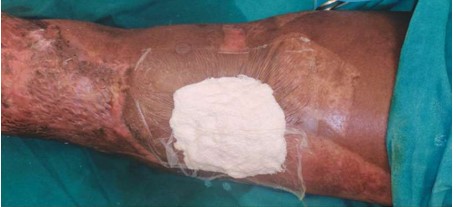
In recent years, there has been a greater emphasis on providing high-quality medical treatment to ensure patients’ safety through improving recovery after surgery (ERAS), reducing postoperative stress, and restoring normal function quickly. Negative pressure wound care has revolutionized the way acute and chronic wounds are treated. The incision site is usually covered with an occlusive or semiocclusive covering after primary wound closure. It is thought that using closed incisional negative pressure therapy on surgical wounds improves wound healing by better distributing shear stresses on wound edges and promoting the evacuation of wound fluids such subcutaneous seroma and hematoma.
References
- 1. Agarwal A. Plast Reconstr Surg. 2019 Jan;143(1S Management of Surgical Incisions Utilizing Closed-Incision Negative-Pressure Therapy):21S- 26S.
- 2. Jeyakumar, P., Hussain, A. T., & Ahamed, A. R. (2018). Reconstruction of Extensive Post–Electric Burn Lowerlimb defect Defects With Exposed Bones—A Study of 12 Cases. Annals of Plastic Surgery.
- 3. Matatov T, Reddy KN, Doucet LD, Zhao CX. Experience with a new negative pressure incision management system in prevention of groin wound infection in vascular surgery patients. J Vasc Surg 2011;57(3):791–5.
- 4. Masden D, Goldstein J, Endara M, Xu K, Steinberg J, Attinger C. Negative pressure wound therapy for at-risk surgical closures in patients with multiple comorbidities. Ann Surg 2012;255(6):1043–7.
- 5. Stannard JP, Volgas DA, McGwin G, Stewart RL, Obremskey W, Moore T, et al. Incisional negative pressure wound therapy after highrisk lower extremity fractures. J Orthop Trauma 2012;26(1):37–42.
- 6. Horch RE. Incisional negative pressure wound therapy for high- -risk wounds. J Wound Care 2015;24:21–8.
- 7. Willy C, Agarwal A, Andersen CA, De Santis G, Gabriel A, Guerra OM, et al. Closed incision negative pressure therapy: international multidisciplinary consensus recommendations. Int Wound J 2016;14(2):385–98.
- 8. Suh H, Lee AY, Park EJ, Hong JP. Negative pressure wound therapy on closed surgical wounds with dead space animal study using a swine model. Ann Plast Surg 2016;76(6):717–22.
- 9. Hyldig N, et al. (2016). Meta-analysis of negativepressure wound therapy for closed surgical incisions. British Journal of Surgery. 2016: 103; 477–486
- 10. Siegwart LC, Sieber L, Fischer S, Maraka S, Kneser U, Kotsougiani-Fischer D. Influence of closed incision negative-pressure therapy on abdominal donor-site morbidity in microsurgical breast reconstruction. Microsurgery 2020:1–8.
- 11. Tyack Z, Simons M, Spinks A, Wasiak J. A systematic review of the quality of burn scar rating scales for clinical and research use. Burns 2012;38(1):6–18.
- 12. Gomoll AH, Lin A, Harris MB. Incisional vacuumassisted closure therapy. J Orthop Trauma. 2006 Nov-Dec;20(10):705-9. doi: 10.1097/01. bot.0000211159.98239.d2. PMID: 17106382.
Data Sharing Statement
There are no additional data available. All raw data and code are available upon request.
Funding
This research received no funding.
Author Contributions
All authors contributed significantly to the work and approve its publication.
Ethics Declaration
This article does not involve any human or animal subjects, and therefore does not require ethics approval.
Acknowledgements
We would like to express our gratitude to the patients, their families, and all those who have contributed to this study.
Conflicts of Interest
No conflicts of interest in this work.
About this article

Cite this article
K Sriharsha Reddy, Ravi Kumar Chittoria, Nishad K, Neijo Thomas/Role of Closed Incision Negative Pressure Therapy in Scar Management /New Indian J Surg. 2022;13(3): 111–113.
Licence:
Attribution-Non-commercial 4.0 International (CC BY-NC 4.0)This license enables reusers to distribute, remix, adapt, and build upon the material in any medium or format for noncommercial purposes only, and only so long as attribution is given to the creator.
| Received | Accepted | Published |
|---|---|---|
| February 23, 2022 | March 15, 2022 | September 30, 2022 |
DOI: https://doi.org/10.21088/nijs.0976.4747.13322.3
Keywords
Closed incisionalNegative pressure therapyScarSearch for Similar Articles
Similar Articles
- Role of Bates-Jenson Wound Assessment Tool (BJWAT) in Wound Management
- Role of New Antimicrobial Solution in the Management of a Chronic Left Foot Woun...
- Laparoscopic Excision of a Giant Retroperitoneal Benign Mesenteric Cyst Encasing...
- Endoscopic-Assisted Sural Nerve and Biceps Femoris Muscle Biopsy in a Young Woma...
- Amniotic Membrane in Wound Healing: Biological Basis, Clinical Evidence and Futu...
Article Level Metrics
Last UpdatedTuesday 24 November 2026, 17:34:54 (IST)
9671
Accesses
5
883
00
Citations
NA
NA
NA
Download citation
Article Keywords
Keyword Highlighting
Highlight selected keywords in the article text.
Timeline
| Received | February 23, 2022 |
| Accepted | March 15, 2022 |
| Published | September 30, 2022 |
licence
Attribution-Non-commercial 4.0 International (CC BY-NC 4.0)
This license enables reusers to distribute, remix, adapt, and build upon the material in any medium or format for noncommercial purposes only, and only so long as attribution is given to the creator.