Full Text (PDF)
Indian Journal of Ancient Medicine and Yoga 17(4):p 196-205, Oct - Dec. 2024. | DOI: https://doi.org/10.21088/ijamy.0974.6986.17424.5
Review Article
Shad Rasa: What we Eat is what we are
Siddhant Singh, Divyanshi Saxena, Komal Gupta, Ankur Singhal
Author Information
Licence:
Attribution-Non-commercial 4.0 International (CC BY-NC 4.0)This license enables reusers to distribute, remix, adapt, and build upon the material in any medium or format for noncommercial purposes only, and only so long as attribution is given to the creator.
Indian Journal of Ancient Medicine and Yoga 17(4):p 196-205, Oct - Dec. 2024. | DOI: https://doi.org/10.21088/ijamy.0974.6986.17424.5
How Cite This Article:
Divyanshi Saxena S, Gupta K, et al. Shad Rasa: What we Eat is what we are. Indian J Ancient Med Yoga. 2024;17(4):196-205.Timeline
Received : December 09, 2024
Accepted : September 27, 2024
Published : December 13, 2024
Abstract
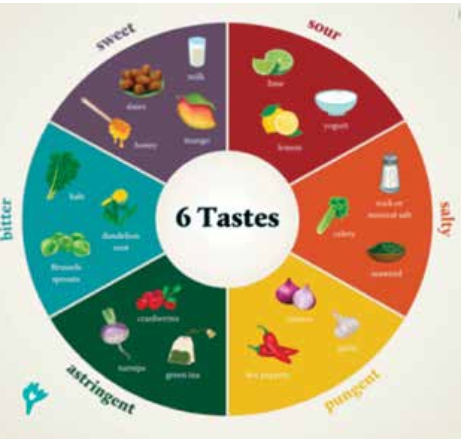
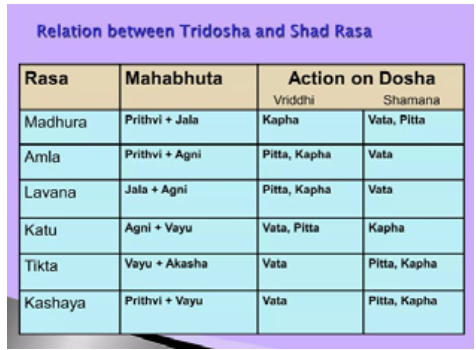
The concept of "Rasa" in Ayurveda, commonly translated as "taste," holds profound significance beyond mere sensory perception. It encompasses various forms, including Pradhana Rasa (primary taste) and Anu-Rasa (secondary taste or aftertaste), each playing a key role in influencing the body’s internal balance and overall health. Rasa is closely linked to the Mahabhutas (five elements), Tridoshas (Vata, Pitta, Kapha), and Dhatus (tissues), affecting digestion, metabolism, and bodily functions. Additionally, the relationship between Rasas and seasonal changes (Rutu) highlights the adaptive nature of diet according to environmental conditions. The six primary Rasas-sweet, sour, salty, bitter, pungent, and astringent-determine the potency, qualities, and therapeutic benefits or drawbacks of food and drink. Excessive consumption or withdrawal of specific Rasas can lead to imbalances, influencing the body’s wellness and susceptibility to diseases. This in terms affects our Prakriti (basic nature of our body) and improper use of Shad Rasa may lead to Vikriti (any disease). Overall Shad Ras affects our Prakriti and imbalaced use results in Vikriti i.e. disease condition. Modern research continues to explore how the essence, potency, and effects of Rasas align with contemporary scientific understanding, emphasizing their potential therapeutic roles. This abstract encapsulates Ayurveda's holistic perspective on taste, advocating further exploration through case studies and clinical research to deepen insights into the physiological impact of Rasas on health.
References
- 1. Acharya Sushruta, Sushruta Samhita commentary of Dalhanacharya Sutrasthana 14th chapter, Shoka No-13, edited by Acharya Yadavji and Trikamji, 7th edition Varanasi, 2002, Page No-62.
- 2. Sri Vagbhatacharya, RasaratnaSamucchaya, by Dr. V.A. Dole, 1st Chapter Shloka No- 68, 2nd edition, Varanasi, Chaukhambha Sanskrit Series Office, 2008, Page No-17.
- 3. Acharya Charaka, Charaka Samhita, Sutrasthana 4th chapter, Shloka No-7, CharakaChandrika Hindi commentary of Agnivesha, edited by Dr.Bramhananda Tripathi, Volume 1, Chaukhamha Surabharati Prakashana, Varanasi, Reprint 2002, Page No-79.
- 4. Acharya Charaka, Charaka Samhita, Siddhisthana 1st chapter, Shloka No-6, CharakaChandrika Hindi commentary of Agnivesha, edited by Dr.Bramhananda Tripathi, Volume 2, Chaukhamha Surabharati Prakashana, Varanasi, Reprint2002, Page No-1317.
- 5. Acharya Charaka, Charaka Samhita, Sutrasthana 1st chapter, Shloka No-64, CharakaChandrika Hindi commentary of Agnivesha, edited by Dr.Bramhananda Tripathi, Volume 2, Chaukhamha Surabharati Prakashana, Varanasi, Reprint2002, Page No-35.
- 6. Acharya Vagbhata, Asthanga Hridaya, Sutrastana 1st chapter, Shloka No-14, Nirmala Hindi Commentary, edited by Dr.Bramhananda Tripathi, Delhi, Chaukhambha Sanskrit Pratisthana, Reprinted 2015, Page No-12.
- 7. Acharya Sushruta, Sushruta Samhita commentary of Dalhanacharya Sutrasthana 42nd chapter, Shoka No-3, edited by Acharya Yadavji and Trikamji, 7th edition Varanasi, Chaukhamba Orientalia, 2002, page no-181.
- 8. Acharya Charaka, Charaka Samhita, Sutrasthana 26th chapter, Shloka No-8, Charaka Chandrika Hindi commentary of Agnivesha, edited by Dr.Bramhananda Tripathi, Volume 1, Chaukhamha Surabharati Prakashana, Varanasi, Reprint2002, Page No-466.
- 9. Acharya Sushruta, Sushruta Samhita commentary of Dalhanacharya Sutrasthana 42ndchapter, Shoka No-3, edited by Acharya Yadavji and Trikamji, 7th edition Varanasi, Chaukhamba Orientalia, 2002, page no-181.
- 10. Acharya Vagbhata, Asthanga Hridaya, Sutrastana 1st chapter, Shloka No-14,15, Nirmala Hindi Commentary, edited by Dr.Bramhananda Tripathi, Delhi, Chaukhambha Sanskrit Pratisthana, Reprinted 2015, Page No-12.
- 11. Acharya Charaka, Charaka Samhita, Sutrasthana 26th chapter, Shloka No-40, Charaka Chandrika Hindi commentary of Agnivesha, edited by Dr.Bramhananda Tripathi, Volume 1, Chaukhamha Surabharati Prakashana, Varanasi, Reprint2002, Page No-480.
- 12. Srimad VriddhaVagbhata, Asthanga Sangraha, Sutrastana 18th Chapter, Shloka No- 3, Saroj Hindi Commentary by Dr. RaviDatta Tripathi, Delhi, Chaukhambha Sanskrit Pratisthan, Reprint 2003, Page No-343.
- 13. Acharya Sushruta, Sushruta Samhita commentary of Dalhanacharya Sutrasthana 46th chapter, Shoka No-460, edited by Acharya Yadavji and Trikamji, 7th edition Varanasi, Chaukhamba Orientalia, 2002, page no-247.
- 14. Acharya Charaka, Charaka Samhita, Sutrasthana 26th chapter, Shloka No-43/2, CharakaChandrika Hindi commentary of Agnivesha, edited by Dr.Bramhananda Tripathi, Volume 1, Chaukhamha Surabharati Prakashana, Varanasi, Reprint2002, Page No-482.
- 15. Acharya Charaka, Charaka Samhita, Sutrasthana 26th chapter, Shloka No-43/3, CharakaChandrika Hindi commentary of Agnivesha, edited by Dr.Bramhananda Tripathi, Volume 1, Chaukhamha Surabharati Prakashana, Varanasi, Reprint2002, Page No-483.
- 16. Acharya Charaka, Charaka Samhita, Sutrasthana 26th chapter, Shloka No-43/4 CharakaChandrika Hindi commentary of Agnivesha, edited by Dr.Bramhananda Tripathi, Volume 1, Chaukhamha Surabharati Prakashana, Varanasi, Reprint2002, Page No- 483.
- 17. Acharya Charaka, Charaka Samhita, Sutrasthana 26th chapter, Shloka No-43/5, CharakaChandrika Hindi commentary of Agnivesha, edited by Dr.Bramhananda Tripathi, Volume 1, Chaukhamha Surabharati Prakashana, Varanasi, Reprint2002, Page No- 484.
- 18. Acharya Charaka, Charaka Samhita, Sutrasthana 26th chapter, Shloka No-43/6, Charaka Chandrika Hindi commentary of Agnivesha, edited by Dr.Bramhananda Tripathi, Volume 1, Chaukhamha Surabharati Prakashana, Varanasi, Reprint2002, Page No- 484.
- 19. Acharya Charaka, Charaka d bvSamhita, Sutrasthana 26th chapter, Shloka No- 43, Charaka Chandrika Hindi commentary of Agnivesha, edited by Dr. Bramhananda Tripathi, Volume 1, Chaukhamha Surabharati Prakashana, Varanasi, Reprint2002, Page No- 484.
Data Sharing Statement
There are no additional data available.
Funding
This research received no funding.
Author Contributions
All authors contributed significantly to the work and approve its publication.
Ethics Declaration
This article does not involve any human or animal subjects, and therefore does not require ethics approval.
Acknowledgements
Information not provide.
Conflicts of Interest
The authors report no conflicts of interest in this work.
About this article

Cite this article
Divyanshi Saxena S, Gupta K, et al. Shad Rasa: What we Eat is what we are. Indian J Ancient Med Yoga. 2024;17(4):196-205.
Licence:
Attribution-Non-commercial 4.0 International (CC BY-NC 4.0)This license enables reusers to distribute, remix, adapt, and build upon the material in any medium or format for noncommercial purposes only, and only so long as attribution is given to the creator.
| Received | Accepted | Published |
|---|---|---|
| December 09, 2024 | September 27, 2024 | December 13, 2024 |
DOI: https://doi.org/10.21088/ijamy.0974.6986.17424.5
Keywords
Shad RasaAnu-rasaMahabhutaViryaDoshaDhatuMalaSearch for Similar Articles
Similar Articles
- Ayurvedic Dietary Interventions and Nutritional Approaches in Haemorrhoids Manag...
- A Critical Review on the Pramehahara dravyas of Dhanwantari Nighantu
- Potential of Ayurveda in ‘Post Hospitalization Syndrome’ W.S.R. Mental Health Ma...
- Ayurvedic Management of Tinea Corporis (Dadru Kustha): A Case Study
- A Case Study: Ayurvedic Bhagna Chikitsa in Traumatic Fracture
Article Level Metrics
Last UpdatedThursday 22 October 2026, 19:38:00 (IST)
5473
Accesses
44
995
00
Citations
NA
NA
NA
Download citation
Article Keywords
Keyword Highlighting
Highlight selected keywords in the article text.
Timeline
| Received | December 09, 2024 |
| Accepted | September 27, 2024 |
| Published | December 13, 2024 |
licence
Attribution-Non-commercial 4.0 International (CC BY-NC 4.0)
This license enables reusers to distribute, remix, adapt, and build upon the material in any medium or format for noncommercial purposes only, and only so long as attribution is given to the creator.