Full Text (PDF)
Indian Journal of Biology 13(1):p 31-42, January-June 2026. | DOI: https://doi.org/10.21088/ijb.2394.1391.13126.4
Original Article
Seasonal Variation of Plankton Density in Selected Water Bodies under Fishermans' Cooperative Societies of Birbhum istrict, West Bengal, India
Ashis Kumar Panigrahi, Anup Kumar Mandal
Author Information
Licence:
Attribution-Non-commercial 4.0 International (CC BY-NC 4.0)This license enables reusers to distribute, remix, adapt, and build upon the material in any medium or format for noncommercial purposes only, and only so long as attribution is given to the creator.
Indian Journal of Biology 13(1):p 31-42, January-June 2026. | DOI: https://doi.org/10.21088/ijb.2394.1391.13126.4
How Cite This Article:
Anup Kumar Mandal, Ashis Kumar Panigrahi. Seasonal Variation of Plankton Density in Selected Water Bodies under Fishermans' Cooperative Societies of Birbhum District, West Bengal, India. Ind. J Biol 2026; 13(1): 31-42.Timeline
Received : May 09, 2026
Accepted : June 16, 2026
Published : June 26, 2026
Abstract
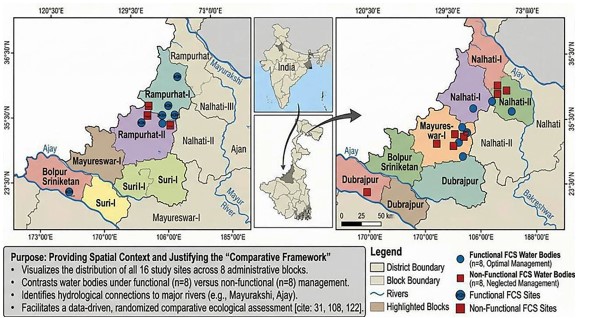
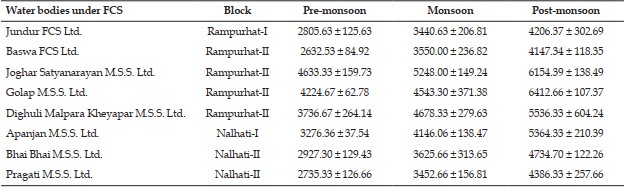
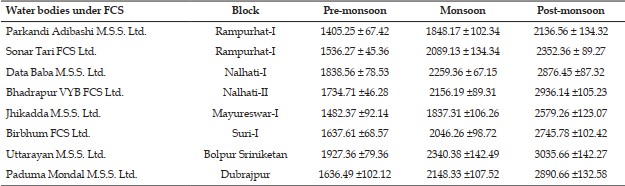
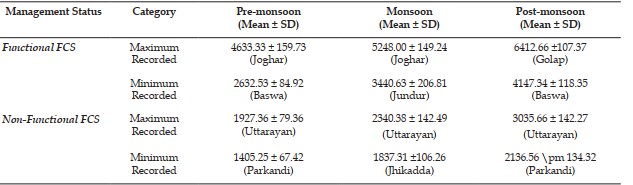
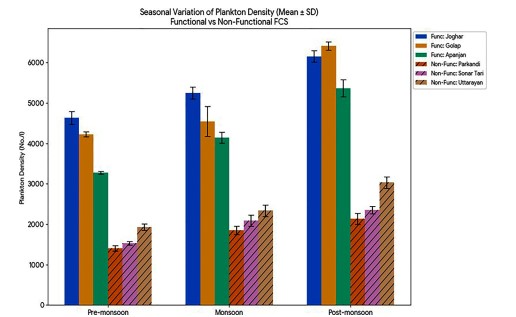
Background: West Bengal is an important place for aquaculture in India, which is the second-largest fish producer in the world. But the fact that fish productivity per hectare is going down in places like Birbhum shows that we need to look at the quality of aquatic ecosystems. Plankton communities are important primary producers and important links in the heterotrophic food chain. They have a direct effect on how fish grow and develop. Methodology: The study followed a standardized, multi-phase framework to evaluate the biological productivity and ecological integrity of 16 selected aquatic ecosystems in the Birbhum district. All procedures, including site selection across eight administrative blocks, were conducted with high academic rigor to ensure reproducibility. Results: A quantitative examination showed clear seasonal trends. The density of plankton was lowest before and during the monsoon, but it rose sharply after the monsoon when the weather became more stable. Functional FCS water bodies kept their best density ranges, such the post- monsoon phase, when they reached up to 6412.66 ± 107.37 No./l. On the other hand, non-functional FCS water bodies had far lower densities, frequently below 3000 No./l, probably because they weren’t managed well when it came to water quality. Conclusion: The results show that bad management in societies that don’t work well hurts plankton productivity. Structured water quality management is suggested to revive plankton development and improve aquaculture potential in these semi-potential areas.
References
- 1. American Public Health Association (APHA). Standard methods for the examination of water and wastewater. 24th ed. Washington,DC: APHA; 2022.
- 2. Bakshi A., Panigrahi A.K., Mondal A. Seasonal variation of aquatic diversity of a lotic ecosystem: a case study of River Churni, West Bengal. Int J Appl Pure Sci Agric. 2016; 2(7): 9–16.
- 3. Banerjee S., Roy N. Hydrobiological profile of wetlands in Birbhum district. Indian J Ecol. 2019; 46(5): 780-86.
- 4. Bhatnagar A., Devi P. Water quality guidelines for management of pond fish culture. Int J Environ Sci. 2013; 3(6): 1980-97.
- 5. Bhattacharya M. Management-driven nutrient enrichment in aquaculture systems. Fish Tech News. 2024; 15(2): 12-19.
- 6. Birbhum District Statistical Office. Fishery resources and production deficit report. Suri: Government of West Bengal; 2025.
- 7. Biswas S. Management efficacy and its role in aquatic productivity. Aquacult Res Manag. 2022; 14(3): 201–215.
- 8. Boyd C.E., Tucker C.S. Pond aquaculture water quality management. Boston: Springer; 2012.
- 9. Chatterjee A. Seasonal dynamics of plankton in West Bengal wetlands. J Freshw Ecol. 2021; 36(1): 112-25.
- 10. Dasgupta S. Impact of siltation on plankton community structure. Wetlands. 2021; 18(4): 220-35.
- 11. Diana J.S., Egna H.S., Chopin T., Peterson M.S., Cao L., Pomeroy R., et al. Responsible aquaculture in 2050: valuing local conditions and human innovations will be key to success. Bioscience. 2013; 63(4): 255-62.
- 12. Directorate of Fisheries. Statistical handbook of fisheries department. Kolkata: Government of West Bengal; 2023.
- 13. Food and Agriculture Organization (FAO). The state of world fisheries and aquaculture 2020. Rome: FAO; 2020.
- 14. Ghosh D., Sen S. Phytoplankton diversity as an indicator of water quality in rural Bengal. Int J Limnol. 2020; 52(2): 14-22.
- 15. Jhingran V.G. Fish and fisheries of India. New Delhi: Hindustan Publishing; 1991.
- 16. Mandal B., Pal S. Role of organic manuring in community-managed ponds. Aquat Sci Rev. 2023; 12(1): 33-41.
- 17. Misra V., Pandey L. Seasonal fluctuations of zooplankton in semi-arid regions. J Arid Environ. 2020; 33(1): 55-67.
- 18. Mukherjee T., Das K. Ecological traps in neglected freshwater ecosystems. Environ Conserv Bull. 2024; 19(1): 88-94.
- 19. One Health Initiative. Interdisciplinary approaches to aquatic ecosystem health. One Health J. 2024; 12: 45-58.
- 20. Panigrahi A.K., Bakshi A., Pattanayak S. A comprehensive review on uptake and accumulation of heavy metals in freshwater fishes. Biosci Biotechnol Res Commun. 2021;14(1).
- 21. Panigrahi A.K., Pattnaik S. Water pollution effects of river Saraswati and Kunti on livelihood: a case study of Fishermans' communities in West Bengal. J Fish. 2020; 8(3):
- 22. Paul A. Nutrient cycling in managed vs unmanaged tropical ponds. J Water Manag. 2022; 25(2): 150-63.
- 23. Ray M., Khan A., Singh J. Spatial correlation of plankton density in administrative blocks of Birbhum. J Aquat Biol. 2022; 31(4): 310–318.
- 24. Saha P., Devi R. Impact of monsoon runoff on nutrient loading in Birbhum water bodies. Indian J Fish Sci. 2023; 58(2): 45-52.
- 25. Sharma U., Gupta P. Comparative analysis of functional and defunct cooperatives. Soc Econ Rev. 2023; 21(3): 214–228.
- 26. Wetzel R.G. Limnology: lake and river ecosystems. 3rd ed. San Diego: Academic Press; 2001.
Data Sharing Statement
There are no additional data available. All raw data and code are available upon request.
Funding
This research received no funding.
Author Contributions
All authors contributed significantly to the work and approve its publication.
Ethics Declaration
This article does not involve any human or animal subjects, and therefore does not require ethics approval.
Acknowledgements
We would like to express our gratitude to the patients, their families, and all those who have contributed to this study.
Conflicts of Interest
No conflicts of interest in this work.
About this article

Cite this article
Anup Kumar Mandal, Ashis Kumar Panigrahi. Seasonal Variation of Plankton Density in Selected Water Bodies under Fishermans' Cooperative Societies of Birbhum District, West Bengal, India. Ind. J Biol 2026; 13(1): 31-42.
Licence:
Attribution-Non-commercial 4.0 International (CC BY-NC 4.0)This license enables reusers to distribute, remix, adapt, and build upon the material in any medium or format for noncommercial purposes only, and only so long as attribution is given to the creator.
| Received | Accepted | Published |
|---|---|---|
| May 09, 2026 | June 16, 2026 | June 26, 2026 |
DOI: https://doi.org/10.21088/ijb.2394.1391.13126.4
Keywords
Plankton DensityBirbhumAquacultureFishermans' Cooperative SocietiesSeasonal VariationWater QualitySearch for Similar Articles
Similar Articles
- Medicinal Mushrooms: Potent Fungi for Diverse Human Health Benefits
- Honey for Nutrition and Health Benefits - Traditional and Modern Uses in Human D...
- Foraging Behaviour of Indian Honey Bee, Apis Cerana Indica Fab, (Apidae: Hymenop...
- Role of Curcumin in Wound Healing
- Characterization of Blood cells and Comparative Analyses of Hematological Profil...
Article Level Metrics
Last UpdatedThursday 22 October 2026, 10:51:26 (IST)
2855
Accesses
31
356
00
Citations
NA
NA
NA
Download citation
Article Keywords
Keyword Highlighting
Highlight selected keywords in the article text.
Timeline
| Received | May 09, 2026 |
| Accepted | June 16, 2026 |
| Published | June 26, 2026 |
licence
Attribution-Non-commercial 4.0 International (CC BY-NC 4.0)
This license enables reusers to distribute, remix, adapt, and build upon the material in any medium or format for noncommercial purposes only, and only so long as attribution is given to the creator.