Full Text (PDF)
Indian Journal of Biology 13(1):p 19-30, January-June 2026. | DOI: https://doi.org/10.21088/ijb.2394.1391.13126.3
Original Article
Correlation between Physico-chemical Parameters & Inorganic Ions with Microalgal Diversity of Damodar and Kopai River Ecosystems during 2024 - 2025
Author Information
Licence:
Attribution-Non-commercial 4.0 International (CC BY-NC 4.0)This license enables reusers to distribute, remix, adapt, and build upon the material in any medium or format for noncommercial purposes only, and only so long as attribution is given to the creator
Indian Journal of Biology 13(1):p 19-30, January-June 2026. | DOI: https://doi.org/10.21088/ijb.2394.1391.13126.3
How Cite This Article:
Tapash Debnath, Monojit Ray. Correlation between Physico-chemical Parameters & Inorganic Ions with Microalgal Diversity of Damodar and Kopai River Ecosystems during 2024 - 2025. Ind. J Biol 2026; 13(1): 19-30.Timeline
Received : January 28, 2026
Accepted : March 02, 2026
Published : June 26, 2026
Abstract
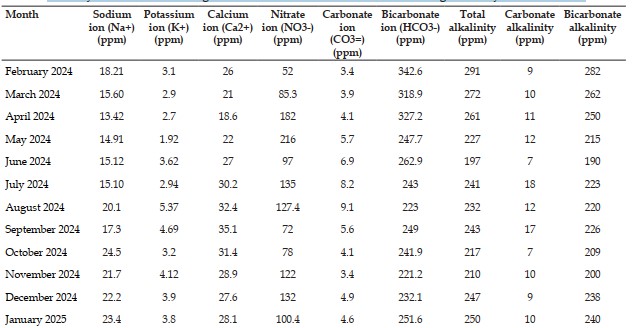
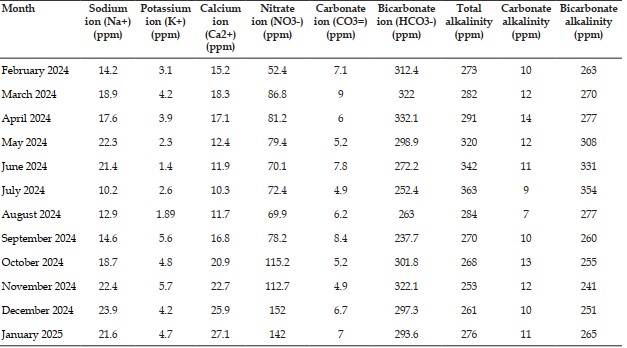
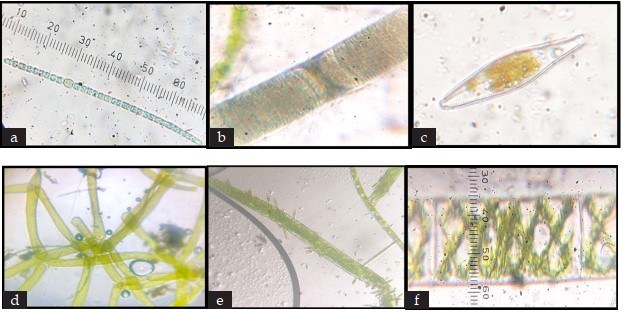
The present study stress on the correlation between physicochemical parameters, significant inorganic ions and microalgal diversity in the Damodar and Kopai river ecosystems during 2024-2025. Physicochemical parameters and biologically inorganic ions are crucial for the survival, growth, and diversity of microalgae in any aquatic ecosystems. They act as essential nutrients, play an important role in osmotic balance, and influence various physiological processes such as photosynthesis, respiration, metabolism, and enzyme activity etc. in microalgal organisms. The present survey revealed the variations of physicochemical parameters like temperature, pH, TDS, conductance, salinity, DO, turbidity, BOD, hardness and inorganic ions like Na+, K+, Ca2+, NO3-, CO3=, HCO3-, total alkalinity, carbonate alkalinity, and bicarbonate alkalinity in the Damodar and Kopai rivers. The Damodar river is a rain-fed river, shallow, wide, and flashy. It originates near Khamarpat hill on the Chotanagpur plateau in the Palamau district of Jharkhand, and its mouth is the Hooghly river in the Howrah district of West Bengal. The Damodar river was earlier known as the “river of sorrow” because it used to flood many areas of Bardhaman, Hooghly, Howrah, and Medinipur districts. The length of the river is 592 km. The Kopai river is the smallest in West Bengal, flowing across the Rarh Bengal region. This river is a tributary of the Bakreshwar river. The Kopai river originates from the foothills of the Chotanagpur plateau in Jharkhand state, India, and ultimately merges with the Mayurakshi river. The length of this river is 176.4 km. Results revealed that 25 species of algal genera from the Damodar river and 21 algal species from the Kopai River were observed during the period from 2024 to 2025. Fluctuations of these physicochemical parameters and inorganic ions significantly affect the growth and diversity of microalgae in the river ecosystems.
References
- 1. Bhattacharyya, K. (2011) The lower Damodar River, India: understanding the human role in changing fluvial environment. Springer, New York.
- 2. Debnath T. and Ray M.*, (2023), Annual variation of physico-chemical parameters of Damodar river water: Feb 2022 – Jan 2023. Journal of Science and Technological
- 3. Debnath T., Ray M.*, and Sk S., (2025), Diversity of Microalgae and Aquatic Macrophytes of Damodar: Effect of Physico-chemical Parameters and Inorganic Ions. Indian
- 4. Debnath T., Ray M.*, Sharma P. and Sk S., (2024), Algal diversity of Kopai river in India. Journal of Science and Technological Researches 2024; 6(4). DOI: https://doi.org/10.51514/JSTR.6.4.2024.13-20
- 5. Debnath T., Ray M.*, Sharma P. and Sk S., (2025), Diversity, Distribution, and Phytosociological Analysis of Aquatic Macrophyte Vegetation in the Kopai River. Journal of Science and Technological Researches 2025; 7(3). DOI:https://doi.org/10.51514/JSTR.7.3.2025.17-25
- 6. Ghosal, J. (2018) Settlement Archaeology of Kopai River, Birbhum District, West Bengal: A Preliminary Study. Heritage: Journal of Multidisciplinary Studies in Archaeology
- 7. Jaccard, P. (1912) The distribution of flora in the alpine Zone, 2:37-50. New Phytologist11.
- 8. Mondal, G.C., Singh, K.A. and Singh, T.B. (2018) Damodar River Basin: Storehouse of Indian Coal. Springer Nature Singapore Pte Ltd., The Indian Rivers, Springer Hydrogeology, DOI:https://doi.org/10.1007/978-981-10-2984-4_21
- 9. Ray, M. and Sengupta, K. (2015) Soil composition and nutrient dynamics of some phytoplanktons of River Jalangi, Nadia WB.,Indian Journal of Biology, 2015. 2(2),167-170. DOI: https://dx.doi.org/10.21088/ijb.2394.1391.2215.10
- 10. Ray, M. and Sk, S. (2023) Effect of PhysicoChemical Parameters and Inorganic Nutrient Ions in Relation with Seasonal Algal Diversity of River Ichamati, West Bengal, India. Current World Environment, 18(3), 1-19. DOI: https://dx.doi.org/10.12944/CWE.18.3.09
- 11. Ray, M. et al. (2021) Comparison of water quality between upper and course of the river Ganga during winter 2021. Journal of Science and Technological Researches 3(2). DOI: https://doi.org/10.51514/JSTR.3.2.2021.16-822
- 12. Ray, M., Ghati, A., Pant, H., Negi, S. and Joshi, H.C. (2021) Comparison of water quality between upper and delta course of the river Ganga during winter 2021. Journal
- 13. Sen, P.K. (1991) Flood hazards and river bank erosion in the lower Damodar Basin. In: Sharma HS (ed) Indian geomorphology.Concept Publishing Company, New Delhi, pp.
- 14. Sorenson, P.A. (1948) Method of establishing groups of equal amplitude in plant sociology based on similarity of species content. KongelingeDanske Videnskabernes Selsk Biol Skrifter. 5:1-34.
Data Sharing Statement
There are no additional data available. All raw data and code are available upon request.
Funding
This research received no funding.
Author Contributions
All authors contributed significantly to the work and approve its publication.
Ethics Declaration
This article does not involve any human or animal subjects, and therefore does not require ethics approval.
Acknowledgements
We would like to express our gratitude to the patients, their families, and all those who have contributed to this study.
Conflicts of Interest
No conflicts of interest in this work.
About this article

Cite this article
Tapash Debnath, Monojit Ray. Correlation between Physico-chemical Parameters & Inorganic Ions with Microalgal Diversity of Damodar and Kopai River Ecosystems during 2024 - 2025. Ind. J Biol 2026; 13(1): 19-30.
Licence:
Attribution-Non-commercial 4.0 International (CC BY-NC 4.0)This license enables reusers to distribute, remix, adapt, and build upon the material in any medium or format for noncommercial purposes only, and only so long as attribution is given to the creator
| Received | Accepted | Published |
|---|---|---|
| January 28, 2026 | March 02, 2026 | June 26, 2026 |
DOI: https://doi.org/10.21088/ijb.2394.1391.13126.3
Keywords
EcosystemPhysicochemical parametersInorganic ionsTemperatureDamodarKopaiSearch for Similar Articles
Similar Articles
- Medicinal Mushrooms: Potent Fungi for Diverse Human Health Benefits
- Honey for Nutrition and Health Benefits - Traditional and Modern Uses in Human D...
- Foraging Behaviour of Indian Honey Bee, Apis Cerana Indica Fab, (Apidae: Hymenop...
- Role of Curcumin in Wound Healing
- Characterization of Blood cells and Comparative Analyses of Hematological Profil...
Article Level Metrics
Last UpdatedWednesday 21 October 2026, 10:28:04 (IST)
2844
Accesses
24
355
00
Citations
NA
NA
NA
Download citation
Article Keywords
Keyword Highlighting
Highlight selected keywords in the article text.
Timeline
| Received | January 28, 2026 |
| Accepted | March 02, 2026 |
| Published | June 26, 2026 |
licence
Attribution-Non-commercial 4.0 International (CC BY-NC 4.0)
This license enables reusers to distribute, remix, adapt, and build upon the material in any medium or format for noncommercial purposes only, and only so long as attribution is given to the creator