Full Text (PDF)
Indian Journal of Biology 13(1):p 12-18, January-June 2026. | DOI: https://doi.org/10.21088/ijb.2394.1391.13126.2
Original Article
Ethnobotanical Uses of Medicinal Plants for Veterinary Purposes by the People of Nawalgarh, Rajasthan
Ravindra Goswami, Sharvista Saini, Priyanka Jagrat
Author Information
Licence:
Attribution-Non-commercial 4.0 International (CC BY-NC 4.0)This license enables reusers to distribute, remix, adapt, and build upon the material in any medium or format for noncommercial purposes only, and only so long as attribution is given to the creator.
Indian Journal of Biology 13(1):p 12-18, January-June 2026. | DOI: https://doi.org/10.21088/ijb.2394.1391.13126.2
How Cite This Article:
Ravindra Goswami, Sharvista Saini, Priyanka Jagrat. Ethnobotanical Uses of Medicinal Plants for Veterinary Purposes by the People of Nawalgarh, Rajasthan. Ind. J Biol 2026; 13(1): 12-18.Timeline
Received : January 31, 2026
Accepted : March 05, 2026
Published : June 26, 2026
Abstract
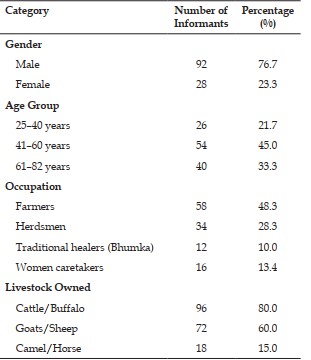
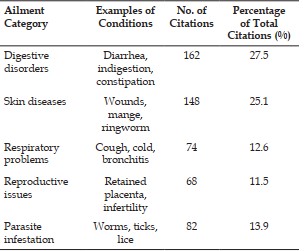
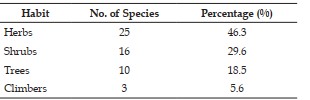
Ethnobotany bridges traditional knowledge and scientific research by documenting plant uses in human and animal healthcare. The present study investigates ethnoveterinary plant uses among the rural communities of Nawalgarh, district Jhunjhunu, Rajasthan, India. Although ethnobotanical documentation exists for human medicinal use in Rajasthan, systematic studies focused on ethnoveterinary practices in Nawalgarh are limited.1-3 This research identifies plant species used by livestock keepers to treat common ailments in cattle, goats, sheep, horses, and camels; categorizes ailments; assesses frequency of use and perceived efficacy; and discusses conservation implications. Data were collected via semi-structured interviews and field observations among 120 informants (herders, farmers, traditional healers) between 2023–2025. A total of 54 plant species from 28 families were documented with detailed usage patterns. Results reveal continued reliance on traditional veterinary remedies, often driven by accessibility, cost, and cultural belief. The study underscores the need to integrate ethnoveterinary knowledge into sustainable animal health strategies and promote conservation of medicinal flora.
References
- 1. Jain SK. Dictionary of Indian Folk Medicine and Ethnobotany. Deep Publications, New Delhi; 1991.
- 2. Ganti S, Rao P, Mishra A. Ethnobotanical survey of medicinal plants in Rajasthan. Indian Journal of Traditional Knowledge. 2018; 17(3): 487–495.
- 3. Singh VP, Meena RK, Yadav BL. Plant resource use in arid Rajasthan. Journal of Arid Environments. 2017; 147: 57–66.
- 4. Cotton CM. Ethnobotany: Principles and Applications. John Wiley & Sons; 1996.
- 5. McCorkle CM. An introduction to ethnoveterinary research and development. Journal of Ethnobiology. 1986; 6(1): 129–149.
- 6. Tuxill J, Nabhan GP. People, Plants and Protected Areas: A Guide to In Situ Management. IUCN; 1998.
- 7. Mathias E, McCorkle C. Ethnoveterinary medicine: An overview. Veterinary Clinics of North America. 2004; 20(3): 651–668.
- 8. Nair KM. Vegetation and floristic diversity of Rajasthan. Proceedings of Indian National Science Academy. 2009; 75(1): 1–12.
- 9. Singh RB. Rural livelihood and livestock dependency in Shekhawati region. Rural Development Journal. 2015; 12(2): 32–41.
- 10. Bhadoriya SK, Tiwari P, Sharma R. Medicinal plants used by tribes of Rajasthan. Ethnobotany Leaflets. 2018; 22: 45–67.
- 11. Kamboj VP. Herbal ethnomedicine in India: Scope and applications. Indian Journal of Traditional Knowledge. 2014; 13(1): 9–24.
- 12. Gupta AK, Sharma M, Singh J. Ethnoveterinary practices in arid regions of India. Journal of Ethnopharmacology. 2019; 237: 252–262.
- 13. Indian Meteorological Department (IMD). Climatological data for Rajasthan; 2022.
- 14. Census of India. Jhunjhunu District Census Handbook. Government of India; 2021.
- 15. Martin GJ. Ethnobotany: A Methods Manual. Earthscan Publications; 1995.
- 16. Jain AK, Rao RR. A Handbook of Field and Herbarium Methods. Today & Tomorrow’s Printers; 1977.
- 17. Alexiades MN. Selected Guidelines for Ethnobotanical Research. The New York Botanical Garden; 1996.
- 18. Friedman J, Yaniv Z, Dafni A, Palewitch D. A preliminary classification of the healing potential of medicinal plants. Botanical Journal of the Linnean Society. 1986; 96: 59–70.
- 19. Turner NJ. The importance of a rose: Evaluating the cultural significance of plants. Social Science & Medicine. 1988; 27(3): 221–229.
- 20. Singh NP, Vohra JN, Hajra PK, Singh DK. Flora of Rajasthan (Part I & II). Botanical Survey of India; 2001.
- 21. Chopra RN, Nayar SL, Chopra IC. Indigenous Drugs of India. Academic Publishers; 1956.
- 22. Katerere DR, Luseba D. Ethnoveterinary botanical medicine: Herbal remedies for animal health. Veterinary Journal. 2009; 179(3):310–315.
- 23. Subapriya R, Nagini S. Medicinal properties of Azadirachta indica: A review. Current Medicinal Chemistry – Anti-Cancer Agents. 2005; 5(2): 149–156.
- 24. Phillips O, Gentry AH. The useful plants of Amazonia: Ethnobotanical importance. Conservation Biology. 1993; 7(1): 48–58.
- 25. Singh G, Maurya S, de Lampasona MP, Catalan CAN. Chemical constituents and antioxidant potential of Ocimum sanctum.Journal of Agricultural and Food Chemistry. 2009;
- 26. Mishra LC, Singh BB, Dagenais S. Scientific basis for the therapeutic use of Withania somnifera. Journal of Alternative and Complementary Medicine. 2000; 6(4): 1–8.
- 27. Patel SB, Rauf A. Ethnoveterinary uses of fenugreek (Trigonella foenum-graecum). Indian Veterinary Journal. 2015; 92(5): 31–34.
- 28. Anonymous. Coriander seed applications in veterinary practices. Ethnopharmacology Review. 2018; 12(4): 75–80.
- 29. Joshi VC, Dwivedi S. Antiparasitic activity of garlic (Allium sativum). Parasitology Today. 2001; 17(8): 345–350.
- 30. Kirtikar KR, Basu BD. Indian Medicinal Plants. Lalit Mohan Basu Publications; 1935.
- 31. Kshetri H. Traditional livestock care practices in Rajasthan. Anthropology Today. 2008; 24(5): 15–19.
- 32. Sharma PC. Ayurvedic foundations of ethnoveterinary medicine. Ancient Science of Life. 2010; 29(4): 21–28.
- 33. Biswas K, Chattopadhyay I, Banerjee RK, Bandyopadhyay U. Neem as antimicrobial agent. Microbiological Research. 2002; 157(1): 13–30.
- 34. Prakash P, Gupta N. Therapeutic uses of Ocimum sanctum (Tulsi). Indian Journal of Clinical Biochemistry. 2005; 20(2): 107–110.
- 35. Ahmad M, et al. Pharmacological properties of Withania somnifera. Phytochemistry Reviews. 2010; 9(3): 589–600.
- 36. Singh S, Yadav R, Meena ML. Conservation challenges of medicinal plants in Rajasthan. Biological Conservation. 2014; 177: 19–26.
- 37. Turner NJ, Łuczaj ŁJ, Migliorini P, et al. Loss of ethnobotanical knowledge and its implications. Ethnobiology Letters. 2021; 12: 56–72.
Data Sharing Statement
There are no additional data available. All raw data and code are available upon request.
Funding
This research received no funding.
Author Contributions
All authors contributed significantly to the work and approve its publication.
Ethics Declaration
This article does not involve any human or animal subjects, and therefore does not require ethics approval.
Acknowledgements
We would like to express our gratitude to the patients, their families, and all those who have contributed to this study.
Conflicts of Interest
No conflicts of interest in this work.
About this article

Cite this article
Ravindra Goswami, Sharvista Saini, Priyanka Jagrat. Ethnobotanical Uses of Medicinal Plants for Veterinary Purposes by the People of Nawalgarh, Rajasthan. Ind. J Biol 2026; 13(1): 12-18.
Licence:
Attribution-Non-commercial 4.0 International (CC BY-NC 4.0)This license enables reusers to distribute, remix, adapt, and build upon the material in any medium or format for noncommercial purposes only, and only so long as attribution is given to the creator.
| Received | Accepted | Published |
|---|---|---|
| January 31, 2026 | March 05, 2026 | June 26, 2026 |
DOI: https://doi.org/10.21088/ijb.2394.1391.13126.2
Keywords
EthnobotanyEthnoveterinaryDocumenting plantNawalgarhTraditional KnowledgeSearch for Similar Articles
Similar Articles
- Medicinal Mushrooms: Potent Fungi for Diverse Human Health Benefits
- Honey for Nutrition and Health Benefits - Traditional and Modern Uses in Human D...
- Foraging Behaviour of Indian Honey Bee, Apis Cerana Indica Fab, (Apidae: Hymenop...
- Role of Curcumin in Wound Healing
- Characterization of Blood cells and Comparative Analyses of Hematological Profil...
Article Level Metrics
Last UpdatedThursday 22 October 2026, 10:48:39 (IST)
2855
Accesses
62
356
00
Citations
NA
NA
NA
Download citation
Article Keywords
Keyword Highlighting
Highlight selected keywords in the article text.
Timeline
| Received | January 31, 2026 |
| Accepted | March 05, 2026 |
| Published | June 26, 2026 |
licence
Attribution-Non-commercial 4.0 International (CC BY-NC 4.0)
This license enables reusers to distribute, remix, adapt, and build upon the material in any medium or format for noncommercial purposes only, and only so long as attribution is given to the creator.