Full Text (PDF)
International Journal of Pediatric Nursing 8(2):p 45-50, May-August 2022. | DOI: https://doi.org/10.21088/ijpen.2454.9126.8222.4
Original Article
Screening of Neonates with Hyperbilirubinemia for Sensorineural Deafness
Sanjay Goudappa Sangavi, Basavaraj Patil, Aishwarya B., Rudrakshi Itagi
Author Information
Licence:
Attribution-Non-commercial 4.0 International (CC BY-NC 4.0)This license enables reusers to distribute, remix, adapt, and build upon the material in any medium or format for noncommercial purposes only, and only so long as attribution is given to the creator.
International Journal of Pediatric Nursing 8(2):p 45-50, May-August 2022. | DOI: https://doi.org/10.21088/ijpen.2454.9126.8222.4
How Cite This Article:
Basavaraj Patil, Aishwarya B, Rudrakshi Itagi, et al./Screening of Neonates with Hyperbilirubinemia for Sensorineural Deafness /Int J Pediatr Nurs. 2022;8(2):45–50.Timeline
Received : April 14, 2022
Accepted : May 15, 2022
Published : August 30, 2022
Abstract
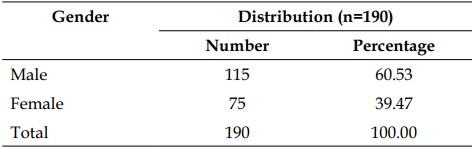
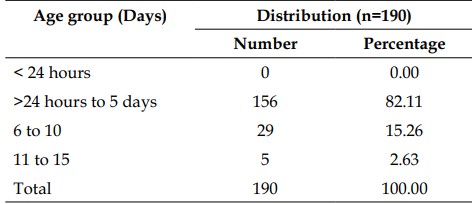
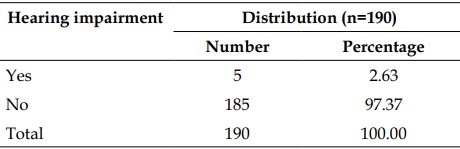
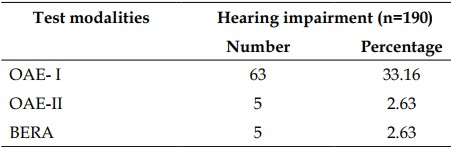
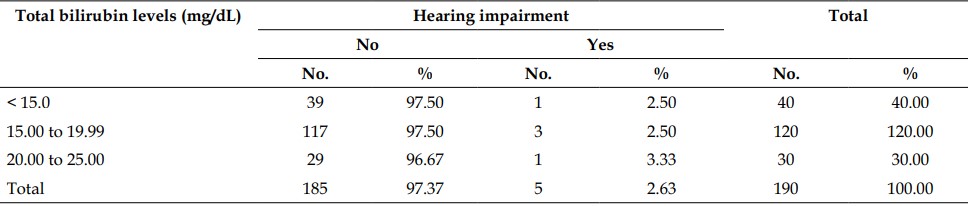
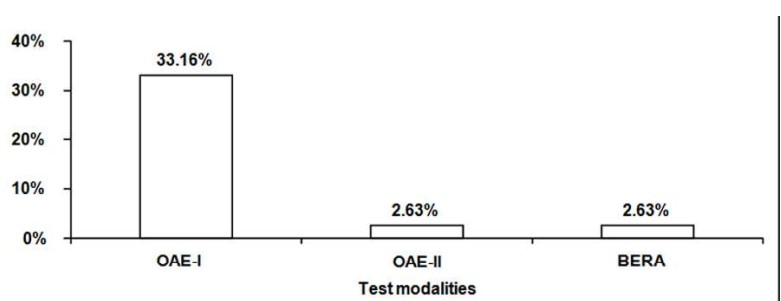
Background and Objectives: Hyperbilirubinemia is associated with hearing impairment. This study was aimed to evaluate the incidence of hearing impairment among the term neonates with hyperbilirubinemia by using otoacostic emission (OAE) and auditory brainstem response (ABR). Methods: This one year hospital based prospective observational study was conducted from October 2019 to March 2021. A Total of 190 healthy term neonates with hyperbilirubinemia admitted under the department of pediatrics, Mahadevappa Rampure Medical College, Kalaburagi during the study period were studied. Results: Most of the neonates were boys (60.53%) and boy to girl ratio was 1.53:1. History of consanguineous marriage was noted in 6.32% of the parents. The mean age was 4.73±2.65 days. Majority of the neonates (97.37%) weighed between 2.5 to 3.5 Kg. The mean birth weight was 2.84±0.84 Kg. The mean direct bilirubin levels were 0.88±29 mg/dL and mean total bilirubin levels were 17.3±2.58 mg/dL. During OAE-I, 33.16% of the neonates were advised to refer for second OAE and during OAE-II, 2.63% of the neonates were advised to undergo BERA. The incidence of hearing impairment based on BERA findings was 2.63%. 60.53% of the babies were born by LSCS while 39.47% were born through vaginal route and all the babies with hearing impairment had vaginal delivery while none of the baby with LSCS had hearing impairment (p=0.009). No association was found between hearing impairment in neonate with sex, age at admission and history of consanguineous marriage in parents and total bilirubin levels (p>0.050). Also the mean direct bilirubin, total bilirubin, birth weight, duration of NICU stay and age admission (p>0.050) were similar in babies with and without hearing impairment. Conclustion and Interpretation: The present study showed incidence of hearing impairment as 33.16% based on OAE examination and 2.63% based on BERA.
References
- 1. Jaundice and hyperbilirubinemia in the newborn. In: Behrman RE, Kliegman RM, Jenson HB, eds. Nelson Textbook of Pediatrics 21st ed. Philadelphia: Saunders, 2020:511–528.
- 2. Osuorah CDI, Ekwochi U, Asinobi IN. Clinical evaluation of severe neonatal Hyperbilirubinaemia in a resource-limited setting: a 4-year longitudinal study in southEast Nigeria. BMC Pediatr. 2018;18(1):202.
- 3. Vinodh M, Ambikapathy P, Aravind MA, Ganesh J. Reversibility of Brainstem Evoked Response Audiometry Abnormalities at 3 Months in Term Newborns with Hyperbilirubinemia. Indian Pediatr 2014;51:134-135.
- 4. Martínez -Cruz CF, Alonso-Themann PG, Poblano A, Cedillo-Rodríguez IA. Hearing and Neurological Impairment in Children with History of Exchange Transfusion for Neonatal Hyperbilirubinemia. International J Pediatr 2014;Article ID 605828:7 pages.
- 5. American Academy of Pediatrics, Joint Committee on Infant Hearing. Year 2007 position statement: principles and guidelines for early hearing detection and intervention programs. Pediatrics 2007;120(4):898-921.
- 6. Mirajkar S, Rajadhyaksha S. Hearing Evaluation of Neonates with Hyperbilirubinemia by Otoacoustic Emissions and Brain Stem Evoked Response Audiometry. J. Nepal Paediatr Soc 2016;36(3):310-3.
- 7. American Academy of Pediatrics Subcommittee on Hyperbilirubinemia;. Management of hyperbilirubinemia in the newborn infant 35 or more weeks of gestation. Pediatrics 2004;114 (1):297-316.
- 8. Hulzebos CV, van Dommelen P, Verkerk PH, Dijk PH, Van Straaten HLM. Evaluation of treatment thresholds for unconjugated hyperbilirubinemia in preterm infants: effects on serum bilirubin and on hearing loss? PLoS One 2013;8:e62858.
- 9. Paulraj MP, Subramaniam K, Yaccob SB, Adom AH, Hema CR. Auditory evoked potential response and hearing loss: a review. Open Biomed Eng J 2015;9:17-24.
- 10. Shankar P, Manjunath V. Study of hearing evaluation for neonates with hyperbilirubinemia using otoacoustic emissions and brain stem auditory evoked response. J of Evolution of Med and Dent Sci 2014;3(10):2403-7.
Data Sharing Statement
There are no additional data available. All raw data and code are available upon request.
Funding
This research received no funding.
Author Contributions
All authors contributed significantly to the work and approve its publication.
Ethics Declaration
This article does not involve any human or animal subjects, and therefore does not require ethics approval.
Acknowledgements
We would like to express our gratitude to the patients, their families, and all those who have contributed to this study.
Conflicts of Interest
No conflicts of interest in this work.
About this article

Cite this article
Basavaraj Patil, Aishwarya B, Rudrakshi Itagi, et al./Screening of Neonates with Hyperbilirubinemia for Sensorineural Deafness /Int J Pediatr Nurs. 2022;8(2):45–50.
Licence:
Attribution-Non-commercial 4.0 International (CC BY-NC 4.0)This license enables reusers to distribute, remix, adapt, and build upon the material in any medium or format for noncommercial purposes only, and only so long as attribution is given to the creator.
| Received | Accepted | Published |
|---|---|---|
| April 14, 2022 | May 15, 2022 | August 30, 2022 |
DOI: https://doi.org/10.21088/ijpen.2454.9126.8222.4
Keywords
Auditory brainstem responseHearing impairmentHyperbilirubinemiaSearch for Similar Articles
Similar Articles
- Craniosynostosis with Midfacial Hypoplasia and Bilateral Choanal Atresia Present...
- Pediatric Bone Disorders: Interpretation Challenges of Vitamin D and Calcium
- Care of Neonates Under Phototherapy: A Narrative Review on the Impact of Phototh...
- Effectiveness of Structured Teaching Program on Knowledge Regarding Text Neck Sy...
- Hemostatic Testing in Critically Ill Infants and Children
Article Level Metrics
Last UpdatedTuesday 29 September 2026, 13:48:31 (IST)
1498
Accesses
9
286
00
Citations
NA
NA
NA
Download citation
Article Keywords
Keyword Highlighting
Highlight selected keywords in the article text.
Timeline
| Received | April 14, 2022 |
| Accepted | May 15, 2022 |
| Published | August 30, 2022 |
licence
Attribution-Non-commercial 4.0 International (CC BY-NC 4.0)
This license enables reusers to distribute, remix, adapt, and build upon the material in any medium or format for noncommercial purposes only, and only so long as attribution is given to the creator.