Full Text (PDF)
New Indian Journal of Surgery 14(1):p 33-35, January-March 2023. | DOI: https://dx.doi.org/10.21088/nijs.0976.4747.14123.5
Case Report
Ruptured Liver Abscess in Children: A Rare Case Presentation
Jignal Kumar P. Sonavale, Kalara Dhaval Kumar
Author Information
Licence:
Attribution-Non-commercial 4.0 International (CC BY-NC 4.0)This license enables reusers to distribute, remix, adapt, and build upon the material in any medium or format for noncommercial purposes only, and only so long as attribution is given to the creator.
New Indian Journal of Surgery 14(1):p 33-35, January-March 2023. | DOI: https://dx.doi.org/10.21088/nijs.0976.4747.14123.5
How Cite This Article:
Kumar KD, Sonavale JKP. Ruptured liver abscess in children: a rare case presentation. New Indian J Surg. 2023;14(1):33-35.Timeline
Received : December 08, 2022
Accepted : January 07, 2023
Published : March 28, 2023
Abstract
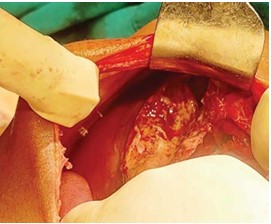
Liver abscess is a common condition in tropical countries and is associated with significant morbidity and mortality. Traditionally, there are two major classifications of hepatic abscess; pyogenic and amoebic. There are various complications associated with hepatic abscesses, of which, rupture of the abscess is the most common. Intraperitoneal rupture of liver abscess is a rare but potentially fatal disease. Accurate preoperative diagnosis is difficult and often necessitates exploratory laparotomy for peritonitis. Improving imaging techniques have aided the CLInicians in the diagnosis of hepatic abscesses and have subsequently become important treatment tools, the demographics of the hepatic abscess have changed. Though open surgery still remains most commonly used management modality, with advent of minimally invasive surgery. Thus, multiple management options are available today and ruptured liver abscess is a preventable and manageable. No specific guidelines are available for choosing the modality of treatment. Thus, this article purpose is to report a case of a patient that presented with acute abdomen at the emergency caused by a rupture liver abscess. A 7 year old male child presented to the Emergency Department due to severe abdominal pain during the last 7 days. The pain was located in the RHC, associated with constipation and three to four episodes of vomiting. On physical examination, generalized abdominal tenderness was present without any guarding or rigidity and no abdominal lump palpable. There were no signs of peritonitis. Blood tests including complete blood count, serum electrolytes, bilirubin, and liver and kidney function tests were performed which were unremarkable and showed no other abnormalities. Prothrombin time, partial thromboplastin time and INR (International Normalized Ratio) were normal. In our case in diagnostic laparoscopy after initial abdomen exploration around 200cc purulent fluid filled peritoneal cavity noted and ruptured liver abscess diagnosis confirmed so diagnostic laparoscopy converted to exploratory laparotomy. Peritoneal lavage given with approx 1500cc warm saline.and metronidazole wash is also given.after clearing all toxic fluid and. All abdominal organs examined and layer wise closing done. The total operative time was 120 minutes and our patient’s post-operative period was unevetful. He was discharged on the seven post-operative day.
References
- 1. Mishra K, Basu S, Roychoudhury S, Kumar P. Liver abscess in children an overview. World J Pediatr. 2010 Aug;6(3):210–216.
- 2. Hendricks MK, Moore SW, Millar AJ. Epidemiological aspects of liver abscesses in children in the Western Cape Province of South Africa. J Trop Pediatr. 1997 Apr;43(2):103–105.
- 3. Guittet V, Ménager C, Missotte I, Duparc B, Verhaegen F, Duhamel JF. Hepatic abscesses in childhood: retrospective study about 33 cases observed in New-Caledonia between 1985 and 2003. Arch Pediatr. 2004 Sep;11(9):1046–1053.
- 4. Moore SW, Millar AJ, Cywes S. Conservative initial treatment for liver abscesses in children. Br J Surg. 1994 Jun;81(6):872–874.
- 5. Kumar A, Srinivasan S, Sharma AK. Pyogenic liver abscess in children - South Indian experiences. J Pediatr Surg. 1998 Mar;33(3):417–421.
Data Sharing Statement
There are no additional data available.
Funding
This research received no funding
Author Contributions
All authors contributed significantly to the work and approve its publication.
Ethics Declaration
This article does not involve any human or animal subjects, and therefore does not require ethics approval
Acknowledgements
Information Not Provided
Conflicts of Interest
No conflicts of interest in this work.
About this article

Cite this article
Kumar KD, Sonavale JKP. Ruptured liver abscess in children: a rare case presentation. New Indian J Surg. 2023;14(1):33-35.
Licence:
Attribution-Non-commercial 4.0 International (CC BY-NC 4.0)This license enables reusers to distribute, remix, adapt, and build upon the material in any medium or format for noncommercial purposes only, and only so long as attribution is given to the creator.
| Received | Accepted | Published |
|---|---|---|
| December 08, 2022 | January 07, 2023 | March 28, 2023 |
DOI: https://dx.doi.org/10.21088/nijs.0976.4747.14123.5
Keywords
Ruptured liver abscessPediatrics age groupPediatrics Surgery Payogenic liver abscess.Pediatrics age groupPediatrics Surgery Payogenic liver abscess.Search for Similar Articles
Similar Articles
- Laparoscopy-Guided Bilateral Oblique Subcostal Transversus Abdominis Plane Bloc...
- Recognizing the Columnar Cell Subtype of Papillary Thyroid Carcinoma: A Case Rep...
- Randomized Controlled Study To Compare Intraperitoneal Plus Port-Site Instillat...
- Single Preoperative Dose Versus Conventional Multidose Antibiotic Prophylaxis In...
- To Compare the Dissection of Gallbladder by Ultrasonic Harmonic Scalpel Versus...
Article Level Metrics
Last UpdatedTuesday 29 September 2026, 14:35:14 (IST)
5232
Accesses
16
437
00
Citations
NA
NA
NA
Download citation
Article Keywords
Keyword Highlighting
Highlight selected keywords in the article text.
Timeline
| Received | December 08, 2022 |
| Accepted | January 07, 2023 |
| Published | March 28, 2023 |
licence
Attribution-Non-commercial 4.0 International (CC BY-NC 4.0)
This license enables reusers to distribute, remix, adapt, and build upon the material in any medium or format for noncommercial purposes only, and only so long as attribution is given to the creator.