Full Text (PDF)
Indian Journal of Medical and Health Sciences 9(2):p 57-63, July-December 2022. | DOI: https://doi.org/10.21088/ijmhs.2347.9981.9222.4
Original Article
Role of SWCR Guidelines in the Management of Hand Injury
Ravi Kumar Chittoria, Dripta Ramya Sahoo, Barath Kumar Singh P
Author Information
Licence:
Attribution-Non-commercial 4.0 International (CC BY-NC 4.0)This license enables reusers to distribute, remix, adapt, and build upon the material in any medium or format for noncommercial purposes only, and only so long as attribution is given to the creator.
Indian Journal of Medical and Health Sciences 9(2):p 57-63, July-December 2022. | DOI: https://doi.org/10.21088/ijmhs.2347.9981.9222.4
How Cite This Article:
Dripta Ramya Sahoo, Ravi Kumar Chittoria, Barath Kumar Singh P/Role of SWCR Guidelines in the Management of Hand Injury/Indian Journal of Medical & Health Sciences. 2022;9(2):57–63.Timeline
Received : October 10, 2022
Accepted : November 03, 2022
Published : December 30, 2022
Abstract
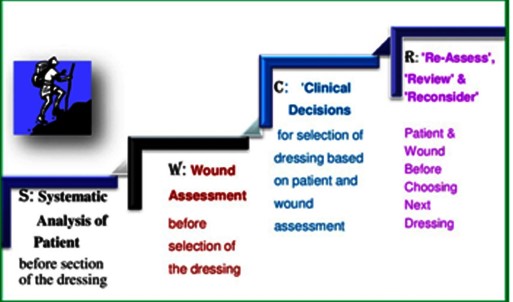
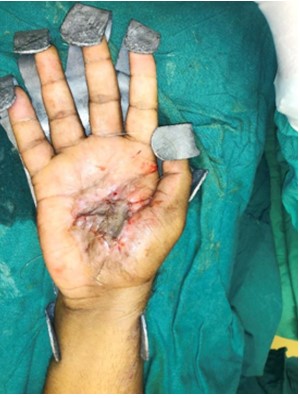
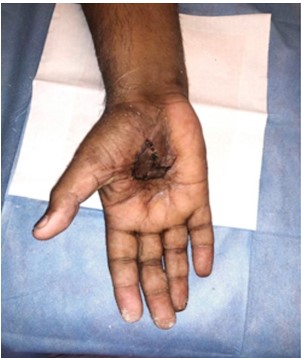
Society for Wound Care and Research was founded with the aim of promoting practice of better wound care and research. The society carries out academic, clinical, research and social activities in a calculated manner aimed at improving wound healing. SWCR guidelines has 4 components with the acronym SWCR where S stands for systematic analysis of patient and wound, W for wound bed preparation, C for clinical decisions and R for repair, reconstruct & rehabilitate. Hand injury is a commonly seen and a leading causeof work related disability. Appropriate wound management and meticulous reconstruction followed by rehabilitation in a systematic manner is of utmost importance in these patients to improve quality of life and return to work in them. Injuries of the hand are particularly challenging from the view point of healing and reconstruction as they require restoration of both functionality and aesthetics. These difficulties can be overcome by systematically approaching the wound through SWCR guidelines. This review article provides a summary of the benefits of using SWCR guidelines in the management of handinjuries.
References
- 1. Gaul JS. Identifiable costs and tangible benefits resulting from the treatment of acute injuries of the hand. J Hand Surg Am. 1987; 12(5 Pt 2):966-70.
- 2. Burke FD, Dias JJ, Lunn PG, Bradley M. Providing care for hand disorders: trauma and elective. J Hand Surg Br. 1991; 16(1):13-8.
- 3. Trybus M, Lorkowski J, Brongel L, Hladki W. Causes and consequences of hand injuries. Am J Surg. 2006; 192(1):52-7.
- 4. De Putter CE, Selles RW, Haagsma JA, Polinder S, Panneman MJM, Hovius SER, et al. Health-related quality of life after upper extremity injuries and predictors for suboptimal outcome. Injury. 2014; 45(11):1752-8.
- 5. Zárate-Ramírez JG, Espinosa-Gutiérrez A. ¿Cuántovalenlaslesiones de la mano? ActaOrtop Mex. 2013; 27(5):345-349.
- 6. Ootes D, Lambers KT, Ring DC. The epidemiology of upper extremity injuries presenting to the emergency department in the United States. Hand (NY). 2012; 7(1): 18-22.
- 7. Grivna M, Eid HO, Abu-Zidan FM. Epidemiology of isolated hand injuries in the United Arab Emirates. World J Orthop. 2016; 7(9):570-6.
- 8. Wen HsuanHou, Ching Chi Chi, Heng Lien Lo, Yun Yun Chou, Ken NKuo, Hung YiChuang. Vocational rehabilitation for enhancing return to work in workerswith traumatic upper limb injuries. Cochrane Database of Systematic Reviews 2017, Issue12.
- 9. Briggs M, Nelson EA. Topical agents or dressings for pain in venous leg ulcers. Cochrane Database Syst Rev.2003;1:CD001177.
- 10. Abbade LP, Lastória S. Venous ulcer: epidemiology, physiopathology, diagnosis and treatment. Int J Dermatol.2005;44(6):449-56.
- 11. Mathes SJ, Nahai F. Reconstructive Surgery: Principles, Anatomy & Technique. Vol. 2. New York: Churchill Livingstone; St. Louis: Quality Medical;1997.
- 12. Gottlieb LJ, Krieger LM. From the reconstructive ladder to the reconstructive elevator. PlastReconstr Surg. 1994;93:1503–4.
- 13. Mohapatra, Devi Prasad M.Ch.; Thiruvoth, FrijiMeethale M.Ch. Reconstruction 2.0: Restructuring the Reconstructive Ladder, Plastic and Reconstructive Surgery: March 2021 - Volume 147 - Issue 3 - p572e-3e.
- 14. Lahiri A. Managing Mutilating Hand Injuries. Clin Plastic Surg. 2019; 46:351–7.
- 15. Midgley RD, Entin MA. Management of mutilating injuries of the hand. ClinPlastSurg 1976;3(1):99–109.
- 16. Moran SL, Berger RA. Biomechanics and hand trauma: what you need. Hand Clin 2003;19(1): 17–31.
- 17. Wu W, Naim JO, Lanzafame RJ. The effect of laser irrafiation on the release of bFGF from 3T3 fibroblasts. PhotochemPhotobiol.1994;59(2):167–70.
- 18. Vinck EM, Cagnie BJ, Cornelissen MJ, Declercq HA, Cambier DC. Increased fibroblast proliferation induced by light emitting diode and low power laser irradiation. Lasers Med Sci.2003;18(2):95–9.
- 19. Frigo L, Fávero GM, Lima HJ, Maria DA, Bjordal JM, et al. Low-level laser irradiation (InGaAlP-660 nm) increases fibroblast cell proliferation and reduces cell death in a dose-dependent manner. Photomed Laser Surg. 2010;28(Suppl 1):151–6.
- 20. Basso FG, Oliveira CF, Kurachi C, Hebling J, Costa CA. Biostimulatory effect of low-level laser therapy on keratinocytes in vitro. Lasers Med Sci.2013;28(2):367–374.
- 21. Sureshbabu A, Okajima H, Yamanaka D, Shastri S, Tonner E, Rae C, et al. IGFBP-5 induces epithelial and fibroblast responses consistent with the fibrotic response. BiochemSoc Trans2009;37:882-5.
- 22. Vedder NB. Wei FC, Mardini S, eds. Problem analysis in reconstructive surgery: Reconstructive ladders, elevators, and surgical judgment. In: Flaps and Reconstructive Surgery. 2017:2nd ed. Toronto: Elsevier;1–5.
- 23. Turner NJ, Badylak SF. Biologic scaffolds for musculotendinous tissue repair. Eur. Cell Mater. 25, 130–143(2013).
- 24. Tenenhaus M, Rennekampff HO. Surgical advances in burn and reconstructive plastic surgery: new and emerging technologies. Clin. Plast. Surg. 39(4), 435–443(2012).
- 25. Saurabgupta et al. Effect Of Low Level Laser Therapy (Lllt) On The Severity Of Post-Burn Immature Scars: A Randomized Control Study. International Journal of Clinical And Diagnostic Research Volume 8, Issue 1, Jan-Feb2020.
Data Sharing Statement
There are no additional data available. All raw data and code are available upon request.
Funding
This research received no funding.
Author Contributions
All authors contributed significantly to the work and approve its publication.
Ethics Declaration
This article does not involve any human or animal subjects, and therefore does not require ethics approval.
Acknowledgements
We would like to express our gratitude to the patients, their families, and all those who have contributed to this study.
Conflicts of Interest
No conflicts of interest in this work.
About this article

Cite this article
Dripta Ramya Sahoo, Ravi Kumar Chittoria, Barath Kumar Singh P/Role of SWCR Guidelines in the Management of Hand Injury/Indian Journal of Medical & Health Sciences. 2022;9(2):57–63.
Licence:
Attribution-Non-commercial 4.0 International (CC BY-NC 4.0)This license enables reusers to distribute, remix, adapt, and build upon the material in any medium or format for noncommercial purposes only, and only so long as attribution is given to the creator.
| Received | Accepted | Published |
|---|---|---|
| October 10, 2022 | November 03, 2022 | December 30, 2022 |
DOI: https://doi.org/10.21088/ijmhs.2347.9981.9222.4
Keywords
Hand injurySWCRGuidelinesManagementSearch for Similar Articles
Similar Articles
- Wound Assessment using a Smartphone-based Application: Imitomeasure in Pressure...
- Emerging Pandemic and Silent Killer – Non Aloholic Fatty Liver Disease: A Compr...
- Prenatal and Postnatal Healthcare in Odisha
- Assessment of Diabetic Foot Ulcers: A Review
- IBS – Irritable Bowel Syndrome – Management through Comprehensive Non-Pharmacolo...
Article Level Metrics
Last UpdatedSaturday 24 October 2026, 08:23:28 (IST)
1895
Accesses
8
404
00
Citations
NA
NA
NA
Download citation
Article Keywords
Keyword Highlighting
Highlight selected keywords in the article text.
Timeline
| Received | October 10, 2022 |
| Accepted | November 03, 2022 |
| Published | December 30, 2022 |
licence
Attribution-Non-commercial 4.0 International (CC BY-NC 4.0)
This license enables reusers to distribute, remix, adapt, and build upon the material in any medium or format for noncommercial purposes only, and only so long as attribution is given to the creator.