Full Text (PDF)
Journal of Psychiatric Nursing 15(2):p 88-95, May-August 2026. | DOI: https://doi.org/10.21088/jpn.2277.9035.15226.4
Review Article
Role of Pediatric Nurses in the Early Identification of Autism Spectrum Disorder (ASD): A Review
Dinesh Sharma, Himanshu Dadhich, C. P. Meena
Author Information
Licence:
Attribution-Non-commercial 4.0 International (CC BY-NC 4.0)This license enables reusers to distribute, remix, adapt, and build upon the material in any medium or format for noncommercial purposes only, and only so long as attribution is given to the creator.
Journal of Psychiatric Nursing 15(2):p 88-95, May-August 2026. | DOI: https://doi.org/10.21088/jpn.2277.9035.15226.4
How Cite This Article:
Himanshu Dadhich, C. P. Meena, Dinesh Sharma. Role of Pediatric Nurses in the Early Identification of Autism Spectrum Disorder (ASD): A Review. J Psychiatr Nurs. 2026; 15(2): 88–95.Timeline
Received : June 18, 2026
Accepted : July 20, 2026
Published : August 30, 2026
Abstract
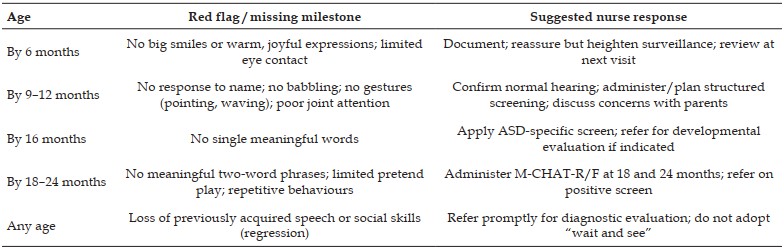
Autism spectrum disorder (ASD) is a lifelong neurodevelopmental condition characterised by persistent difficulties in social communication and interaction, together with restricted, repetitive patterns of behaviour, interests or activities. Its reported prevalence has risen markedly over the past two decades; the most recent surveillance data from the United States estimate that about one in thirtyone eight-year-old children is identified with ASD, and Indian community studies report a substantial, often under-recognised burden. Although reliable diagnosis is possible by the age of two years and the core features frequently emerge in the second year of life, many children are still not identified until they are four or five years old or older, delaying access to the early intervention that most strongly predicts good outcomes. Pediatric nurses are uniquely placed to narrow this gap. They have repeated, trusted contact with infants, toddlers and their caregivers during immunisation, well-child and growth-monitoring visits, in the community and in schools, and they are therefore ideally positioned to monitor developmental milestones, to elicit and take seriously parental concerns, to administer validated screening tools such as the Modified Checklist for Autism in Toddlers, Revised with Follow-up (M-CHAT-R/F), to recognise early behavioural red flags, to make timely referrals for diagnostic evaluation and early-intervention services, and to educate, counsel and support families while reducing stigma. This review describes the nature, epidemiology and early manifestations of ASD, the rationale for early identification, and the recommended framework of developmental surveillance and screening. It then sets out, in a structured and practical way, the role of the pediatric nurse in early identification, including a developmental red-flag guide and a discussion of the Indian context. It is intended as a practical resource for nurses, nursing students and allied child-health professionals.
References
- 1. American Psychiatric Association. Diagnostic and Statistical Manual of Mental Disorders, 5th ed., Text Revision (DSM-5-TR). Washington, DC: American Psychiatric Association Publishing; 2022.
- 2. Lord C, Brugha TS, Charman T, Cusack J, Dumas G, Frazier T, et al. Autism spectrum disorder. Nat Rev Dis Primers. 2020;6(1):5.
- 3. Hyman SL, Levy SE, Myers SM; Council on Children with Disabilities, Section on Developmental and Behavioral Pediatrics. Identification, evaluation, and management of children with autism spectrum disorder. Pediatrics. 2020;145(1):e20193447.
- 4. Shaw KA, Williams S, Patrick ME, ValenciaPrado M, Durkin MS, Howerton EM, et al. Prevalence and early identification of autism spectrum disorder among children aged 4 and 8 years – Autism and Developmental Disabilities Monitoring Network, 16 sites, United States, 2022. MMWR Surveill Summ. 2025;74(2):1–22.
- 5. Maenner MJ, Warren Z, Williams AR, Amoakohene E, Bakian AV, Bilder DA, et al. Prevalence and characteristics of autism spectrum disorder among children aged 8 years – Autism and Developmental Disabilities Monitoring Network, 11 sites, United States, 2020. MMWR Surveill Summ. 2023;72(2):1–14.
- 6. Arora NK, Nair MKC, Gulati S, Deshmukh V, Mohapatra A, Mishra D, et al. Neurodevelopmental disorders in children aged 2–9 years: population-based burden estimates across five regions in India. PLoS Med. 2018;15(7):e1002615.
- 7. Rudra A, Belmonte MK, Soni PK, Banerjee S, Mukerji S, Chakrabarti B. Prevalence of autism spectrum disorder and autistic symptoms in a school-based cohort of children in Kolkata, India. Autism Res. 2017;10(10):1597–1605.
- 8. Chauhan A, Sahu JK, Jaiswal N, Kumar K, Agarwal A, Kaur J, et al. Prevalence of autism spectrum disorder in Indian children: a systematic review and meta-analysis. Neurol India. 2019;67(1):100–104.
- 9. Zwaigenbaum L, Bauman ML, Stone WL, Yirmiya N, Estes A, Hansen RL, et al. Early identification of autism spectrum disorder: recommendations for practice and research. Pediatrics. 2015;136(Suppl 1):S10–S40.
- 10. Lipkin PH, Macias MM; Council on Children with Disabilities, Section on Developmental and Behavioral Pediatrics. Promoting optimal development: identifying infants and young children with developmental disorders through developmental surveillance and screening. Pediatrics. 2020;145(1):e20193449.
- 11. Robins DL, Casagrande K, Barton M, Chen CMA, Dumont-Mathieu T, Fein D. Validation of the Modified Checklist for Autism in Toddlers, Revised with Follow-up (M-CHATR/F). Pediatrics. 2014;133(1):37–45.
- 12. van ’t Hof M, Tisseur C, van BerckelaerOnnes I, van Nieuwenhuyzen A, Daniels AM, Deen M, et al. Age at autism spectrum disorder diagnosis: a systematic review and meta-analysis from 2012 to 2019. Autism. 2021;25(4):862–873.
- 13. Dawson G, Rogers S, Munson J, Smith M, Winter J, Greenson J, et al. Randomized, controlled trial of an intervention for toddlers with autism: the Early Start Denver Model. Pediatrics. 2010;125(1):e17–e23.
- 14. Zwaigenbaum L, Bryson S, Garon N. Early identification of autism spectrum disorders. Behav Brain Res. 2013;251:133–146.
- 15. World Health Organization. International Statistical Classification of Diseases and Related Health Problems, 11th Revision (ICD-11). Geneva: World Health Organization; 2019.
- 16. World Health Organization. Autism: fact sheet. Geneva: World Health Organization; 2023.
- 17. US Preventive Services Task Force. Screening for autism spectrum disorder in young children: US Preventive Services Task Force recommendation statement. JAMA. 2016;315(7):691–696.
- 18. Hockenberry MJ, Wilson D, Rodgers CC. Wong’s Nursing Care of Infants and Children. 11th ed. St. Louis: Elsevier; 2019.
- 19. Sreevani R. A Guide to Mental Health and Psychiatric Nursing. 4th ed. New Delhi: Jaypee Brothers Medical Publishers; 2016.
- 20. Ministry of Health and Family Welfare, Government of India. Rashtriya Bal Swasthya Karyakram (RBSK): operational guidelines. New Delhi: Ministry of Health and Family Welfare; 2013.
Data Sharing Statement
There are no additional data available. All raw data and code are available upon request.
Funding
This research received no funding.
Author Contributions
All authors contributed significantly to the work and approve its publication.
Ethics Declaration
This article does not involve any human or animal subjects, and therefore does not require ethics approval.
Acknowledgements
We would like to express our gratitude to the patients, their families, and all those who have contributed to this study.
Conflicts of Interest
No conflicts of interest in this work.
About this article

Cite this article
Himanshu Dadhich, C. P. Meena, Dinesh Sharma. Role of Pediatric Nurses in the Early Identification of Autism Spectrum Disorder (ASD): A Review. J Psychiatr Nurs. 2026; 15(2): 88–95.
Licence:
Attribution-Non-commercial 4.0 International (CC BY-NC 4.0)This license enables reusers to distribute, remix, adapt, and build upon the material in any medium or format for noncommercial purposes only, and only so long as attribution is given to the creator.
| Received | Accepted | Published |
|---|---|---|
| June 18, 2026 | July 20, 2026 | August 30, 2026 |
DOI: https://doi.org/10.21088/jpn.2277.9035.15226.4
Keywords
Autism Spectrum DisorderEarly IdentificationDevelopmental ScreeningDevelopmental SurveillanceM-Chat-R/FPediatric NursingEarly InterventionSearch for Similar Articles
Similar Articles
- Mental Status Examination: A Comprehensive Guide for Nursing Assessment in Psych...
- A Comparative Study to assess the Behavioural Problems of School Children Betwee...
- Effectiveness of Cold Pack Application in Reducing Pain During Intramuscular Inj...
- Effectiveness of Workplace Mental Wellness Program on Knowledge and Perception R...
- Nursing Management of Postpartum Depression among New Mothers
Article Level Metrics
Last UpdatedTuesday 27 October 2026, 01:15:23 (IST)
2106
Accesses
29
281
00
Citations
NA
NA
NA
Download citation
Article Keywords
Keyword Highlighting
Highlight selected keywords in the article text.
Timeline
| Received | June 18, 2026 |
| Accepted | July 20, 2026 |
| Published | August 30, 2026 |
licence
Attribution-Non-commercial 4.0 International (CC BY-NC 4.0)
This license enables reusers to distribute, remix, adapt, and build upon the material in any medium or format for noncommercial purposes only, and only so long as attribution is given to the creator.