Full Text (PDF)
Journal of Psychiatric Nursing 15(3):p 117-121, September - December 2026. | DOI: https://doi.org/10.21088/jpn.2277.9035.15326.2
Original Article
Effectiveness of Cold Pack Application in Reducing Pain During Intramuscular Injection Among Adult Patients: A Quasi-Experimental Study
T. Panis Kala Thilagam, J. Jenifer
Author Information
Licence:
Attribution-Non-commercial 4.0 International (CC BY-NC 4.0)This license enables reusers to distribute, remix, adapt, and build upon the material in any medium or format for noncommercial purposes only, and only so long as attribution is given to the creator.
Journal of Psychiatric Nursing 15(3):p 117-121, September - December 2026. | DOI: https://doi.org/10.21088/jpn.2277.9035.15326.2
How Cite This Article:
T. Panis Kala Thilagam, J. Jenifer. Effectiveness of Cold Pack Application in Reducing Pain During Intramuscular Injection Among Adult Patients: A Quasi-Experimental Study. J Psychiatr Nurs. 2026; 15(3): 117–121.Timeline
Received : September 15, 2026
Accepted : October 17, 2026
Published : December 30, 2026
Abstract
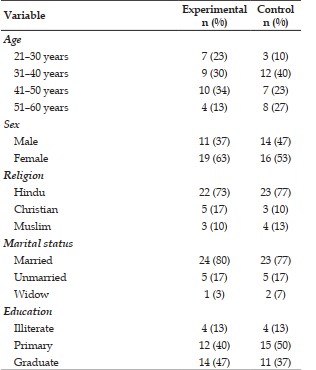
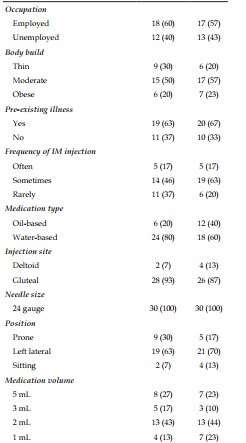
Context: Intramuscular (IM) injection is a common clinical procedure associated with short-term pain. Cold application is a simple, low-cost non-pharmacological method proposed to reduce this discomfort, but rigorous evidence specific to the cold-pack method remains limited. Aims: To evaluate the effectiveness of cold pack application in reducing pain during IM injection among adult outpatients, and to examine associations between pain level and selected demographic and clinical variables. Settings and Design: Quantitative, quasi-experimental, post-test-only controlgroup design conducted in the outpatient department of a hospital in Coimbatore, Tamil Nadu, India. Methods and Material: Sixty adults receiving IM injection were allocated by nonprobability convenience sampling to an experimental group (cold pack applied at the injection site, n=30) or a control group (routine IM injection, n=30). Pain was assessed immediately after injection using a structured pain-assessment instrument. As the original participant-level dataset is no longer available, this report presents the historically recorded group-level results rather than newly generated data. Statistical analysis used: Descriptive statistics, unpaired t test, and chi-square test, as recorded in the original study record; these inferential values could not be independently recalculated. Results: The reported post-test mean pain score was 1.68 in the experimental group and 4.34 in the control group (mean difference 2.66; unpaired t = 4.02, p<0.01). Age was reportedly associated with pain level in the experimental group; no variable examined was significantly associated with pain in the control group. Conclusions: The historical results suggest cold pack application may lower pain during IM injection, consistent in direction with published evidence on local cold interventions. Because participant-level data and some methodological details are unavailable, findings should be treated as historical and confirmed by adequately powered, prospectively documented trials.
References
- 1. Raja SN, Carr DB, Cohen M, Finnerup NB, Flor H, Gibson S, et al. The revised International Association for the Study of Pain definition of pain: concepts, challenges, and compromises. Pain. 2020;161(9):1976-1982.
- 2. World Health Organization. WHO best practices for injections and related procedures toolkit. Geneva: World Health Organization; 2010.
- 3. Durgun H, Şirin FA, Dalcalı BK. The impact of cold application on pain reduction in adult patients receiving intramuscular injections: a systematic review. Florence Nightingale J Nurs. 2025;33:1-8.
- 4. Bilge S, Aydin A, Gun C, Aldinc H, Acar YA, Yaylaci S, et al. Comparison of the efficacy of ShotBlocker and cold spray in reducing intramuscular injection-related pain in adults: a prospective, randomized, controlled trial. Saudi Med J. 2019;40(10):996-1002.
- 5. Gürdap Z, Cengiz Z. Comparison of cold spray and ShotBlocker to reduce intramuscular injection pain: a randomized controlled trial. J Clin Pharm Ther. 2022;47(8):1249-1256.
- 6. Williamson A, Hoggart B. Pain: a review of three commonly used pain rating scales. J Clin Nurs. 2005;14(7):798-804.
- 7. Hjermstad MJ, Fayers PM, Haugen DF, Caraceni A, Hanks GW, Loge JH, et al. Studies comparing numerical rating scales, verbal rating scales, and visual analogue scales for assessment of pain intensity in adults: a systematic literature review. J Pain Symptom Manage. 2011;41(6):1073-1093.
Data Sharing Statement
There are no additional data available. All raw data and code are available upon request.
Funding
This research received no funding.
Author Contributions
All authors contributed significantly to the work and approve its publication.
Ethics Declaration
This article does not involve any human or animal subjects, and therefore does not require ethics approval.
Acknowledgements
We would like to express our gratitude to the patients, their families, and all those who have contributed to this study.
Conflicts of Interest
No conflicts of interest in this work.
About this article

Cite this article
T. Panis Kala Thilagam, J. Jenifer. Effectiveness of Cold Pack Application in Reducing Pain During Intramuscular Injection Among Adult Patients: A Quasi-Experimental Study. J Psychiatr Nurs. 2026; 15(3): 117–121.
Licence:
Attribution-Non-commercial 4.0 International (CC BY-NC 4.0)This license enables reusers to distribute, remix, adapt, and build upon the material in any medium or format for noncommercial purposes only, and only so long as attribution is given to the creator.
| Received | Accepted | Published |
|---|---|---|
| September 15, 2026 | October 17, 2026 | December 30, 2026 |
DOI: https://doi.org/10.21088/jpn.2277.9035.15326.2
Keywords
Cold packIntramuscular injectionInjection painNon-pharmacological interventionNursingSearch for Similar Articles
Similar Articles
- Mental Status Examination: A Comprehensive Guide for Nursing Assessment in Psych...
- A Comparative Study to assess the Behavioural Problems of School Children Betwee...
- Effectiveness of Workplace Mental Wellness Program on Knowledge and Perception R...
- Nursing Management of Postpartum Depression among New Mothers
- Role of Pediatric Nurses in the Early Identification of Autism Spectrum Disorder...
Article Level Metrics
Last UpdatedMonday 26 October 2026, 14:49:29 (IST)
2100
Accesses
8
281
00
Citations
NA
NA
NA
Download citation
Article Keywords
Keyword Highlighting
Highlight selected keywords in the article text.
Timeline
| Received | September 15, 2026 |
| Accepted | October 17, 2026 |
| Published | December 30, 2026 |
licence
Attribution-Non-commercial 4.0 International (CC BY-NC 4.0)
This license enables reusers to distribute, remix, adapt, and build upon the material in any medium or format for noncommercial purposes only, and only so long as attribution is given to the creator.