Full Text (PDF)
Journal of Psychiatric Nursing 15(3):p 122-128, September - December 2026. | DOI: https://doi.org/10.21088/jpn.2277.9035.15326.3
Original Article
A Comparative Study to assess the Behavioural Problems of School Children Between Working and Nonworking Mothers in Selected Schools
Karamjeet Kaur, Gagandeep Singh
Author Information
Licence:
Attribution-Non-commercial 4.0 International (CC BY-NC 4.0)This license enables reusers to distribute, remix, adapt, and build upon the material in any medium or format for noncommercial purposes only, and only so long as attribution is given to the creator.
Journal of Psychiatric Nursing 15(3):p 122-128, September - December 2026. | DOI: https://doi.org/10.21088/jpn.2277.9035.15326.3
How Cite This Article:
Karamjeet Kaur, Gagandeep Singh. A Comparative Study to assess the Behavioural Problems of School Children Between Working and Nonworking Mothers In Selected Schools. J Psychiatr Nurs. 2026; 15(3): 122–128.Timeline
Received : September 05, 2026
Accepted : October 07, 2026
Published : December 30, 2026
Abstract
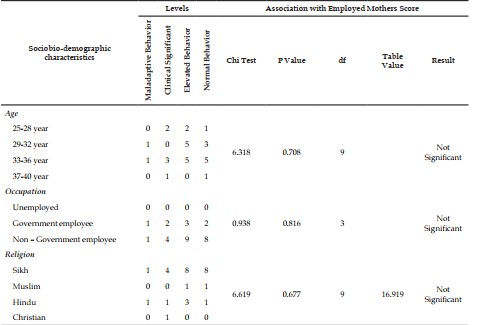
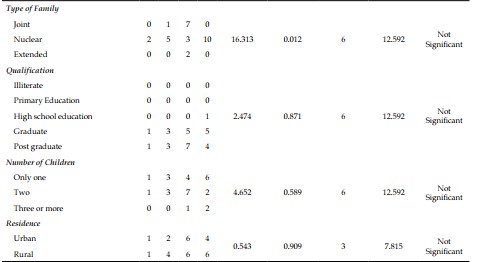
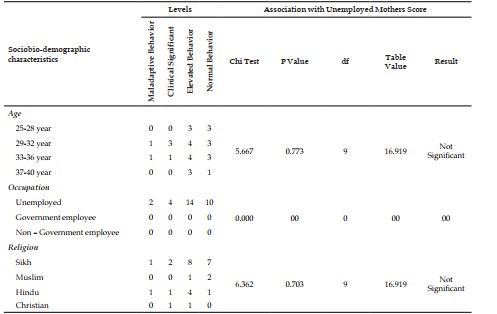
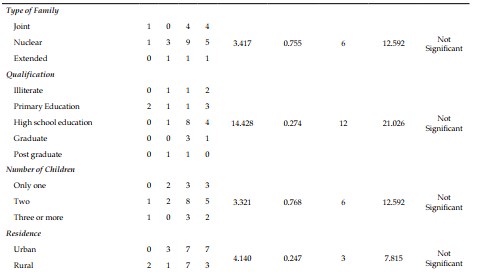
Background of the study: Children of today are the citizens of tomorrow. The common behavioural problems identified in school children includes Habit problems, Sleep problems, Speech problems, Scholastic problems, Psychosexual problems, Personality problems and Psycho social problems. The most common disruptive behaviour disorders include problems of eating, oppositional defiant disorder (ODD), conduct disorder (CD), and attention deficit hyperactivity disorder (ADHD). Methodology: The research design was descriptive and two groups are working and nonworking mothers. The sample size was 60. A tool i.e. modified Standardize tool was used to assess the behavioral problems. Result: It was found that in the mean of working mothers group is 19.40 and mean of nonworking mothers group is 18.63. The standard deviation of working mothers group is 3.047 and nonworking mothers group is 3.011. The df is 29, and the unpaired-test value is 0.980, and the table value is 2.002 and P value 0.331. So it was not significant. Conclusion: The study concluded that, no more comparison between behavioral problems among school children between working and nonworking mothers.
References
- 1. Alexander Ancy, Dr Shetty Asha P; A Comparative Study on Behavioral Problems of Preschool Children among Working and NonWorking Mothers; Journal of Nursing and Health Science; 2014;3(6):35-38.
- 2. Vijayalakshmi K, Kumar CV, Rajamanickam H, Cherian A. Child rearing practices and psychological problems in children. Nursing and Midwifery Research Journal 2007;3(2):49- 51.
- 3. Prakash Jyoti, Mitra A.K., and Prabhu H.R.A.; Child and Behaviour: A School Based Study; 2008;11(1):79-82.
- 4. Sharma R, Dharmawat M. Behavioral adjustment of pre adolescent children of working and non-working mothers. Indian Journal Social Science Researches 2009 Mar; 6(1):118-21.
- 5. Gupta Anindya Kumar, Mongia Monica, and Garg Ajoy Kumar: A descriptive study of behavioral problems in schoolgoing children, Industrial Psychiatric Journal;2017:26(1):91-94.
- 6. Perera H, Gunatunge C. Screening for mental health problems in urban preschool children- a pilot study. Sri Lanka Journal of Child Health 2004; 33 (2):39-42.
- 7. Huaqing C, Kaiser, Ann P. Behavior problems of preschool children from low income families. Topics in Early Childhood Special Education 2003 Dec; 23(4):188-216.
- 8. Gururaj G, Gurish N. Prevalence of behavioural problems in children of Karnataka. Indian Journal of Pediatrics.2007;74(2):1095-8.
- 9. Dr. Manivannan D., and Dr. Gopalan Srinivasa; A study to assess the knowledge regarding behavioral problems of school children among mothers; Journal of nursing and health science;2017:6(6):13-16.
- 10. Masare Monika S., Gokhe Seema S. Bansode, Shinde R. R.; A cross sectional study of behavioral problems of secondary school children and related socio-demographic factors;2017;5(6):2760-2766.
Data Sharing Statement
There are no additional data available. All raw data and code are available upon request.
Funding
This research received no funding.
Author Contributions
All authors contributed significantly to the work and approve its publication.
Ethics Declaration
The study was approved by the ethics committee and informed consent was obtained from all subjects prior to their participation.
Acknowledgements
We would like to express our gratitude to the patients, their families, and all those who have contributed to this study.
Conflicts of Interest
The authors declare that there is no competing interest regarding the research, authorship, and publication of this article.
About this article

Cite this article
Karamjeet Kaur, Gagandeep Singh. A Comparative Study to assess the Behavioural Problems of School Children Between Working and Nonworking Mothers In Selected Schools. J Psychiatr Nurs. 2026; 15(3): 122–128.
Licence:
Attribution-Non-commercial 4.0 International (CC BY-NC 4.0)This license enables reusers to distribute, remix, adapt, and build upon the material in any medium or format for noncommercial purposes only, and only so long as attribution is given to the creator.
| Received | Accepted | Published |
|---|---|---|
| September 05, 2026 | October 07, 2026 | December 30, 2026 |
DOI: https://doi.org/10.21088/jpn.2277.9035.15326.3
Keywords
Behavioural ProblemsSchool ChildrenWorking mothersNonworking mothersSearch for Similar Articles
Similar Articles
- Mental Status Examination: A Comprehensive Guide for Nursing Assessment in Psych...
- Effectiveness of Cold Pack Application in Reducing Pain During Intramuscular Inj...
- Effectiveness of Workplace Mental Wellness Program on Knowledge and Perception R...
- Nursing Management of Postpartum Depression among New Mothers
- Role of Pediatric Nurses in the Early Identification of Autism Spectrum Disorder...
Article Level Metrics
Last UpdatedMonday 26 October 2026, 14:50:11 (IST)
2100
Accesses
10
281
00
Citations
NA
NA
NA
Download citation
Article Keywords
Keyword Highlighting
Highlight selected keywords in the article text.
Timeline
| Received | September 05, 2026 |
| Accepted | October 07, 2026 |
| Published | December 30, 2026 |
licence
Attribution-Non-commercial 4.0 International (CC BY-NC 4.0)
This license enables reusers to distribute, remix, adapt, and build upon the material in any medium or format for noncommercial purposes only, and only so long as attribution is given to the creator.