Full Text (PDF)
Journal of Dermatology 8(1):p 43-47, January – June 2023. | DOI: na
Case Report
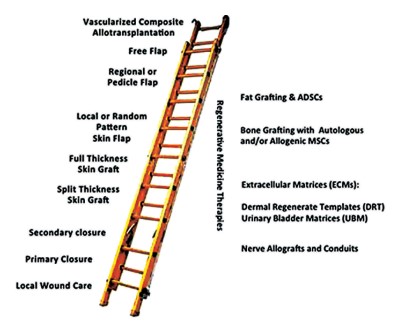
Role of Hybrid Reconstruction Ladder in Scald Burn
Ravi Kumar Chittoria, Kada Sri Vidhul, Barath Kumar Singh P
Author Information
Licence:
Attribution-Non-commercial 4.0 International (CC BY-NC 4.0)This license enables reusers to distribute, remix, adapt, and build upon the material in any medium or format for noncommercial purposes only, and only so long as attribution is given to the creator.
Journal of Dermatology 8(1):p 43-47, January – June 2023. | DOI: na
How Cite This Article:
Kada Sri Vidhul, Ravi Kumar Chittoria, Barath Kumar Singh P/Role of Hybrid Reconstruction Ladder in Scald Burn/RFP Journal of Dermatology 2023;8(1):43–47.Timeline
Received : December 31, 2022
Accepted : January 15, 2023
Published : June 25, 2023
Abstract
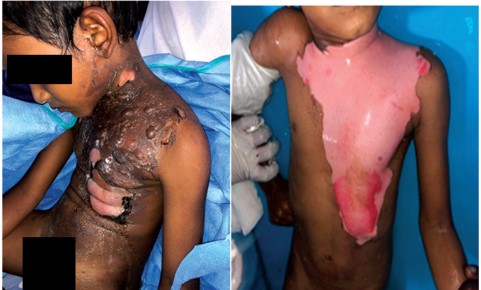
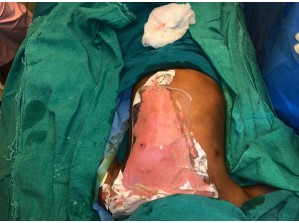
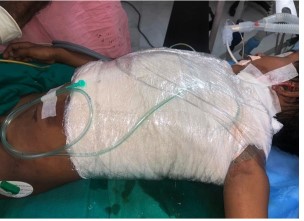
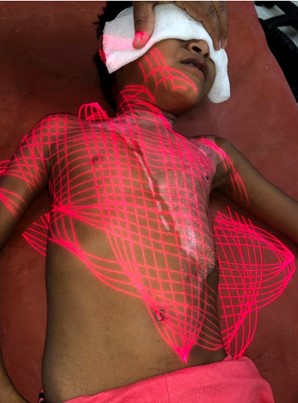
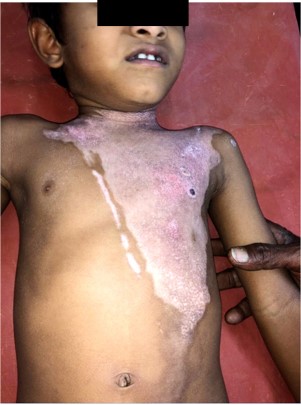
Burns and other related ailments frequently result in fatalities and disabilities. Children and adults suffer burn cases at a higher rate than other age groups. Contact with hot surfaces and scald burns are the most typical hospital presentations in toddlers under the age of two. Some of the factors include the custom of cooking on the ground or sleeping next to a burning candle. Better outcomes are seen when this sort of burns are treated quickly. In this instance, we discuss the use of a hybrid reconstruction ladder in the treatment of pediatric scald burns.
References
- 1. Tenenhaus M, Rennekampff HO. Surgical advances in burn and reconstructive plastic surgery: new and emerging technologies. Clin. Plast. Surg. 39(4), 435–443 (2012).
- 2. Salazar-Álvarez AE, Riera-del-Moral LF, GarcíaArranz M, Alvarez-García J, ConcepciónRodriguez NA, Riera-de-Cubas L: Use of plateletrich plasma in the healing of chronic ulcers of the lower extremity. ActasDermosifiliogr 2014; 105:597-604.
- 3. Picard F, Hersant B, Bosc R, Meningaud JP: Should we use platelet-rich plasma as an adjunct therapy to treat “acute wounds”, “burns”, and “laser therapies”: a review and a proposal of a quality criteria checklist for further studies. Wound Repair Regen 2015; 23:163-170.
- 4. Cobos R, Aizpuru F, Parraza N, Anitua E, Orive G: Effectiveness and efficiency of platelet rich plasma in the treatment of diabetic ulcers. Curr Pharm Biotechnol 2015; 16:630-634.
- 5. Tumino G, Masuelli L, Bei R, et al. Topical treatment of chronic venous ulcers with sucralfate: a placebo con-trolled randomized study. Int J Mol Med. 2008; 22:17.
- 6. Gupta PJ, Heda PS, Shrirao SA, et al. Topical sucralfate treatment of anal fistulotomy wounds: a randomized placebo-controlled trial. Dis Colon Rectum. 2011; 54:699–704.
- 7. Burch R, McMillan B. Sucralfate induces proliferation of dermal fibroblasts and keratinocytes in culture and granulation tissue formation in full-thickness skin wounds. Agents Actions. 1991; 34:229–231.
- 8. Folkman J, Szabo S, Shing Y. Sucralfate affinity for fibro-blast growth factor. J Cell Biol. 1990;111: A223.
- 9. Farivar S, Malekshahabi T, Shiari R. Biological Effects of LowLevel Laser Therapy. J Lasers Med Sci 2014; 5 (2):58-62.
- 10. Andrade F, Rosana C, Manoel F. Effects of lowlevel laser therapy on wound healing. Rev. Col. Bras. Cir. 2014 Apr; 41(2):129-133.
- 11. Avci P, Gupta A, Sadasivam M, Vecchio D, Pam Z, Pam N, et al. Low-level laser (light) therapy (LLLT) in skin: stimulating, healing, restoring. SeminCutan Med Surg. Panayi AC, Leavitt T, Orgill DP. Evidence based review of negative pressure wound therapy. World J Dermatol. 2017;6:1–16.
- 12. Wynn M, Freeman S. The efficacy of negative pressure wound therapy for diabetic foot ulcers: a systematised review. J Tissue Viability. 2019;28 :152–160.2013; 32(1):41–510.
- 13. Shukla VK, Tiwary SK, Barnwal S, Gulati AK, Pandey SS. Effect of autologous epidermal cell suspension transplantation in chronic nonhealing wounds: a pilot study. Can J Surg. 2010;53(1):6–10.
- 14. Gauthier Y, Benzekri L. Non-cultured epidermal suspension in vitiligo: From laboratory to clinic. Indian J Dermatol VenereolLeprol 2012;78: 59-63.
Data Sharing Statement
There are no additional data available. All raw data and code are available upon request.
Funding
This research received no funding.
Author Contributions
All authors contributed significantly to the work and approve its publication.
Ethics Declaration
This article does not involve any human or animal subjects, and therefore does not require ethics approval.
Acknowledgements
We would like to express our gratitude to the patients, their families, and all those who have contributed to this study.
Conflicts of Interest
No conflicts of interest in this work.
About this article

Cite this article
Kada Sri Vidhul, Ravi Kumar Chittoria, Barath Kumar Singh P/Role of Hybrid Reconstruction Ladder in Scald Burn/RFP Journal of Dermatology 2023;8(1):43–47.
Licence:
Attribution-Non-commercial 4.0 International (CC BY-NC 4.0)This license enables reusers to distribute, remix, adapt, and build upon the material in any medium or format for noncommercial purposes only, and only so long as attribution is given to the creator.
| Received | Accepted | Published |
|---|---|---|
| December 31, 2022 | January 15, 2023 | June 25, 2023 |
DOI: na
Keywords
ManagementScald BurnHybrid Reconstruction LadderSearch for Similar Articles
Similar Articles
- Delving into Wolf’s Isotopic Phenomenon: Tale of Two Cases of Psoriasis Localize...
- Pachydermoperiostosis, Complete Form: A Case Report of Rare Occurrence
- Role of Cyclical Negative Pressure Wound Therapy in Thermal Burns
- Behcets Disease in an Immunocompromised Female
- Tale of an Atypical Herpes Zoster Mimicking Ecthyma and Perforating Dermatosis i...
Article Level Metrics
Last UpdatedWednesday 21 October 2026, 06:23:08 (IST)
1725
Accesses
6
194
00
Citations
NA
NA
NA
Download citation
Article Keywords
Keyword Highlighting
Highlight selected keywords in the article text.
Timeline
| Received | December 31, 2022 |
| Accepted | January 15, 2023 |
| Published | June 25, 2023 |
licence
Attribution-Non-commercial 4.0 International (CC BY-NC 4.0)
This license enables reusers to distribute, remix, adapt, and build upon the material in any medium or format for noncommercial purposes only, and only so long as attribution is given to the creator.