Full Text (PDF)
International Physiology 11(1):p 9-14, January – April 2023. | DOI: https://doi.org/10.21088/ip.2347.1506.11123.1
Original Article
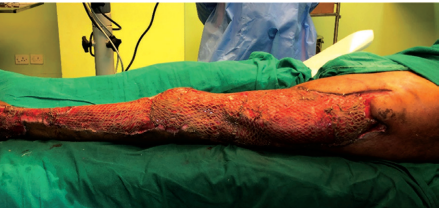
Role of Hybrid Reconstruction Ladder in Management of Necrotizing Fasciitis
Ravi Kumar Chittoria, Dhira Shobith Munipati, Barath Kumar Singh. P
Author Information
Licence:
Attribution-Non-commercial 4.0 International (CC BY-NC 4.0)This license enables reusers to distribute, remix, adapt, and build upon the material in any medium or format for noncommercial purposes only, and only so long as attribution is given to the creator.
International Physiology 11(1):p 9-14, January – April 2023. | DOI: https://doi.org/10.21088/ip.2347.1506.11123.1
How Cite This Article:
Dhira Shobith Munipati, Ravi Kumar Chittoria, Barath Kumar Singh. P/Role of Hybrid Reconstruction Ladder in Management of Necrotizing Fasciitis/International Physiology.2023;11(1):9–14.Timeline
Received : December 09, 2022
Accepted : January 12, 2023
Published : April 27, 2023
Abstract
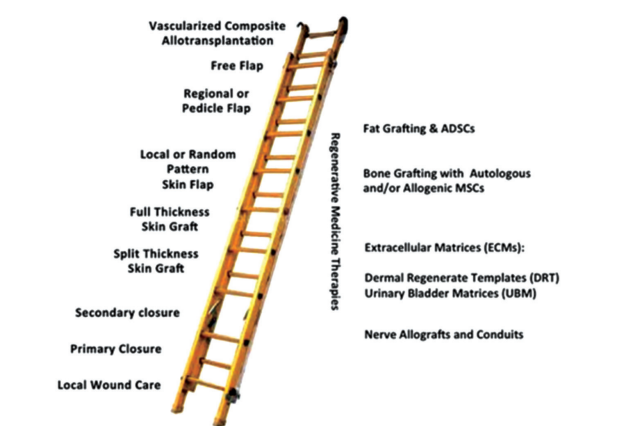
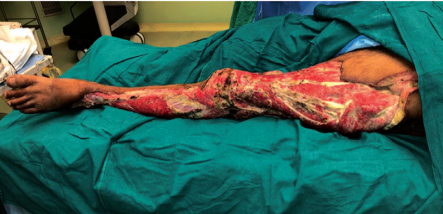
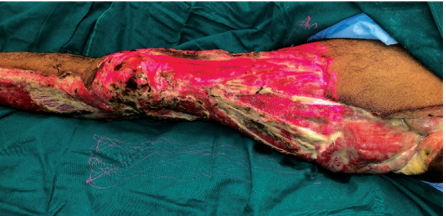
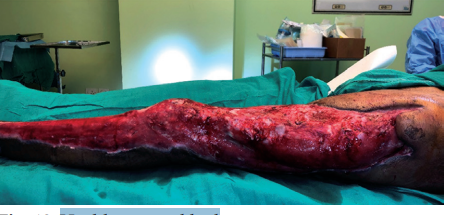
Necrotizing fasciitis is an infection of subcutaneous tissue and fascia which may spread rapidly to deeper tissue and surrounding tissue which may cause damage to the tissue and present as a localized infection and fulminant septic shock with high mortality rate. Necrotizing fasciitis will undergo extensive wound debridement of the necrotic tissue which may create huge raw area with severe morbidity to the patient. A multidisciplinary team has successfully adopted advanced reconstructive methods combined with modalities from regenerative medicine to enhance the results of difficult reconstruction. These procedures, known as "Hybrid reconstruction ladder," combine conventional reconstruction techniques with regenerative medicine applications. This review article provides a summary of the benefits of using a hybrid reconstruction ladder to create a healthy wound bed and reconstruction in a case of necrotizing fascitis.
References
- 1. Bonne SL, Kadri SS. Evaluation and management of necrotizing soft tissue infections. Infect Dis Clin North Am. 2017;31(3):497–511.
- 2. Zaroff LI, Mills W, Duckett JW, Switzer WE, Moncrief JA. Multiple uses of viable cutaneous homografts in the burned patient. Surgery. 1966 Mar;59(3):368–72.
- 3. Wong CJ, Niranjan N. Reconstructive stages as an alternative to the reconstructive ladder. Plast Reconstr Surg. 2008;121(5):362e–363e.
- 4. Erba P, Ogawa R, Vyas R, Orgill DP. The reconstructive matrix: a new paradigm in reconstructive plastic surgery. Plast Reconstr Surg. 2010;126(2):492–8.
- 5. Mohapatra DP, Thiruvoth FM. Reconstruction 2.0: restructuring the reconstructive ladder. Plast Reconstr Surg. 2021 Mar;147(3):572e–573e.
- 6. Vedder NB. Problem analysis in reconstructive surgery: reconstructive ladders, elevators, and surgical judgment. In: Wei FC, Mardini S, editors. Flaps and Reconstructive Surgery. 2nd ed. Toronto: Elsevier; 2017. p. 1–5.
- 7. Gupta S, Chittoria RK, Singh PB, Hemalatha K. Effect of low-level laser therapy (LLLT) on the severity of post-burn immature scars: a randomized control study. Int J Clin Diagn Res. 2020 Jan-Feb;8(1).
- 8. Turner NJ, Badylak SF. Biologic scaffolds for musculotendinous tissue repair. Eur Cell Mater. 2013 Feb 21;25:130–43.
- 9. Freeman JW, Empson YM, Ekwueme EC, Paynter DM, Brolinson PG. Effect of prolotherapy on cellular proliferation and collagen deposition in MC3T3-E1 and patellar tendon fibroblast populations. Transl Res. 2011;158(3):132–9.
- 10. Tenenhaus M, Rennekampff HO. Surgical advances in burn and reconstructive plastic surgery: new and emerging technologies. Clin Plast Surg. 2012;39(4):435–43.
- 11. Borgquist O, Ingemansson R, Malmsjö M. Wound edge microvascular blood flow during negative-pressure wound therapy: examining the effects of pressures from -10 to -175 mmHg. Plast Reconstr Surg. 2010;125(2):502–9.
- 12. Salazar-Álvarez AE, Riera-del-Moral LF, García-Arranz M, Alvarez-García J, Concepción-Rodriguez NA, Riera-de-Cubas L. Use of platelet-rich plasma in the healing of chronic ulcers of the lower extremity. Actas Dermosifiliogr. 2014;105(6):597–604.
- 13. Greenleaf G, Hansbrough JF. Current trends in the use of allograft skin for patients with burns and reflections on the future of skin banking in the United States. J Burn Care Rehabil. 1994;15(5):428–31.
- 14. Munipati DS, Chittoria RK, Singh PB. Role of hybrid reconstruction ladder in management of necrotizing fasciitis. Int Physiol. 2023;11(1):21–5.
Data Sharing Statement
There are no additional data available. All raw data and code are available upon request.
Funding
This research received no funding.
Author Contributions
All authors contributed significantly to the work and approve its publication.
Ethics Declaration
This article does not involve any human or animal subjects, and therefore does not require ethics approval.
Acknowledgements
We would like to express our gratitude to the patients, their families, and all those who have contributed to this study.
Conflicts of Interest
No conflicts of interest in this work.
About this article

Cite this article
Dhira Shobith Munipati, Ravi Kumar Chittoria, Barath Kumar Singh. P/Role of Hybrid Reconstruction Ladder in Management of Necrotizing Fasciitis/International Physiology.2023;11(1):9–14.
Licence:
Attribution-Non-commercial 4.0 International (CC BY-NC 4.0)This license enables reusers to distribute, remix, adapt, and build upon the material in any medium or format for noncommercial purposes only, and only so long as attribution is given to the creator.
| Received | Accepted | Published |
|---|---|---|
| December 09, 2022 | January 12, 2023 | April 27, 2023 |
DOI: https://doi.org/10.21088/ip.2347.1506.11123.1
Keywords
Hybrid Reconstruction LadderNecrotizing FascitisRegenerative MedicineManagementSearch for Similar Articles
Similar Articles
- Mechanisms of Myocardial Damage and Structural Remodeling Caused by Doxorubicin-...
- Impact of Sleep Deprivation on Human Physiology: A Review
- The Effect of a Brief Heart Rate Variability Biofeedback Session on Salivary Cor...
- Impact of Vitamin D Supplementation in Enhancing Pulmonary Function in Adults wi...
- Mona Bedi - Editiorial
Article Level Metrics
Last UpdatedSunday 27 September 2026, 08:25:14 (IST)
1960
Accesses
23
194
00
Citations
NA
NA
NA
Download citation
Article Keywords
Keyword Highlighting
Highlight selected keywords in the article text.
Timeline
| Received | December 09, 2022 |
| Accepted | January 12, 2023 |
| Published | April 27, 2023 |
licence
Attribution-Non-commercial 4.0 International (CC BY-NC 4.0)
This license enables reusers to distribute, remix, adapt, and build upon the material in any medium or format for noncommercial purposes only, and only so long as attribution is given to the creator.