Full Text (PDF)
International Physiology 14(1):p 33-38, January 2026. | DOI: https://doi.org/10.21088/ip.2347.1506.14126.4
Review Article
Impact of Sleep Deprivation on Human Physiology: A Review
Author Information
Licence:
Attribution-Non-commercial 4.0 International (CC BY-NC 4.0)This license enables reusers to distribute, remix, adapt, and build upon the material in any medium or format for noncommercial purposes only, and only so long as attribution is given to the creator.
International Physiology 14(1):p 33-38, January 2026. | DOI: https://doi.org/10.21088/ip.2347.1506.14126.4
How Cite This Article:
Amitava Khan. Impact of Sleep Deprivation on Human Physiology: A Review. Int. Phy. 2026; 14(1): 33–38.Timeline
Received : March 26, 2026
Accepted : May 07, 2026
Published : June 25, 2026
Abstract
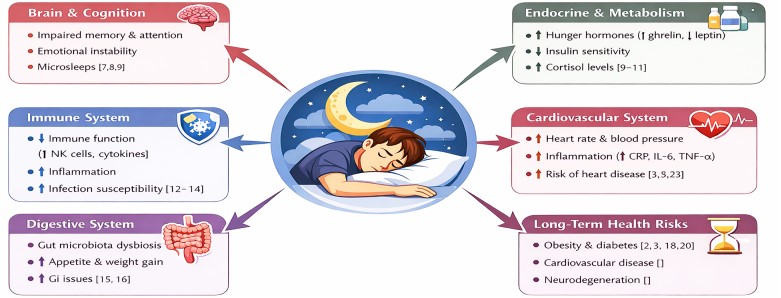
Sleep is an essential biological process required for the maintenance of physiological homeostasis, cognitive performance, and metabolic balance. In modern societies, chronic sleep deprivation has become increasingly prevalent due to lifestyle changes, occupational demands, and technological influences. Insufficient sleep affects multiple physiological systems including the nervous, endocrine, cardiovascular, metabolic, immune, and gastrointestinal systems. Experimental and epidemiological studies demonstrate that sleep deprivation impairs cognitive functions, alters hormonal balance, increases sympathetic nervous system activity, promotes systemic inflammation, and disrupts metabolic regulation. Furthermore, chronic sleep loss is associated with increased risks of obesity, diabetes mellitus, cardiovascular diseases, and mental health disorders. The mechanisms underlying these physiological alterations involve dysregulation of circadian rhythms, increased oxidative stress, neuroendocrine disturbances, and inflammatory responses. This review summarizes the current understanding of the physiological consequences of sleep deprivation in humans, focusing on its effects on major organ systems and underlying biological mechanisms. Understanding these effects is essential for developing preventive strategies and public health policies aimed at reducing the burden of sleep-related health disorders.
References
- 1. Carskadon Mary A., Dement William C. Normal human sleep: An overview. Principles and Practice of Sleep Medicine 2011; 5: 16-26.
- 2. Banks Siobhan, Dinges David F. Behavioral and physiological consequences of sleep restriction. Journal of Clinical Sleep Medicine 2007; 3(5): 519-528.
- 3. Cappuccio Francesco P, D’Elia Luigi, Strazzullo Pasquale, Miller Michelle A. Sleep duration and cardiovascular outcomes. European Heart Journal 2010; 31(7): 829-839.
- 4. Borbély Alexander A. A two-process model of sleep regulation. Human Neurobiology 1982; 1(3): 195-204.
- 5. Arendt Josephine. Melatonin and human rhythms. Chronobiology International 2008; 23(1-2): 21-37.
- 6. Rechtschaffen Allan, Kales Anthony. A manual of standardized terminology of sleep stages. Brain Information Service 1968; 1: 1-12.
- 7. Yoo Seung-Schik, Gujar Ninad, Hu Peter, Jolesz Ferenc A, Walker Matthew P. The human emotional brain without sleep. Current Biology 2007; 17(20): R877-R878.
- 8. Tononi Giulio, Cirelli Chiara. Sleep and synaptic homeostasis. Neuron 2014; 81(1): 12-34.
- 9. Spiegel Karine, Tasali Esra, Penev Plamen, Van Cauter Eve. Sleep curtailment and appetite regulation. Annals of Internal Medicine 2004; 141(11): 846-850.
- 10. Leproult Rachel, Van Cauter Eve. Role of sleep and sleep loss in hormonal release. Endocrine Development 2010; 17(1): 11-21.
- 11. Van Cauter Eve, Leproult Rachel, Plat Luc. Endocrine physiology of sleep. Sleep Medicine Reviews 2008; 12(1): 5-20.
- 12. Besedovsky Luciana, Lange Tanja, Born Jan. Sleep and immune function. Pflügers Archiv 2012; 463(1): 121-137.
- 13. Irwin Michael R. Why sleep is important for health. Annual Review of Psychology 2015; 66(1): 143-172.
- 14. Prather Aric A, Hall Martica, Fury John M., Ross David C., Muldoon Matthew F., Cohen Sheldon, Marsland Aric L. Sleep and antibody response to vaccination. Sleep 2012; 35(8):1063-1069.
- 15. Benedict Christian, Vogel Holger, Jonas Wiebke, Woting Anja, Blaut Michael, Schürmann Annette, Cedernaes Jonathan. Sleep and gut microbiota interactions. Current Opinion in Clinical Nutrition and Metabolic Care 2016; 19(6): 450-456.
- 16. Taheri Shahrad, Lin Ling, Austin Daniel, Young Terry, Mignot Emmanuel. Short sleep duration and obesity. PLoS Medicine 2004;
- 17. Fullagar Hugh H.K., Skorski Sabrina, Duffield Rob, Hammes Daniel, Coutts Aaron J, Meyer Tim. Sleep and athletic performance. Sports Medicine 2015; 45(2): 161-186.
- 18. Walker Matthew P. Sleep, emotion and affect regulation. Annual Review of Psychology 2009; 60(1): 679-708.
- 19. Killgore William D.S. Effects of sleep deprivation on cognition. Progress in Brain Research 2010; 185: 105-129.
- 20. Irwin Michael R., Opp Mark R. Sleep health and inflammation. Current Directions in Psychological Science 2017; 26(1): 35-41.
Data Sharing Statement
There are no additional data available. All raw data and code are available upon request.
Funding
This research received no funding.
Author Contributions
All authors contributed significantly to the work and approve its publication.
Ethics Declaration
This article does not involve any human or animal subjects, and therefore does not require ethics approval.
Acknowledgements
We would like to express our gratitude to the patients, their families, and all those who have contributed to this study.
Conflicts of Interest
No conflicts of interest in this work.
About this article

Cite this article
Amitava Khan. Impact of Sleep Deprivation on Human Physiology: A Review. Int. Phy. 2026; 14(1): 33–38.
Licence:
Attribution-Non-commercial 4.0 International (CC BY-NC 4.0)This license enables reusers to distribute, remix, adapt, and build upon the material in any medium or format for noncommercial purposes only, and only so long as attribution is given to the creator.
| Received | Accepted | Published |
|---|---|---|
| March 26, 2026 | May 07, 2026 | June 25, 2026 |
DOI: https://doi.org/10.21088/ip.2347.1506.14126.4
Keywords
Sleep deprivationCircadian rhythmMetabolismNeurophysiologyCardiovascular healthImmune responseSearch for Similar Articles
Similar Articles
- Reconstruction of Amputated Stump with SVC Thrombosis: Our Experience
- Role of Topical Onion Extract in Scar Management
- Role of Video Dermatoscopy in Scar Management
- Mechanisms of Myocardial Damage and Structural Remodeling Caused by Doxorubicin-...
- The Effect of a Brief Heart Rate Variability Biofeedback Session on Salivary Cor...
Article Level Metrics
Last UpdatedSunday 18 October 2026, 11:37:14 (IST)
2186
Accesses
43
204
00
Citations
NA
NA
NA
Download citation
Article Keywords
Keyword Highlighting
Highlight selected keywords in the article text.
Timeline
| Received | March 26, 2026 |
| Accepted | May 07, 2026 |
| Published | June 25, 2026 |
licence
Attribution-Non-commercial 4.0 International (CC BY-NC 4.0)
This license enables reusers to distribute, remix, adapt, and build upon the material in any medium or format for noncommercial purposes only, and only so long as attribution is given to the creator.