Full Text (PDF)
Journal of Pharmaceutical and Medicinal Chemistry 12(1):p 27-32, January - June 2026. | DOI: https://doi.org/10.21088/jpmc.2395.6615.12126.5
Review Article
Role of Glycomic Biological Age Markers in Health and Disease
Author Information
Licence:
Attribution-Non-commercial 4.0 International (CC BY-NC 4.0)This license enables reusers to distribute, remix, adapt, and build upon the material in any medium or format for noncommercial purposes only, and only so long as attribution is given to the creator.
Journal of Pharmaceutical and Medicinal Chemistry 12(1):p 27-32, January - June 2026. | DOI: https://doi.org/10.21088/jpmc.2395.6615.12126.5
How Cite This Article:
Rahul Saxena, Suyash Saxena. Role of Glycomic Biological Age Markers in Health and Disease. J Pharmaceut Med Chem. 2026; 12(1): 27-32.Timeline
Received : May 20, 2026
Accepted : June 20, 2026
Published : June 30, 2026
Abstract
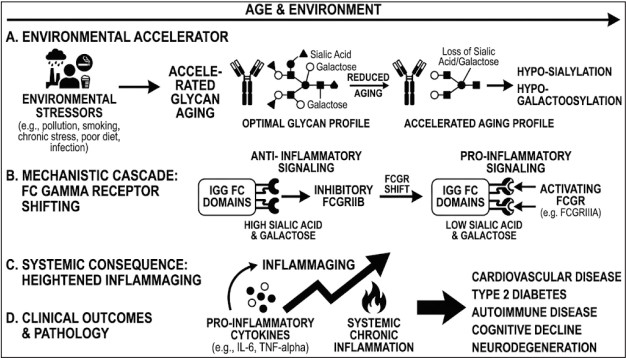
Chronological age is an imperfect tool for assessing healthspan and risk for diseases. As a result, biological markers of age become important components of personalized medicine. One of such markers, the plasma glycome, and especially Immunoglobulin G (IgG) $N$-glycosylation, is gaining attention due to its dynamic nature and involvement of genetics, environment, and lifestyle. In this review, we summarize current knowledge about the role of glycomic biological age markers (“Glycan Age”) in health and disease. Aging causes the progressive reduction in the levels of IgG galactosylation and sialylation with changes in fucosylation and bisection. Moreover, these structural changes do not only reflect the physiological decline, but also impact immune cell activity by changing the affinity for activating and inhibitory $Fc\gamma$ receptors and cause the shift from anti-inflammatory towards pro-inflammatory status resulting in sterile systemic low-level inflammation, called “inflammaging.” As a marker clinically, premature glycan aging becomes a strong predictor of disease outcomes in various disease categories. Glycan aging tends to occur several years prior to the onset of clinical symptoms in autoimmunity, heart diseases, metabolic syndromes, neurodegenerative conditions, and cancers, and works as an independent predictor of overall mortality. Importantly, glycan aging is a very manipulable clock; changes in endocrine status (perimenopause), lifestyle modifications, and therapies of longevity have been shown to effectively reverse this biological clock. Finally, it would be necessary to overcome the technical issues related to standardization and integrate glycomics into multi-omics clocks using machine learning approaches.
References
- 1. Fares S, Wehrle CJ, Hong H, Sun K, Jiao C, Zhang M, et al. Emerging and Clinically Accepted Biomarkers for Hepatocellular Carcinoma. Cancers. 2024;16(8):1453. doi:10.3390/cancers16081453.
- 2. Abeltino A, Hatem D, Serantoni C, Riente A, De Giulio MM, De Spirito M, et al. Unraveling the Gut Microbiota: Implications for Precision Nutrition and Personalized Medicine. Nutrients. 2024;16(22):3806. doi:10.3390/ nu16223806.
- 3. Tan GSQ, Miller L, Wade S, Ilomäki J, Lukose D, Rong J, et al. Association Discovery Approach in Healthcare Big Data to Identify Drug Safety and Drug Repurposing Signals. Clin Pharmacol Ther. 2026;119(1):228-240. doi:10.1002/cpt.70080.
- 4. Wu Y, Zhang Z, Chen L, Sun S. Immunoglobulin G glycosylation and its alterations in agingrelated diseases. Acta Biochim Biophys Sin. 2024;56(8):1221-1233. doi:10.3724/ abbs.2024137.
- 5. Vinicki M, Pribić T, Vučković F, Frkatović- Hodžić A, Plaza-Andrades I, Tinahones F, et al. Effects of testosterone and metformin on the GlycanAge index of biological age and the composition of the IgG glycome. GeroScience. 2024;47(6). doi:10.1007/s11357-024-01349-z.
- 6. Bu M, Li Z, Jones EE, Lubaba U, Liu X, Li H. Immunoglobulin G in aging and cancer. Front Immunol. 2026;17:1854902. doi:10.3389/ fimmu.2026.1854902.
- 7. Gupta P, Sághy T, Bollmann M, Jin T, Ohlsson C, Carlsten H, et al. Local Immune Activation and Age Impact on Humoral Immunity in Mice, with a Focus on IgG Sialylation. Vaccines. 2024;12(5):479. doi:10.3390/vaccines12050479.
- 8. Krištić J, Lauc G. The importance of IgG glycosylation—What did we learn after analyzing over 100,000 individuals. Immunological Reviews. 2024;328:143-170. doi:10.1111/imr.13407.
- 9. Lyu YX, Fu Q, Wilczok D, Ying K, King A, Antebi A, et al. Longevity biotechnology: bridging AI, biomarkers, geroscience and clinical applications for healthy longevity. Aging. 2024;16. doi:10.18632/aging.206135.
- 10. Mijakovac A, Lauc G, et al. The Immunoglobulin G Glycome: A Modifiable Biomarker and Functional Effector of Aging, Disease, and Mortality. medRxiv [Preprint]. 2026. doi:10.11 01/2026.01.15.26341250.
- 11. Sun W, Jian X, Zhang J, Meng X, Wang H, Zheng D, et al. The Causality between Human Immunoglobulin G (IgG) N-Glycosylation and Aging: A Mendelian Randomization Study. Molecules. 2024;29(6):1281. doi:10.3390/ molecules29061281.
- 12. Šimunić-Briški N, et al. Regular moderate physical exercise decreases Glycan Age index of biological age and reduces inflammatory potential of Immunoglobulin. Glycoconj J. 2024;41:67–76. doi:10.1007/s10719-024- 10145-w.
- 13. Krištić J, Lauc G. Combining blood biochemistry and glycan ages for an even more prognostic biological age. medRxiv [Preprint]. 2025. doi:10.1101/2025.09.14.25335700.
- 14. Chi Longevity. Your Real Age Explained: Five Biological Clocks of Health. Chi Longevity Educational Series. 2026 Mar [cited 2026 Jul 17]. Available from: https://chilongevity. com/education/your-real-age-explained-thefive-biological-clocks-of-health.
- 15. Zhao H, et al. Absolute Quantification of Aging-Associated Glycans in IgG for Biological Age Prediction: Insights from Glycomics and Transcriptomics. bioRxiv [Preprint]. 2025. doi:10.1101/2025.04.12.548901.
- 16. Rapčan B, Song M, Frkatović-Hodžić A, Pribić T, Vuk J, Beletić A, et al. Glycan clock of ageing— analytical precision and time-dependent interand intra-individual variability. GeroScience. 2024;46(5):5781–5796. doi:10.1007/s11357-024- 01124-0.
- 17. Juan CG, et al. In Silico Network Perturbation Reveals Hierarchical Roles of DNA Repair and Glycosylation Linking Exercise to Human Ageing Clock. medRxiv [Preprint]. 2026. doi:1 0.1101/2026.02.01.26345311.
- 18. Gilroy R, Lauc G. Glycoproteins and longevity: an interview with Professor Gordan Lauc. Expert Opin Ther Targets. 2024;28(6):487–489. doi:10.1080/14728222.2024.2351299.
Data Sharing Statement
There are no additional data available. All raw data and code are available upon request.
Funding
This research received no funding.
Author Contributions
All authors contributed significantly to the work and approve its publication.
Ethics Declaration
This article does not involve any human or animal subjects, and therefore does not require ethics approval.
Acknowledgements
We would like to express our gratitude to the patients, their families, and all those who have contributed to this study.
Conflicts of Interest
No conflicts of interest in this work.
About this article

Cite this article
Rahul Saxena, Suyash Saxena. Role of Glycomic Biological Age Markers in Health and Disease. J Pharmaceut Med Chem. 2026; 12(1): 27-32.
Licence:
Attribution-Non-commercial 4.0 International (CC BY-NC 4.0)This license enables reusers to distribute, remix, adapt, and build upon the material in any medium or format for noncommercial purposes only, and only so long as attribution is given to the creator.
| Received | Accepted | Published |
|---|---|---|
| May 20, 2026 | June 20, 2026 | June 30, 2026 |
DOI: https://doi.org/10.21088/jpmc.2395.6615.12126.5
Keywords
Glycan AgeImmunoglobulin G (IgG)InflammagingBiological Age BiomarkersGlycosylationSearch for Similar Articles
Similar Articles
- Pharmaceutical Care in Primary Healthcare: A Study of Nurses
- Artificial Intelligence in Pharmaceutical Research and Development: From Target...
- Developing a Structured Teaching Program for Precision Medicine in Nursing Pract...
- Comprehensive Scientific Review on the Natural Process of Aging, Anti-Aging Mech...
- Formulation and Evaluation of Curcumin Lozenges to Treat Throat Infections
Article Level Metrics
Last UpdatedSunday 18 October 2026, 14:17:58 (IST)
1355
Accesses
16
116
00
Citations
NA
NA
NA
Download citation
Article Keywords
Keyword Highlighting
Highlight selected keywords in the article text.
Timeline
| Received | May 20, 2026 |
| Accepted | June 20, 2026 |
| Published | June 30, 2026 |
licence
Attribution-Non-commercial 4.0 International (CC BY-NC 4.0)
This license enables reusers to distribute, remix, adapt, and build upon the material in any medium or format for noncommercial purposes only, and only so long as attribution is given to the creator.