Full Text (PDF)
Journal of Global Public Health 5(1):p 43-45, January – June 2023. | DOI: NA
Case Report
Role of ABSI Score in Burns
Ravi Kumar Chittoria, Julia Sunil, Barath Kumar Singh P
Author Information
Licence:
Attribution-Non-commercial 4.0 International (CC BY-NC 4.0)This license enables reusers to distribute, remix, adapt, and build upon the material in any medium or format for noncommercial purposes only, and only so long as attribution is given to the creator.
Journal of Global Public Health 5(1):p 43-45, January – June 2023. | DOI: NA
How Cite This Article:
Julia Sunil, Ravi Kumar Chittoria, Barath Kumar Singh P/Role of ABSI Score in Burns/J of Global Pub Health. 2023; 5(1): 43–45Timeline
Received : December 10, 2022
Accepted : December 30, 2022
Published : June 25, 2023
Abstract
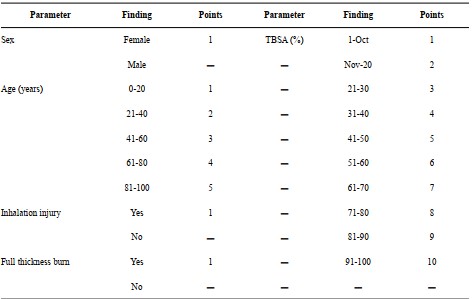
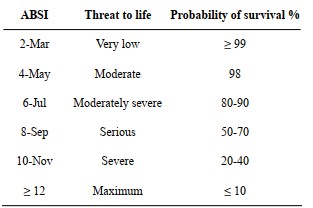
Burn injuries can present in multiple ways and in a diverse patient population. Its severity is not only determined by the nature of burn injury or the extent of the injury but also by several patient factors. Mortality in burn injury used to be very unpredictable but now there are various means of predicting morbidity and mortality in a burns patient. The abbreviated burns severity index (ABSI) score is one of such recent tools formulated to aid in predicting outcome in burns patient. In this case study we evaluate the role of Abbreviated Burns Severity Index (ABSI) score in predicting mortality outcome in a patient with thermal burns.
References
- 1. World Health Organization (WHO) Global burden of disease: 2004 summary tables. World Health Organization, Geneva Health 24-27.
- 2. Tahir et al (2009) Prediction of mortality after major burn: physiological versus biochemical measures. Wounds 21(7):177–182.
- 3. Dahal P et al (2015) Baux’s and abbreviated burn severity score for the prediction of mortality in patients with acute burn injury. J Coll Med Sci Nepal 11(4):24–27.
- 4. Osler T, Glance LG, Hosmer DW (2010) Simplified estimates of the probability of death after burn injuries: extending and updating the Baux score. J Trauma 68(3):690–697.
- 5. Brusselaers N, Agbenorku P, Hoyte-Williams PE (2013) Assessment of mortality prediction models in a Ghanaian burn population. Burn 39(5):997–1003.
- 6. El Soud MA, Ali RA, Taha AA, Khirfan SM. ABSI scoring system for burns: concerns and modifications in a developing country. European Journal of Plastic Surgery. 2019 Apr;42(2):177-182.
- 7. Parikh P, Sunesara I, Lutz E et al (2015) Burns during pregnancy: implications for maternalperinatal providers and guidelines for practice. Obstet Gynecol Surv 70(10):633–643.
Funding
This research received no funding.
Author Contributions
All authors contributed significantly to the work and approve its publication.
Ethics Declaration
This article does not involve any human or animal subjects, and therefore does not require ethics approval.
Acknowledgements
We would like to express our gratitude to the patients, their families, and all those who have contributed to this study.
Conflicts of Interest
No conflicts of interest in this work.
About this article

Cite this article
Julia Sunil, Ravi Kumar Chittoria, Barath Kumar Singh P/Role of ABSI Score in Burns/J of Global Pub Health. 2023; 5(1): 43–45
Licence:
Attribution-Non-commercial 4.0 International (CC BY-NC 4.0)This license enables reusers to distribute, remix, adapt, and build upon the material in any medium or format for noncommercial purposes only, and only so long as attribution is given to the creator.
| Received | Accepted | Published |
|---|---|---|
| December 10, 2022 | December 30, 2022 | June 25, 2023 |
DOI: NA
Keywords
Abbreviated burns severity indexABSIThermal burnsSearch for Similar Articles
Article Level Metrics
Last UpdatedSaturday 05 September 2026, 12:29:34 (IST)
781
Accesses
2
114
00
Citations
NA
NA
NA
Download citation
Article Keywords
Keyword Highlighting
Highlight selected keywords in the article text.
Timeline
| Received | December 10, 2022 |
| Accepted | December 30, 2022 |
| Published | June 25, 2023 |
licence
Attribution-Non-commercial 4.0 International (CC BY-NC 4.0)
This license enables reusers to distribute, remix, adapt, and build upon the material in any medium or format for noncommercial purposes only, and only so long as attribution is given to the creator.