Full Text (PDF)
Physiotherapy and Occupational Therapy Journal 18(1):p 71-78, Jan -March 2025. | DOI: https://doi.org/10.21088/potj.0974.5777.18125.9
Review Article
Revisiting Physiotherapy Diagnosis
Author Information
Licence:
Attribution-Non-commercial 4.0 International (CC BY-NC 4.0)This license enables reusers to distribute, remix, adapt, and build upon the material in any medium or format for noncommercial purposes only, and only so long as attribution is given to the creator.
Physiotherapy and Occupational Therapy Journal 18(1):p 71-78, Jan -March 2025. | DOI: https://doi.org/10.21088/potj.0974.5777.18125.9
How Cite This Article:
Bid Dibyendunarayan D. Revisiting Physiotherapy Diagnosis. Physio. and Occ. Therapy Jr. 2025; 18(1): 71-78.Timeline
Received : December 26, 2024
Accepted : February 15, 2025
Published : March 25, 2025
Abstract
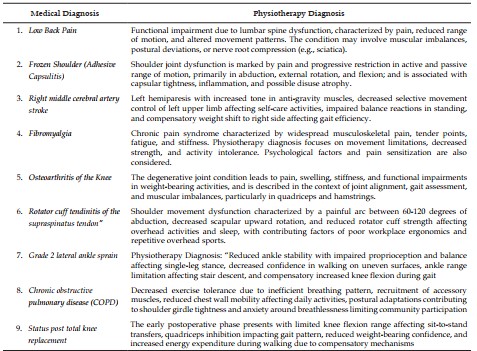
Physiotherapy diagnosis is an integral component of effective rehabilitation and patient management, focusing on the identification and classification of functional impairments, movement dysfunctions, and activity limitations. Unlike medical diagnoses, which emphasize pathologies, physiotherapy diagnosis adopts a holistic, function-oriented approach aligned with the biopsychosocial model. This article explores the significance of physiotherapy diagnosis, highlighting its role in enhancing treatment planning and promoting patient-centered care. It delves into diagnostic frameworks, such as the International Classification of Functioning (ICF) system. Challenges, including diagnostic variability and the need for standardization, are addressed alongside the merits of evidence-based practices. By emphasizing collaboration and innovation, physiotherapy diagnosis emerges as a dynamic and vital discipline in modern healthcare, ensuring tailored interventions and improved patient outcomes.
References
- 1. Jiandani M.P., Mhatre B.S. Physical therapy diagnosis: How is it different? Journal of postgraduate medicine. 2018; 64(2): 69-72.
- 2. Physiotherapeutische Diagnostik und Clinical Reasoning. VPT Magazin. 2024; 10(05): 27-31.
- 3. Mirsky R., Hibah S., Hadad M., Gorenstein A., Meir K. “PhysIt” A Diagnosis and Troubleshooting Tool for Physiotherapists in Training. Diagnostics. 2020; 10(2): 72.
- 4. Bruno Prata M., Roberto Mattar C., Mauro F., Francimar Ferrari R., Flavia Massa C., de S., et al. Brazilian classification of physical therapy diagnosis. Brazilian journal of physical therapy. 2024; 28(3): 101066-.
- 5. Spoto M.M., Collins J. Physiotherapy diagnosis in clinical practice: A survey of orthopaedic certified specialists in the USA. Physiotherapy Research International: The Journal for Researchers and Clinicians in Physical Therapy. 2008; 13(1): 31-41.
- 6. Pérez-Gómez C., Calderón-Cruz I. Conceptualización para la formulación del diagnóstico fisioterapéutico en comunidad Conceptual bases for the formulation of the Physiotherapeutic diagnosis in the community. Rev Salud Pública. 2019; 21(6): 1-7.
- 7. Suppé B. Physiotherapeutische Untersuchung und Therapieplanung. Springer eBooks. 2014: 105-51.
- 8. Perron M., Brosseau R., Maltais D.B., Piette V., Godbout A., Corriveau H., et al. A proposal for a universal physical therapy diagnostic concept. Brazilian journal of physical therapy. 2023; 27(6): 100560-.
- 9. Fritz J.M., Wainner R.S. Examining Diagnostic Tests: An Evidence-Based Perspective. Physical therapy. 2001; 81(9): 1546-64.
- 10. Danler A. Die physiotherapeutische Bewegungsdiagnose. manuelletherapie. 2017; 21(03): 139-43.
- 11. Berghmans B., Seleme M. Physiotherapeutic Diagnostic Process for Female Urinary Incontinence. Lecture Notes in Computational Vision and Biomechanics. 2018: 165-83.
- 12. Décary S., Fallaha M., Pelletier B., Frémont P., Martel-Pelletier J., Pelletier J.P., et al. Diagnostic validity and triage concordance of a physiotherapist compared to physicians’ diagnoses for common knee disorders. BMC musculoskeletal disorders. 2017;18(1).
- 13. Kaizik M.A., Hancock M.J., Herbert R.D. DiTA: a database of diagnostic test accuracy studies for physiotherapists. Journal of Physiotherapy. 2019; 65(3): 119-20.
- 14. Delitto A., Snyder-Mackler L. The Diagnostic Process: Examples in Orthopedic Physical Therapy. Physical therapy. 1995; 75(3): 203-11.
- 15. Umphred D. Physical Therapy Differential Diagnosis in the Clinical Setting. 1995; 9(2): 39-45.
- 16. Spitznagle T., Cabelka C., Clinton S., Abraham K., Norton B. Diagnosis Dialog for Women’s Health Conditions: The Process and Proposed Pelvic Floor Muscle Diagnoses. Journal of Women’s Health Physical Therapy. 2017; 41(3): 154-62.
- 17. Alshuweihi H.H., Al-Sharman A., Abdelbasset W.K. A narrative review on the role of physiotherapy in musculoskeletal disorders. Fizjoterapia Polska. 2024; 24(3): 367-72.
- 18. Rose S.J. Musing on Diagnosis. Physical therapy. 1988; 68(11): 1665-.
- 19. Almond A., Zou Y., Forbes R. Navigating diagnostic uncertainty in musculoskeletal practice: The perspectives and experiences of new graduate physiotherapists. Musculoskeletal Science and Practice. 2021; 52: 102354.
- 20. Leslom A.N.D., Zabarah S.H.S., Hamad M.O.A., Muhammad A.M.As., Hussain H.A.A.0, Husayn ASA. Redefining Rehabilitation: A Critical Analysis of Physiotherapy and Medical Device Integration. International Journal of Bio-Medical Informatics and e-Health. 2022; 10(6): 156-61.
- 21. Jones M., Grimmer K., Edwards I., Higgs J., Trede F. Challenges in Applying Best Evidence to Physiotherapy. Internet Journal of Allied Health Sciences and Practice. 2006; 4(3).
- 22. Mitchell L. Can the International Classification of Functioning, Disability and Health (ICF) provide high-level descriptions of Scottish physiotherapy cases? Advances in Physiotherapy. 2008; 10: 119-26.
- 23. Glaessel A., Kirchberger I., Stucki G., Cieza A. Does the Comprehensive International Classification of Functioning, Disability and Health (ICF) Core Set for Breast Cancer capture the problems in functioning treated by physiotherapists in women with breast cancer? Physiotherapy. 2011; 97 1: 33-46.
- 24. Nilmart P., Vongsirinavarat M., Somprasong S, Apinonkul B. Development of an extensive assessment list for knee osteoarthritis based on the International Classification of Functioning, Disability and Health: A Delphi study. International Journal of Rehabilitation Research. 2019.
- 25. Karimijashni M., Westby M., Ramsay T., Beaulé P., Poitras S. Development and content validation of a questionnaire identifying patients’ functional priorities and abilities after hip or knee arthroplasty. Disability and rehabilitation. 2024: 1-15.
- 26. Pisoni C., Giardini A., Majani G., Maini M., Giardini A. International Classification of Functioning, Disability and Health (ICF) core sets for osteoarthritis. A useful tool in the follow-up of patients after joint arthroplasty. European journal of physical and rehabilitation medicine. 2008; 44 4: 377-85.
- 27. Mittrach R., Grill E., Walchner-Bonjean M, Scheuringer M., Boldt C., Huber E., et al. Goals of physiotherapy interventions can be described using the International Classification of Functioning, Disability and Health. Physiotherapy. 2008; 94: 150-7.
- 28. Tempest S., Harries P., Kilbride C., De Souza L. Enhanced clarity and holism: the outcome of implementing the ICF with an acute stroke multidisciplinary team in England. Disability and Rehabilitation. 2013; 35: 1921-5.
- 29. Finger M., Selb M., De Bie R., Escorpizo R. Using the International Classification of Functioning, Disability and Health in Physiotherapy in Multidisciplinary Vocational Rehabilitation: A Case Study of Low Back Pain. Physiotherapy research international: the journal for researchers and clinicians in physical therapy. 2015; 20 4: 231-41.
Data Sharing Statement
There are no additional data available. All raw data and code are available upon request.
Funding
This research received no funding.
Author Contributions
All authors contributed significantly to the work and approve its publication.
Ethics Declaration
This article does not involve any human or animal subjects, and therefore does not require ethics approval.
Acknowledgements
We would like to express our gratitude to the patients, their families, and all those who have contributed to this study.
Conflicts of Interest
No conflicts of interest in this work.
About this article

Cite this article
Bid Dibyendunarayan D. Revisiting Physiotherapy Diagnosis. Physio. and Occ. Therapy Jr. 2025; 18(1): 71-78.
Licence:
Attribution-Non-commercial 4.0 International (CC BY-NC 4.0)This license enables reusers to distribute, remix, adapt, and build upon the material in any medium or format for noncommercial purposes only, and only so long as attribution is given to the creator.
| Received | Accepted | Published |
|---|---|---|
| December 26, 2024 | February 15, 2025 | March 25, 2025 |
DOI: https://doi.org/10.21088/potj.0974.5777.18125.9
Keywords
Physiotherapy diagnosisFunctional impairmentsMovement dysfunctionsInternational Classification of Functioning (ICF)Evidence-based practicepatient-centered careclinical reasoningSearch for Similar Articles
Similar Articles
- Leadership in Physiotherapy: A Narrative Review
- Effectiveness of Low Level Laser Theapy in the Management of Temporomandibular J...
- The Impact of Air Pollution on Cardiopulmonary Health: Molecular Mechanisms, Pre...
- Efectiveness of Physiotherapy in Postpartum Women with Diastasis Recti: A Review
- Pain Neuroscience Education: Transforming Physiotherapy Practice
Article Level Metrics
Last UpdatedFriday 23 October 2026, 15:17:51 (IST)
4358
Accesses
9
739
00
Citations
NA
NA
NA
Download citation
Article Keywords
Keyword Highlighting
Highlight selected keywords in the article text.
Timeline
| Received | December 26, 2024 |
| Accepted | February 15, 2025 |
| Published | March 25, 2025 |
licence
Attribution-Non-commercial 4.0 International (CC BY-NC 4.0)
This license enables reusers to distribute, remix, adapt, and build upon the material in any medium or format for noncommercial purposes only, and only so long as attribution is given to the creator.