Full Text (PDF)
RFP Indian Journal of Medical Psychiatry 7(2):p 49-57, July - Dec 2024. | DOI: n.a
Original Article
Psychiatric Morbidity in Postpartum Women: A Hospital Based Cross Sectional Study
Manasa N, Bibi Ayesha Kalburgi, Narayan R. Mutalik
Author Information
Licence:
Attribution-Non-commercial 4.0 International (CC BY-NC 4.0)This license enables reusers to distribute, remix, adapt, and build upon the material in any medium or format for noncommercial purposes only, and only so long as attribution is given to the creator
RFP Indian Journal of Medical Psychiatry 7(2):p 49-57, July - Dec 2024. | DOI: n.a
How Cite This Article:
Manasa N, Bibi Ayesha Kalburgi, Narayan R. Mutalik, Psychiatric Morbidity in Postpartum Women: A Hospital Based Cross Sectional Study. RFP Ind Jr of Med Psy. 2024;7(2):49–57.Timeline
Received : October 26, 2024
Accepted : December 14, 2024
Published : December 30, 2024
Abstract
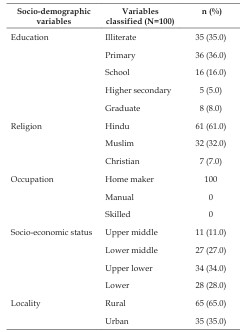
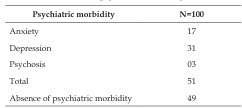
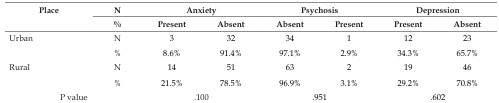
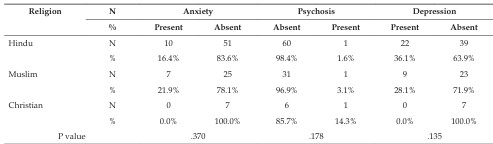
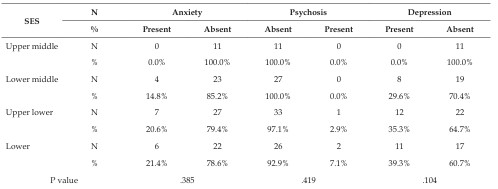
Context: The transition to motherhood brings about significant psychological and biological changes, making both pregnancy and the postpartum period are particularly susceptible to health challenges. Mental health issues during this time have often been neglected within the realm of reproductive health, despite their substantial contribution to the global burden of illness and disability. These conditions are associated with a range of symptoms including abnormally high or low mood, irritability, disturbed sleep, hallucinations/delusions, and occasionally suicidal or infanticidal ideation, if not treated promptly, they can substantially impact upon the mother’s health, mother-infant bonding, and family dynamics. Aim: To study psychiatric morbidity in women during postpartum period. Settings and Design: Hospital based cross sectional study. Methods and Material: This is an observational, hospital-based cross-sectional study conducted on postpartum women visiting immunization clinic for first immunization of their babies within 6 weeks of delivery, who fulfil the inclusion and exclusion criteria. The sample size estimated is 100. Assessment tools used are Predesigned questionnaire, Edinburgh postnatal depression scale, BPRS and HAM A. Statistical analysis used: The data were analysed using IBM SPSS version 29. Continuous and categorical variables have been presented as mean ± standard deviation and percentages respectively. Results: The population studied tends to be younger (mean age of 27.4+5), predominantly from rural areas (65%), and with limited educational attainment (71% either illiterate or with only primary education) and majority come from lower socio-economic backgrounds. Psychiatric morbidity is mainly in the form of depression (31%) followed by anxiety (17%) with very low prevalence of psychosis (3%). This population appears to face socio-economic and educational disadvantages, but in our study no statistical significance was found between variants like socio economic status, religion and psychiatric morbidity. Conclusions: The study found that postpartum psychiatric morbidity, particularly depression (31%) and anxiety (17%), is common, while psychosis is rare (3%). No significant association was observed between psychiatric morbidity and socio-demographic factors like socio-economic status or religion. These findings highlight the need for broader mental health support for postpartum women, regardless of socio-demographic backgrounds. A larger sample size with prospective assessment is recommended to validate these results.
References
- 1. Goyal S, Gupta B, Sharma E, Dalal PK, Pradeep Y. Psychiatric Morbidity, Cultural Factors, and Health-Seeking Behaviour in Perinatal Women: A Cross-Sectional Study from a Tertiary Care Centre of North India. Indian J Psychol Med. 2020 Jan 6;42(1):52-60. doi: 10.4103/IJPSYM. IJPSYM_96_19. PMID: 31997866; PMCID: PMC6970307.
- 2. Hendrick V, Altshuler LL, Suri R. Hormonal changes in the postpartum and implications for postpartum depression. Psychosomatics. 1998 Mar-Apr;39(2):93-101. doi: 10.1016/S0033- 3182(98)71355-6. PMID: 9584534.
- 3. O’Keane V, Lightman S, Patrick K, Marsh M, Papadopoulos AS, Pawlby S, Seneviratne G, Taylor A, Moore R. Changes in the maternal hypothalamic-pituitary-adrenal axis during the early puerperium may be related to the postpartum ‘blues’. J Neuroendocrinol. 2011 Nov; 23(11):1149-55. doi: 10.1111/j.1365- 2826.2011.02139.x.PMID: 22004568.
- 4. World Health Organization, United Nations Population Fund, Key Centre for Women’s Health in Society. Menta Health Aspects of Women’s Reproductive Health: A Global Review of the Literature. Geneva: World Health Organization; 2009.
- 5. Upadhyay RP, Chowdhury R, Aslyeh Salehi, Sarkar K, Singh SK, Sinha B, Pawar A, Rajalakshmi AK, Kumar A. Postpartum depression in India: a systematic review and meta-analysis. Bull World Health Organ. 2017 Oct 1; 95(10):706-717C. doi: 10.2471/BLT.17.192237. Epub 2017 Sep 5. PMID: 29147043; PMCID: PMC5689195.
- 6. Cox JL, Holden JM, Sagovsky R. Detection of postnatal depression. Development of the 10- item Edinburgh Postnatal Depression Scale. Br J Psychiatry. 1987 Jun; 150:782-6. doi: 10.1192/ bjp.150.6.782. PMID: 3651732.
- 7. Maier W, Buller R, Philipp M, Heuser I. The Hamilton Anxiety Scale: reliability, validity and sensitivity to change in anxiety and depressive disorders. J Affect Disord. 1988 Jan-Feb; 14(1):61- 8. doi: 10.1016/0165-0327(88)90072-9. PMID: 2963053
- 8. Overall JE, Gorham DR. The brief psychiatric rating scale. Psychological reports. 1962 Jun; 10(3):799-812
- 9. Hofmann AB, Schmid HM, Jabat M, Brackmann N, Noboa V, Bobes J, Garcia-Portilla MP, Seifritz E, Vetter S, Egger ST. Utility and validity of the Brief Psychiatric Rating Scale (BPRS) as a transdiagnostic scale. Psychiatry Res. 2022 Aug; 314:114659. doi: 10.1016/j.psychres. 2022.114659. Epub 2022 May 31. PMID: 35709637.
- 10. Rai S, Pathak A, Sharma I. Postpartum psychiatric disorders: Early diagnosis and management. Indian journal of psychiatry. 2015 Jul 1;57 (Suppl 2):S216-21.
- 11. Stewart DE, Robertson E, Dennis CL, Grace SL, Wallington T. Postpartum depression: Literature review of risk factors and interventions. Toronto: University Health Network Women’s Health Program for Toronto Public Health. 2003 Oct:1- 289.
- 12. Kumar R. Postnatal mental illness: a transcultural perspective. Soc Psychiatry PsychiatrEpidemiol. 1994 Nov;29(6):250-64. doi: 10.1007/BF00802048. PMID: 7825036.
- 13. Kumar R, Marks M, Platz C, Yoshida K. Clinical survey of a psychiatric mother and baby unit: characteristics of 100 consecutive admissions. J Affect Disord. 1995 Jan 11;33(1):11-22. doi: 10.1016/0165-0327(94)00067-j. PMID: 7714304.
- 14. Chandran M, Tharyan P, Muliyil J, Abraham S. Post-partum depression in a cohort of women from a rural area of Tamil Nadu, India. Incidence and risk factors. Br J Psychiatry. 2002 Dec;181:499- 504. doi: 10.1192/bjp.181.6.499. PMID: 12456520.
- 15. Gautam S, Nijhawan M, Gehlot PS. Post partum psychiatric syndromes-an analysis of 100 consecutive cases. Indian J Psychiatry. 1982 Oct; 24(4):383-6. PMID: 21965943; PMCID: PMC3012801.
- 16. Rezaie-Keikhaie K, Arbabshastan ME, Rafiemanesh H, Amirshahi M, Ostadkelayeh SM, Arbabisarjou A. Systematic review and metaanalysis of the prevalence of the maternity blues in the postpartum period. Journal of Obstetric, Gynecologic& Neonatal Nursing. 2020 Mar 1;49(2):127-36.
- 17. Meltzer-Brody S, Howard LM, Bergink V, Vigod S, Jones I, Munk-Olsen T, Honikman S, Milgrom J. Postpartum psychiatric disorders. Nature Reviews Disease Primers. 2018 Apr 26;4(1):1-8.
- 18. Fawcett EJ, Fairbrother N, Cox ML, White IR, Fawcett JM. The prevalence of anxiety disorders during pregnancy and the postpartum period: a multivariate Bayesian meta-analysis. The Journal of clinical psychiatry. 2019 Jul 23; 80(4):1181.
- 19. VanderKruik R, Barreix M, Chou D, Allen T, Say L, Cohen LS. The global prevalence of postpartum psychosis: a systematic review. BMC psychiatry. 2017 Dec; 17:1-9.
- 20. Nott PN, Franklin M, Armitage C, Gelder MG. Hormonal changes and mood in the puerperium. The British Journal of Psychiatry. 1976 Apr; 128(4):379-83.
- 21. Steiner M. Psychobiology of mental disorders associated with childbearing: An overview. Acta Psychiatrica Scandinavica. 1979 Nov; 60(5):449-64.
- 22. Handley SL, Dunn TL, Waldron G, Baker JM. Tryptophan, cortisol and puerperal mood. The British Journal of Psychiatry. 1980 May; 136(5):498-508.
- 23. Thippeswamy H, Davies W. A new molecular risk pathway for postpartum mood disorders: clues from steroid sulfatase–deficient individuals. Archives of Women’s Mental Health. 2021 Jun;24(3):391-401.
- 24. Deligiannidis KM, Kroll-Desrosiers AR, Mo S, Nguyen HP, Svenson A, Jaitly N, Hall JE, Barton BA, Rothschild AJ, Shaffer SA. Peripartum neuroactive steroid and γ-aminobutyric acid profiles in women at-risk for postpartum depression. Psychoneuroendocrinology. 2016 Aug 1; 70:98-107.
- 25. Muneer A, Minhas FA, Nizami AT, Mujeeb F, Usmani AT. Frequency and associated factors for postnatal depression. J Coll Physicians Surg Pak. 2009 Apr 1; 19(4):236-9.
- 26. Srivastava AS, Mara B, Pandey S, Tripathi MN, Pandit B, Yadav JS. Psychiatric morbidities in postpartum females: a prospective follow-up during puerperium. Open Journal of Psychiatry & Allied Sciences. 2015; 6(2):101-5.
- 27. Gupta S, Kishore J, Mala YM, Ramji S, Aggarwal R. Postpartum depression in north Indian women: prevalence and risk factors. The Journal of Obstetrics and Gynaecology of India. 2013 Aug; 63:223-9.
- 28. GK P, Arounassalame B. Impact of sociocultural factors on postpartum depression in South Indian women. International Journal of Reproduction, Contraception, Obstetrics and Gynecology. 2014; 3(2):338-43.
- 29. Kumar N, Nagaraj AK, Koudike U, Majgi SM. Psychiatric morbidity and correlates in postpartum women in a tertiary care hospital. Indian journal of psychological medicine. 2016 Jul; 38(4):309-14.
- 30. Saldanha D, Rathi N, Bal H, Chaudhari B. Incidence and evaluation of factors contributing towards postpartum depression. Medical Journal of Dr. DY Patil University. 2014 May 1; 7(3):309- 16.
- 31. Wan EY, Moyer CA, Harlow SD, Fan Z, Jie Y, Yang H. Postpartum depression and traditional postpartum care in China: role of zuoyuezi. International Journal of Gynecology & Obstetrics. 2009 Mar; 104(3):209-13.
- 32. Ramchandani PG, Richter LM, Stein A, Norris SA. Predictors of postnatal depression in an urban South African cohort. Journal of affective disorders. 2009 Mar 1; 113(3):279-84.
- 33. Britton JR. Pre-discharge anxiety among mothers of well newborns: Prevalence and correlates. Acta paediatrica. 2005 Dec; 94(12):1771-6.
Data Sharing Statement
There are no additional data available. All raw data and code are available upon request.
Funding
This research received no funding
Author Contributions
All authors contributed significantly to the work and approve its publication
Ethics Declaration
This article does not involve any human or animal subjects, and therefore does not require ethics approval
Acknowledgements
We would like to express our gratitude to the patients, their families, and all those who have contributed to this study.
Conflicts of Interest
No conflicts of interest in this work
About this article

Cite this article
Manasa N, Bibi Ayesha Kalburgi, Narayan R. Mutalik, Psychiatric Morbidity in Postpartum Women: A Hospital Based Cross Sectional Study. RFP Ind Jr of Med Psy. 2024;7(2):49–57.
Licence:
Attribution-Non-commercial 4.0 International (CC BY-NC 4.0)This license enables reusers to distribute, remix, adapt, and build upon the material in any medium or format for noncommercial purposes only, and only so long as attribution is given to the creator
| Received | Accepted | Published |
|---|---|---|
| October 26, 2024 | December 14, 2024 | December 30, 2024 |
DOI: n.a
Keywords
Postpartum womenSearch for Similar Articles
Article Level Metrics
Last UpdatedWednesday 21 October 2026, 05:58:33 (IST)
1331
Accesses
13
243
00
Citations
NA
NA
NA
Download citation
Article Keywords
Keyword Highlighting
Highlight selected keywords in the article text.
Timeline
| Received | October 26, 2024 |
| Accepted | December 14, 2024 |
| Published | December 30, 2024 |
licence
Attribution-Non-commercial 4.0 International (CC BY-NC 4.0)
This license enables reusers to distribute, remix, adapt, and build upon the material in any medium or format for noncommercial purposes only, and only so long as attribution is given to the creator