Full Text (PDF)
RFP Indian Journal of Medical Psychiatry 7(2):p 59-71, July - Dec 2024. | DOI: n.a
Original Article
How does the Dream Experience (Length, Location, Characters, Social Interactions, and Emotions) Change from Childhood to Adulthood?
Author Information
Licence:
Attribution-Non-commercial 4.0 International (CC BY-NC 4.0)This license enables reusers to distribute, remix, adapt, and build upon the material in any medium or format for noncommercial purposes only, and only so long as attribution is given to the creator
RFP Indian Journal of Medical Psychiatry 7(2):p 59-71, July - Dec 2024. | DOI: n.a
How Cite This Article:
Sudhakar Venukapalli, How does the Dream Experience (Length, Location, Characters, Social Interactions, and Emotions) Change from Childhood to Adulthood. RFP Ind Jr of Med Psy. 2024;7(2):59–71.Timeline
Received : October 26, 2024
Accepted : November 15, 2024
Published : December 30, 2024
Abstract
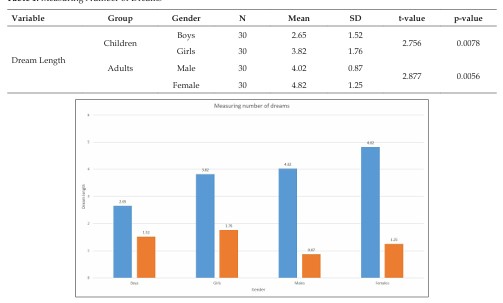
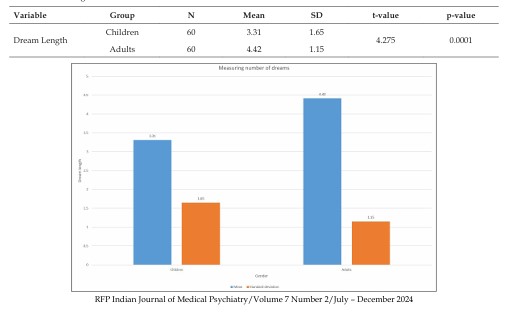
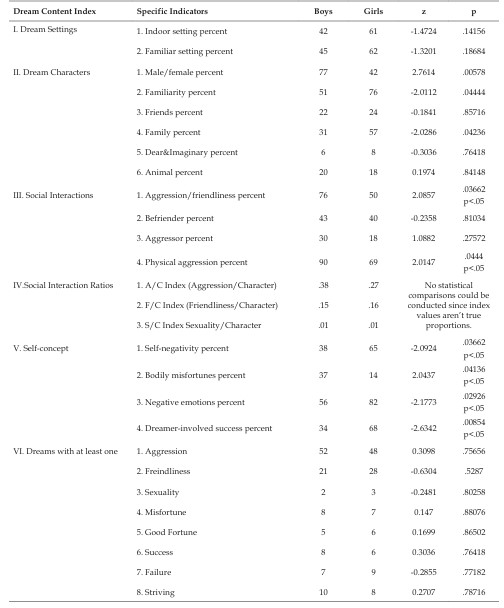
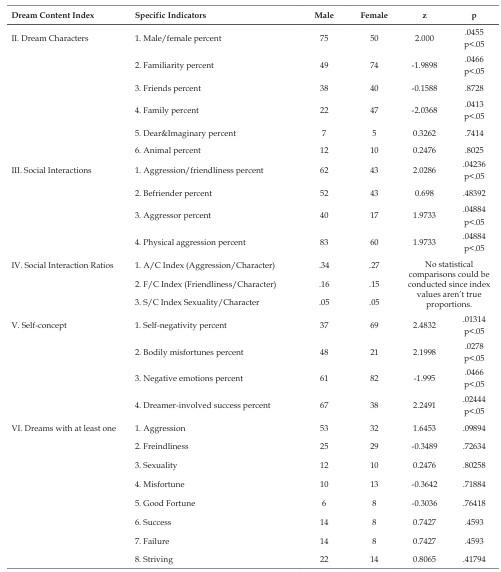
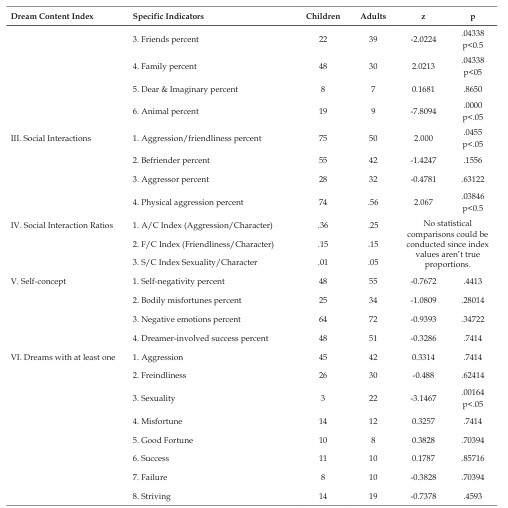
Background: This research study is part of a larger study, which was intended to examine the manifest dream content and meaning representation in children and adults. This part of the study addressed the question, Are there any significant differences between children’s and adults dream reports obtained through the Dream Recording Booklet with respect to the content? And are there any gender differences between children and adult groups. Aim and Objectives: To study how does the dream experience (length, location, characters, social interactions, and emotions) change from childhood to adulthood. Materials and Methods: To study the objective, the researcher adopted the methodology standardized by Margaret Bowman Howard of Iowa State University, Iowa, USA (1978), which in turn is based on the methodology developed by Hall and Van de Castle. The Dream Recording Booklet was circulated among the participants with clear instructions. Children were requested to recall and record their dreams just after the sunrise awakenings. Parents were asked to support reminding children about their daily recordings without interfering with the children’s dream experiences. In six to eight months, dream data was collected from all the children and adults in the sample. This home-based data collection method worked out very well in obtaining the data. Results: In our comparison of assertiveness between children and adults, we observed that children have a mean score of 3.31, accompanied by a standard deviation of 1.65. Adults, on the other hand, exhibit a higher mean score of 4.42, with a standard deviation of 1.15. The analysis yielded a t-value of 3.491 and a p-value of 0.0008. Since the p-value is below the threshold of 0.05, we can confidently conclude that there is a significant difference between the two groups. This leads us to reject the null hypothesis (H0), which posits that there is no substantial difference in the number of dreams experienced by children and adults. Instead, we accept the alternative hypothesis (H1), indicating that children and adults indeed differ in the number of dreams they experience. This insight can guide further research and discussions on the emotional and cognitive development of both age groups. Conclusion: The findings of this study align with those of several other studies conducted by Avila-White, Schneider, & Domhoff, 1999; Oberst, Charles, & Chamarro, 2005; Saline, 1999; Strauch & Lederbogen, 1999. The scores obtained support the idea that cultural differences influence the dreams of both children and adults. As a result, dream content analysis plays a significant role in understanding the nature of dreams across different age groups.
References
- 1. Avila-White, Deborah, Adam Schneider, G. William Domhoff (1999), The Most Recent Dreams of 12–13 Year Old Boys and Girls: A Methodological Contribution to the Study of Dream Content in Teenagers, Dreaming, June 1999, 9(2):163-171; DOI: 10.1023/A:1021393716255
- 2. Brenneis, C. (1970). Male and female ego modalities in manifest dream content. Journal of Abnormal Psychology, 76, 434-442.
- 3. CARTwRIGHT, D., 1953. Toward a social psychology of groups. Presidential address delivered before the Society for the Psychological Study of Social Issues, Cleveland, Ohio, 5.
- 4. Crugnola, Cristina Riva., Alfio Maggiolini, Claudia Caprin, Cinzia De Martini, and Federica Giudici (2008), Dream Content of 10- to 11-YearOld Preadolescent Boys and Girls, Dreaming, Vol.18, No.3, 201-216; DOI: 10.1037/a0013379
- 5. Domhoff, G. W. (1996). Finding meaning in dreams: A quantitative approach. New York: Plenum Press.
- 6. Dumhoff, G. William (1999), New Directions in the Study of Dream Content Using the Hall and Van de Castle Coding System, Dreaming, Vol.9 Nos.2/3.
- 7. Foulkes, D. (1982). Children’s dreams: Longitudinal studies. New York: Wiley.
- 8. Foulkes, D. (1999&2002). Children’s dreaming and the development of consciousness. Harvard University Press.
- 9. HaIl C.S. and R.L. Van de Castle, (1966). The Content Analysis o f Dreams, Appleton- CenturyCrofts, New York.
- 10. Hall, C.S. Strangers in Dreams (1963): An Empirical Confirmation of the Oedipus Complex. Journal of Personality, Vol. 31, pp. 336-345.
- 11. Hall, C.S. (1967), Are Prenatal and Birth Experiences Represented in Dreams? The Psychoanalytic Review, Vol. 54, pp. 99-105.
- 12. Hall, C.S. (1969) Content Analysis of Dreams: Categories, Units, and Norms. In Gerbner, G. et al., Eds. The Analysis of Communication Content. New York: Wiley, pp. 147-158.
- 13. Hall C.S. (1969), Normative Dream-Content Studies. In Kramer, M.,( Edited.) Dream Psychology and the New Biology of Dreaming. New York: Thomas, . pp. 175-184.
- 14. Hall, C. S. and G. W. Domhoff (1968) . The Dreams of Freud and Jung. Psychology Today, June, pp. 42- 45; 64-65.
- 15. Hall, C.S. and R.E. Lind (1970). Dreams, Life, and Literature: A Study of Franz Kafka. Chapel Hill, North Carolina: University of North Carolina Press.
- 16. Hall, C.S. and R.L. Van de Castle (1966). The Content Analysis of Dreams. New York: AppletonCentury-Crofts.
- 17. Hauri, Peter, Jack Sawyer and Allan Rechtschaffen (1967), Dimensions of Dreaming: A Factored Scale for Rating Dream Reports, Journal of Abnormal Psychology, Journal of Abnormal Psychology, 72(1):16-22
- 18. Howard, M.B. (1978). Manifest dream content of adolescents. Doctoral dissertation, Iowa State University
- 19. Krippner, Stanley and Jan Weinhold (2002), Gender differences in a content analysis study of 608 dream reports from research participants in the united states, Social Behavior And Personality, 2002, 30(4), 399-410; DOI 10.2224/ sbp.2002.30.4.399ates.
- 20. Langs R.J. (1966): Manifest dreams from three clinical groups. Arch Gen Psychiat 14:634–43.
- 21. Oberst, U., Charles, C., & Chamarro, A. (2005). Influence of gender and age in aggressive dream content of Spanish children and adolescents. Dreaming, 15, 170–177.
- 22. Saline, Sharon (1999), The Most Recent Dreams of Children Ages 8-11, Dreaming, Vol.9., Nos. 2/3.
- 23. Sheppard E, Rosehan D. (1965): Thematic analysis of dreams. Percept Motor Skills 21:375–84.
- 24. Strauch, I., & Lederbogen, S. (1999). The home dreams and waking fantasies of boys and girls between ages 9 and 15: A longitudinal study. Dreaming, 9, 153–161.
- 25. Strauch, I. (2005). REM dreaming in the transition from late childhood to adolescence: A longitudinal study. Dreaming, 15(3), 155–169. https://doi.org/10.1037/1053-0797.15.3.155
- 26. Tartz, Robert S. and Stanley Krippner (2008), Cognitive Differences in Dream Content Between Argentine Males and Females Using Quantitative Content Analysis, Dreaming, 2008, Vol. 18, No. 4, 217–235; DOI: 10.1037/a0013780
- 27. Tokar J.T., Brunse A.J., Castelnuovo-Tedesco P., Stefflre VJ (1973). An objective method of dream analysis. Psychoanal Q. 1973;42(4):563-78. PMID: 4766829.
- 28. Valli K., Revonsuo A, Pälkäs O, Ismail K.H., Ali K.J., Punamäki R.L. (2005). The threat simulation theory of the evolutionary function of dreaming: Evidence from dreams of traumatized children. Conscious Cogn. Mar;14(1):188-218. doi: 10.1016/ S1053-8100(03)00019-9. PMID: 15766897.
- 29. Winget, C., & Kramer, M. (1979). Dimensions of dreams. Gainesville, FL: University of Florida Press.
Data Sharing Statement
There are no additional data available. All raw data and code are available upon request
Funding
This research received no funding
Author Contributions
All authors contributed significantly to the work and approve its publication
Ethics Declaration
This article does not involve any human or animal subjects, and therefore does not require ethics approval
Acknowledgements
We would like to express our gratitude to the patients, their families, and all those who have contributed to this study.
Conflicts of Interest
No conflicts of interest in this work
About this article

Cite this article
Sudhakar Venukapalli, How does the Dream Experience (Length, Location, Characters, Social Interactions, and Emotions) Change from Childhood to Adulthood. RFP Ind Jr of Med Psy. 2024;7(2):59–71.
Licence:
Attribution-Non-commercial 4.0 International (CC BY-NC 4.0)This license enables reusers to distribute, remix, adapt, and build upon the material in any medium or format for noncommercial purposes only, and only so long as attribution is given to the creator
| Received | Accepted | Published |
|---|---|---|
| October 26, 2024 | November 15, 2024 | December 30, 2024 |
DOI: n.a
Keywords
PsychoanalysisDream ContentDream ExperienceEmotions in DreamsDream CharacteristicsDream ContentDream ExperienceEmotions in DreamsDream CharacteristicsSearch for Similar Articles
Article Level Metrics
Last UpdatedWednesday 21 October 2026, 07:02:35 (IST)
1331
Accesses
15
243
00
Citations
NA
NA
NA
Download citation
Article Keywords
Keyword Highlighting
Highlight selected keywords in the article text.
Timeline
| Received | October 26, 2024 |
| Accepted | November 15, 2024 |
| Published | December 30, 2024 |
licence
Attribution-Non-commercial 4.0 International (CC BY-NC 4.0)
This license enables reusers to distribute, remix, adapt, and build upon the material in any medium or format for noncommercial purposes only, and only so long as attribution is given to the creator