Full Text (PDF)
RFP Indian Journal of Medical Psychiatry 8(2):p 47-56, July - Dec. 2025. | DOI: https://doi.org/10.21088/ijmp.2395.311X.8225
Original Article
A Cross-Sectional Study on The Role and Comparative Impact of Stressful Life Events in Suicide and Suicide Attempts
Aadap Pranathi, Md Adil Faizan, Govindappagari Venkata Jithendra, Geethanjali null, M Pramod Kumar Reddy
Author Information
Licence:
Attribution-Non-commercial 4.0 International (CC BY-NC 4.0)This license enables reusers to distribute, remix, adapt, and build upon the material in any medium or format for noncommercial purposes only, and only so long as attribution is given to the creator.
RFP Indian Journal of Medical Psychiatry 8(2):p 47-56, July - Dec. 2025. | DOI: https://doi.org/10.21088/ijmp.2395.311X.8225
How Cite This Article:
Aadap Pranathi, Md Adil Faizan, Govindappagari Venkata Jithendra et. al, A Cross-Sectional Study on The Role and Comparitive Impact of Stressful Life Events in Suicide and Suicide Attempts. RFP Ind Jr of Med Psy. 2025; 8(2): 47-56.Timeline
Received : July 14, 2025
Accepted : September 23, 2025
Published : December 30, 2025
Abstract
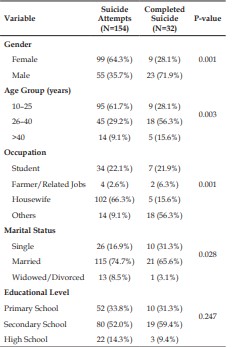
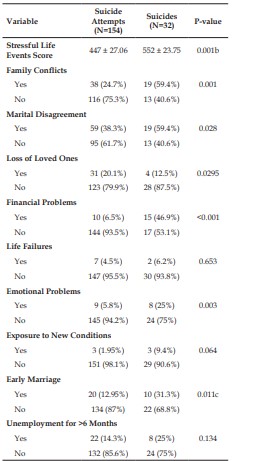
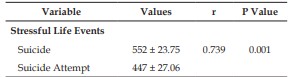
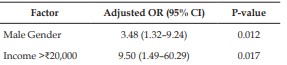
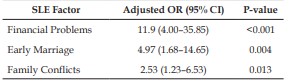
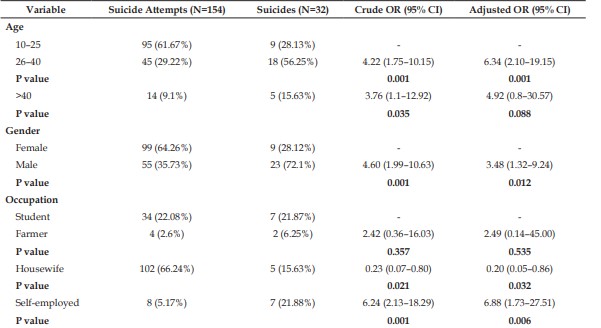
Background: Suicide and suicide attempts represent significant global public health concerns, particularly in developing countries like India. Stressful life events (SLEs) are recognized as critical risk factors for suicidal behavior (SB), yet limited research in India has directly compared the impact of SLEs between completed suicides and suicide attempts. Objectives: This study aimed to examine the role and comparative impact of SLEs in individuals who died by suicide versus those who attempted suicide in Khammam, Telangana. Methods: A cross-sectional study was conducted at the Government General Hospital, Khammam, from 2024 to 2025. Out of 624 individuals with documented SB, 186 participants were randomly selected 154 with suicide attempts and 32 with completed suicides. Data on socio-demographics and SLEs were collected via hospital records, structured interviews, and a culturally adapted Life Events Questionnaire. Statistical analyses, including logistic regression, were conducted to identify predictors of suicide. Results: Completed suicides were predominantly male (71.9%) and in the 26–40-year age group, whereas suicide attempts were more common in younger individuals (10–25 years) and females. The mean SLE score was significantly higher in suicides (552 ± 23.75) than in attempts (447 ± 27.06; p=0.001). Financial problems (OR=11.9), early marriage (OR=4.97), and family conflicts (OR=2.53) were the strongest predictors of completed suicide. Higher income, self-employment, and exposure to new environments also independently increased suicide risk. Conclusion: SLEs are strongly associated with increased suicide risk, particularly financial distress, early marriage, and family conflicts. Targeted interventions addressing these stressors, alongside socio-cultural factors, are imperative for suicide prevention strategies in rural and semi-urban Indian settings.
References
- 1. World Health Organization. Suicide prevention (SUPRE). Geneva: World Health Organization; 2023. Available from: https://www.who.int/ teams/mental-health-and-substance-use/ suicide-prevention.54 RFP Indian Journal of Medical Psychiatry IJMP/Volume 8 Number 2/July–December 2025
- 2. World Health Organization. Suicide worldwide in 2019: global health estimates. Geneva: World Health Organization; 2021. Available from: https://www.who.int/publications/i/ item/9789240067381.
- 3. Nock MK, Borges G, Bromet EJ, et al. Crossnational prevalence and risk factors for suicidal ideation, plans and attempts. Br J Psychiatry. 2008;192(2):98–105. doi: 10.1192/ bjp.bp.107.040113.
- 4. Weissman MM, Bland RC, Canino GJ, et al. Prevalence of suicide ideation and suicide attempts in nine countries. Psychol Med. 1999;29(1):9–17. doi: 10.1017/ s003329179800820x.
- 5. Vijayakumar L. Suicide in developing countries. Crisis. 2005;26(3):112–6. doi: 10.1027/0227-5910.26.3.112.
- 6. Kessler RC, Borges G, Walters EE. Prevalence of and risk factors for lifetime suicide attempts in the National Comorbidity Survey. Arch Gen Psychiatry. 1999;56(7):617–26. doi: 10.1001/ archpsyc.56.7.617.
- 7. National Crime Records Bureau. Accidental deaths and suicides in India – 2022. New Delhi: Ministry of Home Affairs, Government of India; 2023. Available from: https://ncrb. gov.in/sites/default/files/ADSI%202022%20 Volume%201.pdf
- 8. Ahmad M, Khan AM, Yousuf S, Huda F. Hanging as a method of suicide: Retrospective analysis of autopsy cases. Egypt J Forensic Sci. 2015;5(2):90–5. doi: 10.1016/j.ejfs.2015.04.001.
- 9. Patel V, Ramasundarahettige C, Vijayakumar L, et al. Suicide mortality in India: A nationally representative survey. Lancet. 2012;379(9834):2343–51. doi: 10.1016/s0140- 6736(12)60738-x.
- 10. Rezaeian M. The association between natural disasters and suicide: A systematic review. Malays J Med Sci. 2013;20(2):30–6. Available from: https://pubmed.ncbi.nlm.nih.gov/ 23983522/
- 11. Mann JJ, Apter A, Bertolote J, et al. Suicide prevention strategies: A systematic review. JAMA. 2005;294(16):2064–74. doi: 10.1001/ jama.294.16.2064.
- 12. Fergusson DM, Horwood LJ, Ridder EM, Beautrais AL. Suicidal behaviour in adolescence and subsequent mental health outcomes in young adulthood. Psychol Med. 2005;35(7):983–93. doi: 10.1017/ s003329170400422x.
- 13. Vijayakumar L, John S, Pirkis J, Whiteford H. Suicide in developing countries (2): Risk factors. Crisis. 2005;26(3):112–9. doi: 10.1027/0227-5910.26.3.112.
- 14. International Institute for Population Sciences (IIPS) and ICF. National Family Health Survey (NFHS-5), 2019-21: India. Mumbai: IIPS; 2021. Available from: https://dhsprogram.com/ pubs/pdf/FR375/FR375.pdf
- 15. Patel V, Araya R, Chatterjee S, et al. Treatment and prevention of mental disorders in lowincome and middle-income countries. Lancet. 2007;370(9591):991–1005. doi: 10.1016/s0140- 6736(07)61240-9.
- 16. Vijayakumar L. Indian research on suicide. Indian journal of psychiatry. 2010 Jan 1;52(Suppl1):S291-6.
- 18. Beautrais AL. Risk factors for suicide and attempted suicide among young people. Australian & New Zealand Journal of Psychiatry. 2000 Jun;34(3):420-36.
- 20. Joiner, T. E. (2005). Why people die by suicide. Harvard University Press.
- 21. Zalsman, G., Hawton, K., & Corcoran, P. (2016). Suicide prevention strategies: An international perspective. The Lancet Psychiatry, 3(1), 34-44. https://doi.org/10.1016/S2215- 0366(15)00281-1.
- 22. Van Orden, K. A., & Joiner, T. E. (2010). The interpersonal-psychological theory of suicidal behavior. Current Directions in Psychological Science, 19(5), 277-282. https:// doi.org/10.1177/0963721410382686.
- 23. Knipe, D. W., Clements, C. R., & Gunnell, D. (2017). The impact of stressful life events on suicide risk: A meta-analysis. Psychological Medicine, 47(12), 2113-2124. https://doi. org/10.1017/S0033291717000839.
- 24. Zhang, J., & Li, X. (2012). Economic stress and suicide in China: A review. International Journal of Social Psychiatry, 58(3), 259-265. https://doi. org/10.1177/0020764011420394.
- 25. Beautrais, A. L. (2003). Financial stress and suicide: A review of the literature. Suicide and LifeThreatening Behavior, 33(1), 3-8. https://doi. org/10.1521/suli.33.1.3.22769.
- 26. Sharma, S., & Srivastava, M. (2017). Early marriage and its effects on mental health in India: A review. Indian Journal of Social Psychiatry, 33(2), 113-118. https://doi. org/10.4103/ijsp.ijsp_10_17.
- 27. Ganesan, S., Mathai, A., & Suresh, A. (2019). Early marriage and its association with suicide risk among women in rural India. Indian Journal of Psychiatry, 61(3), 234- 240. https://doi.org/10.4103/psychiatry. IndianJPsychiatry_7_18.
- 28. Duncan, D. F., St. John, D. W., & Becker, G. L. (2017). The role of work-related stress and job satisfaction in the occurrence of suicide: A case-control study. Journal of Occupational Health Psychology, 22(3), 362-374. https://doi. org/10.1037/ocp0000049. 29. Pirkis, J., & Blood, R. W. (2006). Suicide and suicidal behaviour. Medical Journal of Australia, 184(10), S1-S12. https://doi. org/10.5694/j.1326-5377.2006.tb00632.x.
- 30. Chang, S. S., Gunnell, D., Sterne, J. A., & Lu, T. H. (2013). Suicide risk in relation to income and unemployment: A cohort study of 1.3 million people in Taiwan. Lancet, 361(9374), 1079–1085. https://doi.org/10.1016/S0140- 6736(03)12808-0.
- 31. Gupta, H., Kumar, V., & Sharma, S. (2017). Migration and mental health: Exploring the risk of suicidal behaviors among migrants in India. Asian Journal of Psychiatry, 30, 8-13. https://doi.org/10.1016/j.ajp.2017.01.011.
- 32. Cavanagh, J. T., Carson, A. J., Sharpe, M., & Lawrie, S. M. (2003). Psychological autopsy studies of suicide: A systematic review. Psychological Medicine, 33(3), 395-405. https:// doi.org/10.1017/S0033291702007020.
- 33. Rahe, R. H., Holmes, T. H., & Wachs, T. D. (1970). Life events and illness susceptibility. American Journal of Psychiatry, 126(10), 1294- 1302. https://doi.org/10.1176/ajp.126.10.1294.
- 34. Turecki, G., & Brent, D. A. (2016). Suicide and suicidal behaviour. Lancet, 387(10024), 1227-1239. https://doi.org/10.1016/S0140- 6736(16)30002-X.
- 35. Hawton, K., Saunders, K. E., & O’Connor, R. C. (2013). Self-harm and suicide in adolescents. Lancet, 379(9834), 2373-2382. https://doi. org/10.1016/S0140-6736(12)60322-5.
Data Sharing Statement
There are no additional data available. All raw data and code are available upon request.
Funding
This research received no funding.
Author Contributions
All authors contributed significantly to the work and approve its publication.
Ethics Declaration
This article does not involve any human or animal subjects, and therefore does not require ethics approval.
Acknowledgements
We would like to express our gratitude to the patients, their families, and all those who have contributed to this study.
Conflicts of Interest
No conflicts of interest in this work.
About this article

Cite this article
Aadap Pranathi, Md Adil Faizan, Govindappagari Venkata Jithendra et. al, A Cross-Sectional Study on The Role and Comparitive Impact of Stressful Life Events in Suicide and Suicide Attempts. RFP Ind Jr of Med Psy. 2025; 8(2): 47-56.
Licence:
Attribution-Non-commercial 4.0 International (CC BY-NC 4.0)This license enables reusers to distribute, remix, adapt, and build upon the material in any medium or format for noncommercial purposes only, and only so long as attribution is given to the creator.
| Received | Accepted | Published |
|---|---|---|
| July 14, 2025 | September 23, 2025 | December 30, 2025 |
DOI: https://doi.org/10.21088/ijmp.2395.311X.8225
Keywords
SuicideSuicide AttemptsStressful Life EventsRisk FactorsIndiaCrossSectional StudySearch for Similar Articles
Similar Articles
- Relationship Between Mmitral Valve Prolapse and Panic Disorder
- Late-Onset Mania in a 73-Year-Old Male: A Case Report
- Internet Derived Information Obstruction Treatment (IDIOT) Syndrome and its Impa...
- Multivariable Regression Analysis of Depression, Anxiety and Stress in Male Alco...
- A Study to Evaluate the Effectiveness of Supportive Psychotherapy among the Elde...
Article Level Metrics
Last UpdatedSunday 06 September 2026, 02:40:44 (IST)
903
Accesses
23
155
00
Citations
NA
NA
NA
Download citation
Article Keywords
Keyword Highlighting
Highlight selected keywords in the article text.
Timeline
| Received | July 14, 2025 |
| Accepted | September 23, 2025 |
| Published | December 30, 2025 |
licence
Attribution-Non-commercial 4.0 International (CC BY-NC 4.0)
This license enables reusers to distribute, remix, adapt, and build upon the material in any medium or format for noncommercial purposes only, and only so long as attribution is given to the creator.