Full Text (PDF)
RFP Indian Journal of Medical Psychiatry 7(2):p 43-47, July - Dec 2024. | DOI: n.a
Original Article
Obstructive Sleep Apnea (OSA) and its Association with Depression
Md Adil Faizan, K Sri Divya Reddy, Geethanjali null, M Raghuram, R Sateesh Babu
Author Information
Licence:
Attribution-Non-commercial 4.0 International (CC BY-NC 4.0)This license enables reusers to distribute, remix, adapt, and build upon the material in any medium or format for noncommercial purposes only, and only so long as attribution is given to the creator.
RFP Indian Journal of Medical Psychiatry 7(2):p 43-47, July - Dec 2024. | DOI: n.a
How Cite This Article:
Md Adil Faizan, K Sri Divya Reddy, et al., Obstructive Sleep Apnea (OSA) and its Association with Depression. RFP Ind Jr of Med Psy. 2024;7(2):43–47.Timeline
Received : August 20, 2024
Accepted : October 05, 2024
Published : December 30, 2024
Abstract
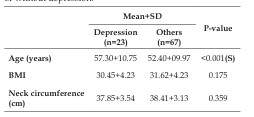
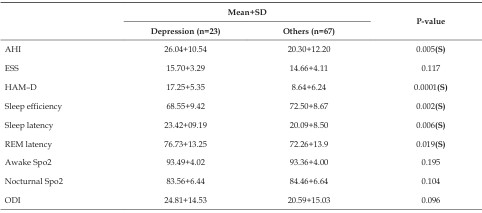
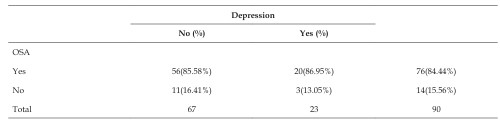
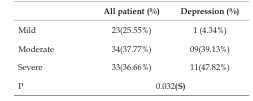
Objective: This study investigates the correlation between Obstructive Sleep Apnea (OSA) and depression, examining how OSA impacts psychiatric well-being and quality of life. Introduction: Obstructive Sleep Apnea (OSA) is characterized by episodes of partial or complete airway obstruction during sleep, leading to fragmented and non-restorative sleep. OSA has significant implications for mental health, including a strong association with depression and other psychiatric conditions. Despite considerable evidence linking OSA with psychiatric symptoms, the precise nature of this relationship remains ambiguous. Methods: A cross-sectional study was conducted with 182 participants at a tertiary care center in Telangana from July 2022 to June 2023. Tools employed included the Epworth Sleepiness Scale (ESS), Polysomnography (PSG), and the Hamilton Depression Rating Scale (HAM-D). Participants included those referred for PSG who consented to the study. Exclusions were made for patients with nocturnal oxygen supplementation, recent upper airway surgery, or unstable cardiopulmonary, neurological, or psychiatric conditions.Results: Out of 90 patients who underwent PSG, 23 were diagnosed with depression. These patients were significantly older (mean age 57.30 years) compared to non-depressed individuals (mean age 52.40 years, P < 0.001). Depression was associated with higher HAM-D scores (mean 17.25) and poorer sleep efficiency (68.55%) compared to non-depressed patients (HAM-D mean 8.64, sleep efficiency 72.50%). Additionally, depressed patients exhibited longer sleep latency and REM latency. The Apnoea-Hypopnoea Index (AHI) was significantly higher in depressed patients (mean 26.04) compared to non-depressed patients (mean 20.30, P = 0.005). The majority of depressed patients had abnormal PSG results, with 91.3% showing aberrant findings. Discussion: The study confirms a significant association between OSA and depression. Depression exacerbates OSA symptoms and impairs sleep quality, with substantial implications for patient management and treatment outcomes. The link between OSA and psychiatric conditions such as depression highlights the need for integrated treatment approaches that address both sleep and mental health issues. Conclusion: OSA is prevalent among individuals with depression, and its impact on psychiatric well-being is considerable. Clinicians should be vigilant in screening for OSA in depressed patients to improve overall treatment outcomes. Further research is needed to explore the mechanisms underlying the OSA-depression connection and to develop comprehensive management strategies.
References
- 1. Slowik JM, Sankari A, Collen JF. Obstructive Sleep Apnea. [Updated 2022 Dec 11]. In: Stat Pearls [Internet]. Treasure Island (FL): Stat Pearls Publishing; 2024 Jan
- 2. Epidemiology of sleep apnoea/hypopnea syndrome and sleep-disordered breathing. P. Jennum, R.L. Riha European Respiratory Journal Apr 2009, 33 (4) 907-914; DOI:10.1183/09031936.00180108
- 3. Abbasi A, Gupta SS, Sabharwal N, Meghrajani V, Sharma S, Kamholz S, Kupfer Y. A comprehensive review of obstructive sleep apnea. Sleep Science. 2021 Apr; 14(2):142.
- 4. Hakim F, Gozal D, Gozal LK. Sympathetic and catechol aminergic alterations in sleep apnea with particular emphasis on children. Frontiers in neurology. 2012 Jan 30; 3:20505.
- 5. Osman AM, Carter SG, Carberry JC, Eckert DJ. Obstructive sleep apnea: current perspectives. Nat Sci Sleep.2018Jan23;10:21-34.doi:10.2147/ NSS.S124657.
- 6. Shoib S, Ullah I, Nagendrappa S, Taseer AR, De Berardis D, Singh M, Asghar MS. Prevalence of mental illness in patients with obstructive sleep apnea - A cross-sectional study from Kashmir, India. Ann Med Surg (Lond). 2022 Jul 6; 80:104056. doi:10.1016/j.amsu.2022.104056.
- 7. Olaithe M, Nanthakumar S, Eastwood PR, Bucks RS. Cognitive and mood dysfunction in adult obstructive sleep apnoea (OSA): Implications for psychological research and practice. Translational Issues in Psychological Science.2015Mar;1(1):67.
- 8. Turner K, Zambrelli E, Lavolpe S, Baldi C, Furia F, Canevini MP. Obstructive sleep apnea: neurocognitive and behavioral functions before and after treatment. Functional Neurology. 2019; 34(2):71-8.
- 9. Riemann D, Benz F, Dressle RJ, Espie CA, Johann AF, Blanken TF, Leerssen J, Wassing R, Henry AL, Kyle SD, Spiegel halder K. Insomnia disorder: State of the science and challenges for the future. Journal of sleep research. 2022 Aug; 31(4):e13604.
- 10. Shoib S, Malik JA, Masoodi S. Depression as a Manifestation of Obstructive SleepApnea. JNeurosciRuralPract.2017 Jul-Sep; 8(3):346-351. doi:10.4103/jnrp.jnrp_462_16
Data Sharing Statement
There are no additional data available. All raw data and code are available upon request.
Funding
This research received no funding
Author Contributions
All authors contributed significantly to the work and approve its publication
Ethics Declaration
This article does not involve any human or animal subjects, and therefore does not require ethics approval
Acknowledgements
We would like to express our gratitude to the patients, their families, and all those who have contributed to this study
Conflicts of Interest
No conflicts of interest in this work
About this article

Cite this article
Md Adil Faizan, K Sri Divya Reddy, et al., Obstructive Sleep Apnea (OSA) and its Association with Depression. RFP Ind Jr of Med Psy. 2024;7(2):43–47.
Licence:
Attribution-Non-commercial 4.0 International (CC BY-NC 4.0)This license enables reusers to distribute, remix, adapt, and build upon the material in any medium or format for noncommercial purposes only, and only so long as attribution is given to the creator.
| Received | Accepted | Published |
|---|---|---|
| August 20, 2024 | October 05, 2024 | December 30, 2024 |
DOI: n.a
Keywords
Obstructive Sleep ApneaDepressionPolysomnographyPsychiatric ComorbiditySleep Disorders.DepressionPolysomnographyPsychiatric ComorbiditySleep Disorders.Search for Similar Articles
Similar Articles
- Relationship Between Mmitral Valve Prolapse and Panic Disorder
- Late-Onset Mania in a 73-Year-Old Male: A Case Report
- Internet Derived Information Obstruction Treatment (IDIOT) Syndrome and its Impa...
- Multivariable Regression Analysis of Depression, Anxiety and Stress in Male Alco...
- A Study to Evaluate the Effectiveness of Supportive Psychotherapy among the Elde...
Article Level Metrics
Last UpdatedSunday 06 September 2026, 02:39:23 (IST)
903
Accesses
16
155
00
Citations
NA
NA
NA
Download citation
Article Keywords
Keyword Highlighting
Highlight selected keywords in the article text.
Timeline
| Received | August 20, 2024 |
| Accepted | October 05, 2024 |
| Published | December 30, 2024 |
licence
Attribution-Non-commercial 4.0 International (CC BY-NC 4.0)
This license enables reusers to distribute, remix, adapt, and build upon the material in any medium or format for noncommercial purposes only, and only so long as attribution is given to the creator.