Full Text (PDF)
Community and Public Health Nursing 10(2):p 89-95, May. Aug 2025. | DOI: https://doi.org/10.21088/cphn.2455.8621.10225.4
Original Article
Protocol for a Qualitative Study Exploring the Perspectives on the Lived Experiences of COVID-19 Survivors in a Selected Community Sector, Madhya Pradesh
Author Information
Licence:
Attribution-Non-commercial 4.0 International (CC BY-NC 4.0)This license enables reusers to distribute, remix, adapt,
and build upon the material in any medium or format for noncommercial purposes
only, and only so long as attribution is given to the creator.
Community and Public Health Nursing 10(2):p 89-95, May. Aug 2025. | DOI: https://doi.org/10.21088/cphn.2455.8621.10225.4
How Cite This Article:
George G, Devakirubai E. Protocol for a qualitative study exploring the perspectives on the lived experiences of COVID-19 survivors in a selected community sector, Madhya Pradesh. Community Pub Health Nurs. 2025;10(2):89-95.Timeline
Received : February 15, 2025
Accepted : March 21, 2025
Published : July 10, 2025
Abstract
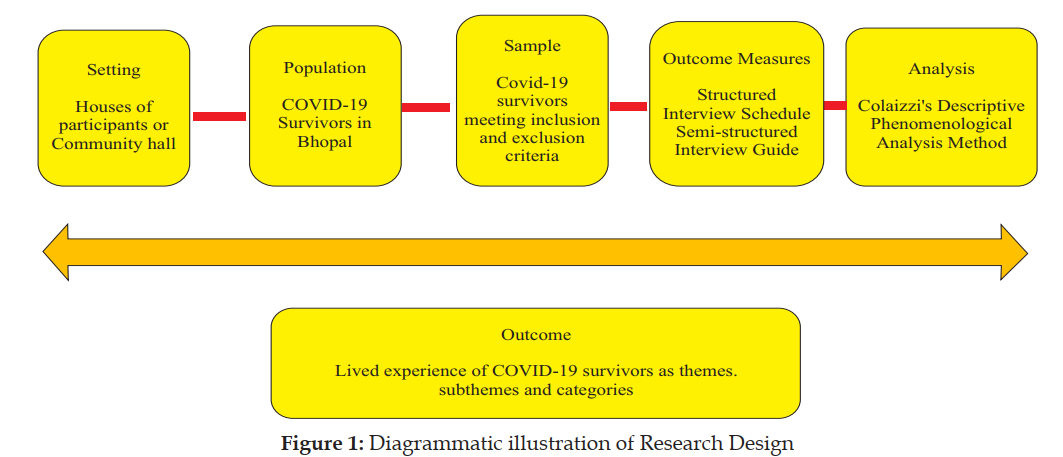
Introduction: COVID-19, also known as Coronavirus, is a highly virulent infection of the upper respiratory tract caused by the SARS-CoV-2 virus. On January 30, 2020, the World Health Organization (WHO) declared COVID-19 as a public health emergency of international concern. While extensive research exists on COVID-19’s epidemiology, treatments, and outcomes, rural survivors’ personal and communal experiences are less understood, despite the unique factors that shape rural health and resilience. Aim: A phenomenological study was used to explore the “lived experiences of COVID-19 survivors in a selected community sector, Madhya Pradesh.” Methodology: The study will use Husserl’s descriptive phenomenology, which focuses on subjective lived experiences. Purposive sampling with initial snowball sampling, maximum variation sampling will be used in the study. Structured interview schedule on demographic and clinical variables of COVID-19 survivors and semi-structured individual in-depth interview guide will use collect data. Data will collect till data saturation. Ethical permission is obtained from the Institute Ethics committee. Data Analysis: Qualitative analysis, descriptive statistics will be used to examine the data that the researcher had gathered from the patients during the study. The analysis will be done using Colaizzi’s seven step method and MAXQDA/NVivo. Conclusion: The outcome of the project will be recommendations that reflect the views and experiences of COVID-19 survivors. The findings will be disseminated via conferences and peer-reviewed publications.
References
- 1. Pamlin D, Armstrong S. 12 Risks that Threaten Human Civilisation: The Case for a New Risk Category. Stockholm (Sweden): Global Challenge Foundation; 2015.
- 2. Xu H, Zhong L, Deng J, Peng J, Dan H, Zeng X, et al. High expression of ACE2 receptor of 2019-nCoV on the epithelial cells of oral mucosa. Int J Oral Sci. 2020 Feb 24;12(1):8. doi: 10.1038/s41368-020-0074-x.
- 3. Wan Y, Shang J, Graham R, Baric RS, Li F. Receptor Recognition by the Novel Coronavirus from Wuhan: an Analysis Based on Decade-Long Structural Studies of SARS Coronavirus. J Virol. 2020 Mar 17;94(7):e00127-20.
- 4. Baig AM, Khaleeq A, Ali U, Syeda H. Evidence of the COVID-19 Virus Targeting the CNS: Tissue Distribution, Host-Virus Interaction, and Proposed Neurotropic Mechanisms. ACS Chem Neurosci. 2020 Apr 1;11(7):995-998.
- 5. World Health Organization. WHO COVID-19 Situation Report. 2020. Available from: (link unavailable)
- 6. Gumarang Jr BK, Mallannao RC, Gumarang BK. Colaizzi’s methods in descriptive phenomenology: basis of A Filipino novice researcher. Int J Multidiscip Appl Bus Educ Res. 2021 Oct 13;2(10):928-933.
- 7. MAXQDA [software]. Version 2024. Berlin: VERBI Software; 2023.
- 8. Lincoln YS, Guba EG. But is it rigorous? Trustworthiness and authenticity in naturalistic evaluation. New Dir Program Eval. 1986 Jun;(30):73-84.
Data Sharing Statement
There are no additional data available. All raw data and code are available upon request.
Funding
No funding has been received for the study.
Author Contributions
All authors contributed significantly to the work and approve its publication.
Ethics Declaration
This article does not involve any human or animal subjects, and therefore does not require ethics approval.
Acknowledgements
Information not provided.
Conflicts of Interest
The authors report no conÁict of interest.
About this article

Cite this article
George G, Devakirubai E. Protocol for a qualitative study exploring the perspectives on the lived experiences of COVID-19 survivors in a selected community sector, Madhya Pradesh. Community Pub Health Nurs. 2025;10(2):89-95.
Licence:
Attribution-Non-commercial 4.0 International (CC BY-NC 4.0)This license enables reusers to distribute, remix, adapt,
and build upon the material in any medium or format for noncommercial purposes
only, and only so long as attribution is given to the creator.
| Received | Accepted | Published |
|---|---|---|
| February 15, 2025 | March 21, 2025 | July 10, 2025 |
DOI: https://doi.org/10.21088/cphn.2455.8621.10225.4
Keywords
HumansPublic HealthCOVID-19ResiliencePsychologicalSARS-CoV-2Search for Similar Articles
Similar Articles
- A Study to assess the Impact of Structured Teaching Programme on Knowledge of Pl...
- Effectiveness of Nurse Led Intervention on Knowledge and Practice of Food Borne...
- Effectiveness of a Structured Teaching Programme on Knowledge, Attitude, and Pra...
- A Study to assess the Effectiveness of Video Assisted Teaching on Knowledge Rega...
- Effectiveness of Planned Teaching Programme on Knowledge and Skill Regarding BLS...
Article Level Metrics
Last UpdatedTuesday 29 September 2026, 13:50:16 (IST)
7593
Accesses
27
1522
00
Citations
NA
NA
NA
Download citation
Article Keywords
Keyword Highlighting
Highlight selected keywords in the article text.
Timeline
| Received | February 15, 2025 |
| Accepted | March 21, 2025 |
| Published | July 10, 2025 |
licence
Attribution-Non-commercial 4.0 International (CC BY-NC 4.0)
This license enables reusers to distribute, remix, adapt,
and build upon the material in any medium or format for noncommercial purposes
only, and only so long as attribution is given to the creator.