Full Text (PDF)
Indian Journal of Surgical Nursing 11(3):p 89-97, September-December 2022. | DOI: https://doi.org/10.21088/ijsn.2277.467X.11322.3
Original Article
Prevalence of Postpartum Depression during Covid 19 Pandemic
S Sridevy, I. Pravina, Felicia Chitra
Author Information
Licence:
Attribution-Non-commercial 4.0 International (CC BY-NC 4.0)This license enables reusers to distribute, remix, adapt, and build upon the material in any medium or format for noncommercial purposes only, and only so long as attribution is given to the creator.
Indian Journal of Surgical Nursing 11(3):p 89-97, September-December 2022. | DOI: https://doi.org/10.21088/ijsn.2277.467X.11322.3
How Cite This Article:
I Pravina, S Sridevy, Felicia Chitra/Prevalence of Postpartum Depression during Covid 19 Pandemic/Indian J Surg Nurs. 2022;11(3):89–97.Timeline
Received : July 19, 2022
Accepted : August 20, 2022
Published : December 30, 2022
Abstract
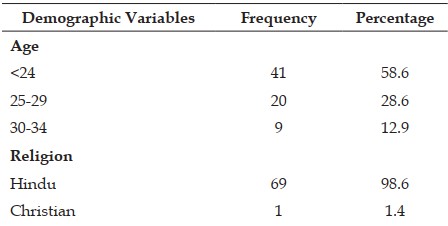
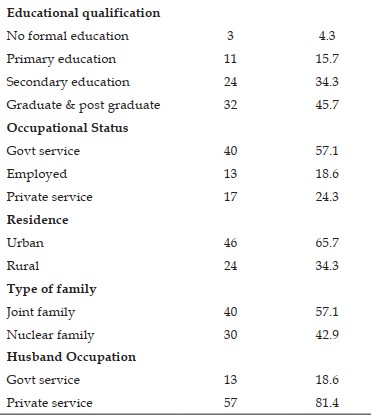
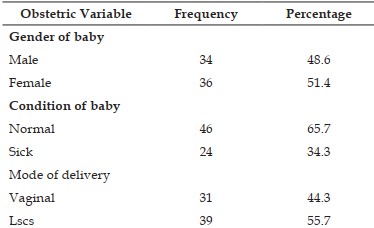
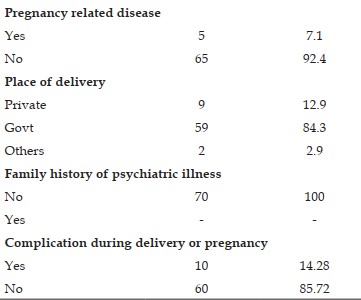
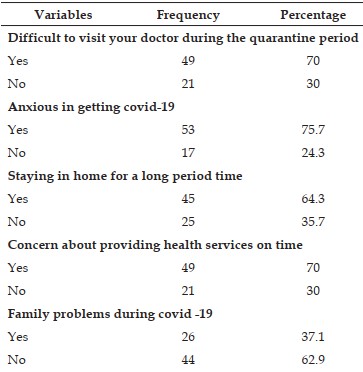
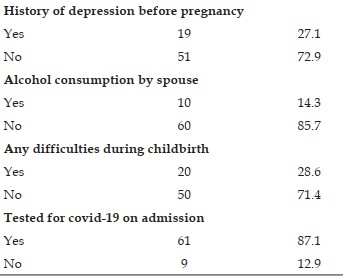
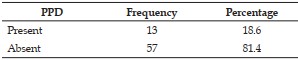
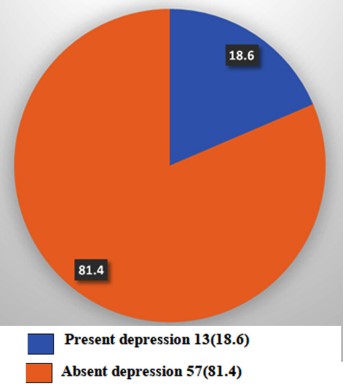
Background: The coronavirus disease (COVID-19) is a highly infectious disease and have posed a global health threat. The 2019 coronavirus disease (COVID-19) is a public health emergency of International concern. To date, there are limited studies that have investigated the impact of COVID-19 pandemic on mental health among female population. Aim: This study was aimed to investigate the prevalence of postpartum depression (PPD) and its related factors among women in RGGW&CH, Puducherry during the COVID-19 pandemic. Methodology: A cross-sectional study was performed from June 2021, using direct interview among 70 mothers at 6–12 weeks postpartum. The Edinburgh Postnatal Depression Scale and a self structured questionnaire regarding associated factors was administered to all participants. Result: In this study, the proportion of patients with and without post-partum depression was found to be 13(18.6)% and 57(81.4)% respectively.The demographic and obstetric variables such as religion, mode of delivery, and complication during delivery of pregnancy were statistically significant at the p value of p<0.035, p<0.003, p<0.001 respectively. The chi-square test reveals that factors such as family problems during covid, history of depression before pregnancy, husband consume alcohol, stressful feeling, adequate family support are significantly associated with level of depression, p<0.008, p<0.002, p< 0.006, p< 0.009, p< 0.027. Conclusion: According to findings, there was a high prevalence of postpartum depression among postnatal mother during the COVID-19 period. Additionally, strategies have to be developed by health care authorities to design recommendations and actions to prevent occurrence of post-partum depression during the pandemic.
References
- 1. Wang C, Horby PW, Hayden FG, Gao GF. A novel coronavirus outbreak of global health concern. The lancet. 2020 Feb 15;395(10223):470-3.
- 2. Nishiura H, Jung SM, Linton NM, Kinoshita R, Yang Y, Hayashi K, et al. The extent of transmission of novel coronavirus in Wuhan, China, 2020. J Clin Med. 2020;9(2):330.
- 3. Mahase E. China coronavirus: WHO declares international emergency as death toll exceeds 200. BMJ: British Medical Journal (Online). 2020 Jan 31;368.
- 4. Liang P, Wang Y, Shi S, Liu Y, Xiong R. Prevalence and factors associated with postpartum depression during the COVID-19 pandemic among women in Guangzhou, China: a cross-sectional study. BMC psychiatry. 2020 Dec;20(1):1-8.
- 5. Lu YC, Shu BC, Chang YY. The mental health of hospital workers dealing with severe acute respiratory syndrome. Psychotherapy and psychosomatics. 2006;75(6):370-5.
- 6. Rubin GJ, Potts HW, Michie S. The impact of communications about swine flu (influenza A H1N1v) on public responses to the outbreak: results from 36 national telephone surveys in the UK. Health Technology Assessment. 2010;14(34):183-266.
- 7. Wang C, Pan R, Wan X, Tan Y, Xu L, Ho CS, Ho RC. Immediate psychological responses and associated factors during the initial stage of the 2019 coronavirus disease (COVID-19) epidemic among the general population in China. International journal of environmental research and public health. 2020 Jan;17(5):1729.
- 8. Yim IS, Tanner Stapleton LR, Guardino CM, HahnHolbrook J, Dunkel Schetter C. Biological and psychosocial predictors of postpartum depression: systematic review and call for integration. Annual review of clinical psychology. 2015 Mar 28;11:99-137.
- 9. Abdollahi F, Zarghami M. Effect of postpartum depression on women’s mental and physical health four years after childbirth. East Mediterr Health J. 2018 Oct 1;24 (10):1002-9.
- 10. Faisal-Cury A, Menezes PR, d’Oliveira AF, Schraiber LB, Lopes CS. Temporal relationship between intimate partner violence and postpartum depression in a sample of low income women. Maternal and child health journal. 2013 Sep;17(7):1297-303.
- 11. Schaller M, Murray DR, Bangerter A. Implications of the behavioural immune system for social behaviour and human health in the modern world. Philosophical Transactions of the Royal Society B: Biological Sciences. 2015 May 26;370 (69):20140105.
- 12. Lee DT, Yip SK, Chiu HF, Leung TY, Chan KP, Chau IO, Leung HC, Chung TK. Detecting postnatal depression in Chinese women: validation of the Chinese version of the Edinburgh Postnatal Depression Scale. The British Journal of Psychiatry. 1998 May;172(5):433-7.
- 13. Modi VP, Parikh MN, Valipay SK. A study on prevalence of postpartum depression and correlation with risk factors. Annals of Indian Psychiatry. 2018 Jan 1;2(1):27.
- 14. Tarabay AI, Boogis D, Tabbakh AT, Kemawi RA, Boogis LA, Tabbakh AT, Al-Hadrami MM, AlHadrami MM. Prevalence and Factors Associated with Postpartum Depression during the COVID-19 Pandemic among Women in Jeddah, Saudi Arabia: A Cross-Sectional Study. Open Journal of Obstetrics and Gynecology. 2020 Nov 30;10(11):1644.
- 15. Selvam G, Balasubramanian J, Chanu SM. Frequency of postpartum depression among primi mothers undergoing delivery in JIPMER using Edinburgh postnatal depression scale.
- 16. Suárez-Rico BV, Estrada-Gutierrez G, SánchezMartínez M, Perichart-Perera O, RodríguezHernández C, González-Leyva C, Osorio-Valencia E, Cardona-Pérez A, Helguera-Repetto AC, Espino y Sosa S, Solis-Paredes M. Prevalence of depression, anxiety, and perceived stress in postpartum Mexican women during the COVID-19 lockdown. International journal of environmental research and public health. 2021 Apr 27;18(9):4627.
Data Sharing Statement
There are no additional data available. All raw data and code are available upon request.
Funding
This research received no funding.
Author Contributions
All authors contributed significantly to the work and approve its publication.
Ethics Declaration
This article does not involve any human or animal subjects, and therefore does not require ethics approval.
Acknowledgements
We would like to express our gratitude to the patients, their families, and all those who have contributed to this study.
Conflicts of Interest
No conflicts of interest in this work.
About this article

Cite this article
I Pravina, S Sridevy, Felicia Chitra/Prevalence of Postpartum Depression during Covid 19 Pandemic/Indian J Surg Nurs. 2022;11(3):89–97.
Licence:
Attribution-Non-commercial 4.0 International (CC BY-NC 4.0)This license enables reusers to distribute, remix, adapt, and build upon the material in any medium or format for noncommercial purposes only, and only so long as attribution is given to the creator.
| Received | Accepted | Published |
|---|---|---|
| July 19, 2022 | August 20, 2022 | December 30, 2022 |
DOI: https://doi.org/10.21088/ijsn.2277.467X.11322.3
Keywords
Post-partum DepressionPostnatal motherCOVID-19PrevalenceSearch for Similar Articles
Similar Articles
Article Level Metrics
Last UpdatedFriday 24 July 2026, 06:43:42 (IST)
1071
Accesses
3
216
00
Citations
NA
NA
NA
Download citation
Article Keywords
Keyword Highlighting
Highlight selected keywords in the article text.
Timeline
| Received | July 19, 2022 |
| Accepted | August 20, 2022 |
| Published | December 30, 2022 |
licence
Attribution-Non-commercial 4.0 International (CC BY-NC 4.0)
This license enables reusers to distribute, remix, adapt, and build upon the material in any medium or format for noncommercial purposes only, and only so long as attribution is given to the creator.