Full Text (PDF)
Indian Journal of Anesthesia and Analgesia 9(4):p 167-177, july-august 2022. | DOI: https://doi.org/10.21088/ijaa.2349.8471.9422.17
Original Article
Preoperative Anxiety Analysis in Patients Undergoing Surgeries: A Comparative Study using Preoperative Counselling, Tablet Diazepam 10 Mg and Non-Counselled Patients
Deepak M. Kokane null, Anju Minj 1 null, Deepak M Kokane 2 null, S D Chauhan 3 null, Surekha More 4 null
Author Information
Licence:
Attribution-Non-commercial 4.0 International (CC BY-NC 4.0)This license enables reusers to
distribute, remix, adapt, and build upon the material in any medium or format
for noncommercial purposes only, and only so long as attribution is given to
the creator.
Indian Journal of Anesthesia and Analgesia 9(4):p 167-177, july-august 2022. | DOI: https://doi.org/10.21088/ijaa.2349.8471.9422.17
How Cite This Article:
Anju Minj, Deepak M. Kokane, S.D. Chauhan, et al./Preoperative Anxiety Analysis In Patients Undergoing Surgeries: A Comparative Study using Preoperative Counselling, Tablet Diazepam 10 Mg and Non-Counselled Patients/Indian J Anesth Analg. 2022;9(4)167-177.
Timeline
Received : June 24, 2022
Accepted : July 02, 2022
Published : August 18, 2022
Abstract
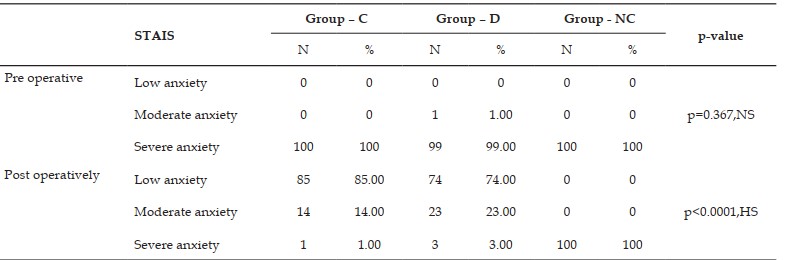
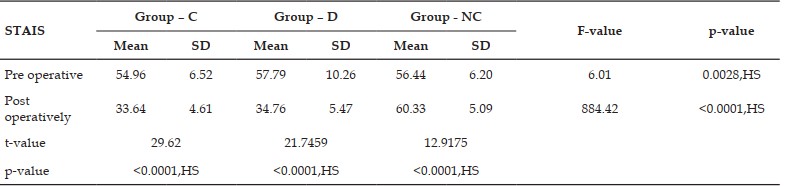
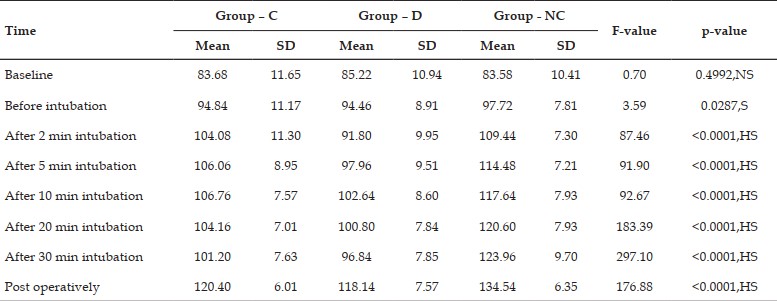
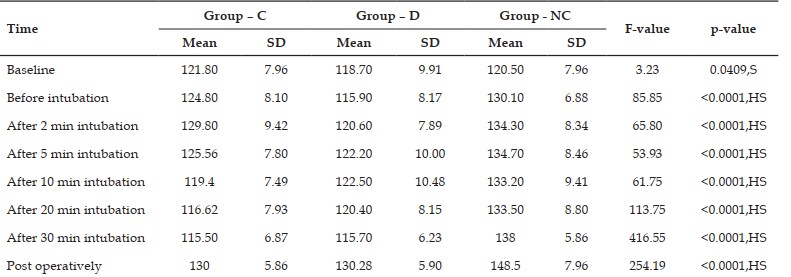
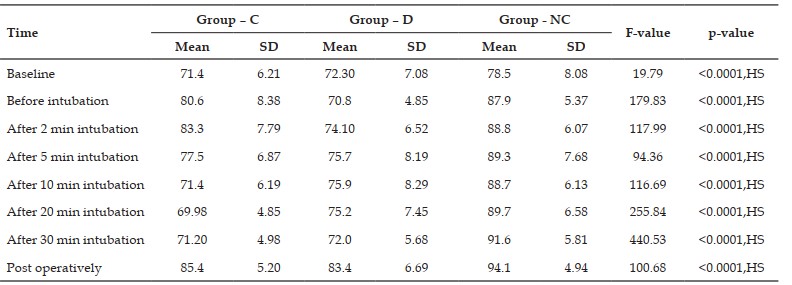
Objectives: To compare the anxiety level of patients who have received pre-operative counselling, tablet Diazepam 10 mg previous night of surgery and patients who have neither received any anxiolytic medication nor pre-operative counselling, To monitor preoperative, intraoperative and post-operative pulse rate, blood pressure of study groups, to note the length of hospital, stay of the patient post operatively. Methods: Three hundred ASA 1/2 patients admitted for elective surgical procedure requiring anesthesia were assigned into one of the three groups. •Group C =Pre-Operative counselling done, •Group D =Tab. Diazepam 10mg HS 1day prior to Surgery. •Group NC= Non-counselled patients.The study group C patients are counselled in respects of the type of anesthesia, operative procedure. The study group D is given tab. Diazepam 10 mg a night prior to surgery. The study group NC is neither given pre-operative counselling nor given tab Diazepam. They are non-counselled group.Data is collected by means of a questionnaire given to the patients in the form of Spielberger’ state – Trait Anxiety Inventory scale (STAIS). The patients anxiety levels were measured. Result: In our study the three groups had high STAIS score before surgery with normal baseline haemodynamic values. Patients who received counselling and tab. Diazepam pre operatively were haemodynamically stable during intra and post operative period and had a low to moderate anxiety score during post operative visit as compared to group NC which neither received pre operative counselling nor tab. Diazepam and had unstable pulse rate, systolic blood pressure, diastolic blood pressureduring intra and post operative period. Their STAIS score after surgery remained high as compared to their pre operative score. Group C and D had mean hospital stay of 4.04 ± 0.65 to 4.75 ± 0.97 days which is less than group NC with mean hospital stay was 6.55 ± 0.67 days. Conclusion: Lack of information related to possible pre-operation and post-operation conditions increases the anxiety level of patients. This causes intra operative instability in haemodynamic, post-operative emotional problems and thus increase hospital stay. Personal interview and previous night anxiolytic (Tab. Diazepam) are good at alleviating the anxiety throughout the perioperative period. Transfer of knowledge and information through counselling to be more effective in decreasing the anxiety and apprehension. It is more helpful in patients who are illiterate and who do not actively participate in the interview. Hence, a personal interview along with an anxiolytic previous night of surgery is a good option in allaying the anxiety. This study has critically examined and found that preoperative patient education significantly reduces intra operative haemodynamic instability, postoperative anxiety and length of hospital stay. This study strongly recommends preoperative patient education so as to have better outcome, less morbidity and less healthcare cost.
References
- 1. Textbook of miller’s Anesthesia, 9th edition 2020, page no. 1641 – 42, 2437 – 39, 2259.
- 2. DrYeola, DrJaipuriya P. Effect of preoperativecounseling on post operative outcome in Hernia surgery patients. International Journal of Science and Research (IJSR) Volume 5 Issue 7, July 2016.
- 3. P Akkamahadevi, VV Subramanian, The efficacy of different methods of pre-operative counselling on perioperative anxiety in patients undergoing regional anesthesia. Indian Journal of Anesthesia | Vol. 60 | Issue 1 | Jan 2016. September 28,
- 4. J. B. Dyck FRCPC, F. Chung, FRCPC, A comparison of propranolol and diazepam for preoperative anxiolysis. 12th April 1991. Canadian Journal Of Anesthesia 1991 / 38:6 / pp704-9.
- 5. H.A. Jlala, J.L.French,G.L. Foxall, J.G. Hardman and N. M, Bedforth, Effect of preoperative multimedia information on perioperative anxiety in patients undergoing procedures under regional anesthesia. January 4, 2010. British Journal of Anesthesia 104 (3): 369–74 (2010).
- 6. Arup Dasgupta, SayandevDasgupta, SupratikSen, Sukanta Sen. Girish Kishore Sinha. Benzodiazepinehypnotics as oral pre anesthetic medication: a comparative clinical study. 24 october 2016. International Surgery Journal | January 2017 | Vol 4 | Issue 1.
- 7. Inna Maranets, MD and Zeev N. Kain MD, Preoperative anxiety and intraoperative anesthetic requirements. AnesthAnalg 1999;89:1346-51. August 27, 1999.
- 8. P. Forrest, D. C. Galletly and P. Yee, Placebo controlled comparison of Midazolam, Triazolam and Diazepam as oral premedicants for out patientanesthesia, August 1987. Anesthesia and Intensive Care. Vol. 15. No. 3. August. 1987.
- 9. Michael F. Roizen, MD, P. ALLanKlock, MD, and Jerome Klafta, MD, How much do they really want to know Preoperative patient interviews and the Anesthesiologist. 1996. International Anesthesia research socirty. AnesthAnalg 1996;82:443-4
- 10. C. F. Swinhoe, MB,BS,MRCGP,FRCA,FFARCSI, Patient’s knowledge of Anesthetic practice and the role of anesthetists. South Afr J AnaesthAnalg 2017;23(1).
- 11. L. Birol, “Period of nursery Izmir,” Etki Press, 2005,pp.14-15.
- 12. R. Yardakci and N. Akyolcu, “The effect of the visits made preoperation on the patients’ anxiety level,” The Turkish Journal of research and Development in nursing, vol.1, No.2, 2004, pp. 7-14.
- 13. F. Erdil and N. OzhanElbas, “Medical – Surgical Nursing ,” DesingOfset, Ankara, 2001,pp.98-136.
- 14. M. Mitchell, “Anxiety Management : A Distinct Nursing role in day surgery,” Ambulatory Surgery, Vol. 8, No. 3, 2000, pp.119-127.
- 15. Man AK, Yap JC, Kwan SY, Suen KL, Yip HS, Chen PP. The effect of intra-operative vedio on patient anxiety. Anesthesia 2003;58:64-8.
- 16. Maranets I, Kain ZN. Preoperative anxiety and intraoperative anesthetic requirements. AnesthAnalg 1999;89:1346-51.
- 17. Boore, J., 1978. Prescription for Recovery. RCN, London) and Hayward, J., 1975. Information-a prescription against Pain, RCN, London) Int J Nurs Stud. 1999 Apr;36(2):171-7.
- 18. A. Akkaş, “Determinibg the Anxiety Levels of Patients during the Pre-operative Period and the Factors Which May Cause Anxiety,” The Turkish Journal of Research and Development in Nursing, No 1, 2001, pp. 23-29.
- 19. K. Asilioglu and S. S. Celik, “The Effect of Preoperative Education on Anxiety of Open Cardiac Surgery Patients,” Patient Education and Counseling, Vol. 53, No. 1, 2004, pp. 65-70.
- 20. M. Sjöling, G. Nordahl, N. Olofsson and K. Asplund, “The Impact ofPreoperative İnformation on State Anxiety, Postoperative Pain and Satisfaction with Pain Management,” Patient Education and Counseling, Vol. 51, No. 2, 2003, pp. 169-176.
- 21. Ö. Karayurt, “Effects of Different Preoperative Teaching Programmes on the State Anxiety and Pain Level,” Journal of Cumhuriyet University NursingSchool, Vol. 2, No. 1, 1998, pp. 20-26.
- 22. Mechanisms to reduce hospital stays. Engelman RM, Ann Thorac Surg. 1996 Feb;61(2 Suppl):S26-9; discussion S33-4.
- 23. Kain ZN, Mayes LC, Bell C, Weisman S, HofstadterMB, Rimar S. remedication in the United States: astatus report. AnesthAnalg. 1997;84:427-32.
- 24. Madej TH, Passuke RT. Anesthesia preme dication: aims, assessment and methods. Can J Anaesth 1987;34:259-73.
- 25. Roizen MF. Pre-operative evaluation. In: Miller RD, Anesthesia 3rd edition. New York, Churchill Livingstone Inc, 1990.
- 26. Bunker TD. An information leaflet for surgicalpatients. Ann R CollSurg Engl. 1983;65:242- 3.
- 27. Bugge K, Bertelsen F, Bendtsen A. Patient’s desirefor information about anesthesia danishattitudes. ActaAnesthesiol Scand. 1998;42:91-6.
- 28. Chun-Ling Yang,1 Yan-Hua Tan,1 Xiu-Xia Jiang,1 Feng-Ying Meng,1 Yu-Ling Wu,1 Qiu-Lan Chen,1 Long-Le Ma1 ,2 and Le-Xin Wang 1 ,2 European Journal of Cardiovascular Nursing 11(3) Pg. 284– 288 © The European Society of Cardiology 2012
- 29. Sunil Sadruddin Samnani, 1 Muhammad Farooq Umer, 1 Syed Hussain Mehdi, 1 and Farah Naz Farid2Hindawi. Publishing CorporationInternational Scholarly Research NoticesVolume 2014, Article ID 250536, 5 agesReceived 28 April 2014; Accepted 8 August 2014; Published 29 October 2014.
- 30. Vittorio Oteri1 & Anna Martinelli2 & Elisa Crivellaro3 & Francesca Gigli3Neurosurgical Review (2021) 44:3047–3057Received: 2 November 2020 / Revised: 18 January 2021 /Accepted: 8 February 2021
- 31. Achmet Ali • DemetAltun • BahadirHakanOguz •Mehmet Ilhan • Fatma Demircan • Kemalettin KoltkaJAnesth (2014) 28:222–227Received: 21 June 2013 / Accepted: 30 August 2013 / Published online: 29 September 2013.
- 32. Fateme Dehghan1,2, Rostam Jalali3* and Hasan Bashiri1Dehghan et al. Perioperative Medicine (2019) 8:5Received: 3 March 2019 Accepted: 13 May 2019.
- 33. Jalali R. PhD1 *Dehghan F. PhD2 Iran Journal of Nursing (IJN)Vol. 30, No. 107, Oct 2017:1- 10.
- 34. H. O. Osinowo, B. O. Olley and A. O. Adejumo Osinowo H. O. et al WAJM Vol.22 No.4, October – December, 2003.
Data Sharing Statement
There are no additional data available. All raw data and code are available upon request.
Funding
This research received no funding.
Author Contributions
All authors contributed significantly to the work and approve its publication.
Ethics Declaration
This article does not involve any human or animal subjects, and therefore does not require ethics approval.
Acknowledgements
We would like to express our gratitude to the patients, their families, and all those who have contributed to this study.
Conflicts of Interest
No conflicts of interest in this work.
About this article

Cite this article
Anju Minj, Deepak M. Kokane, S.D. Chauhan, et al./Preoperative Anxiety Analysis In Patients Undergoing Surgeries: A Comparative Study using Preoperative Counselling, Tablet Diazepam 10 Mg and Non-Counselled Patients/Indian J Anesth Analg. 2022;9(4)167-177.
Licence:
Attribution-Non-commercial 4.0 International (CC BY-NC 4.0)This license enables reusers to
distribute, remix, adapt, and build upon the material in any medium or format
for noncommercial purposes only, and only so long as attribution is given to
the creator.
| Received | Accepted | Published |
|---|---|---|
| June 24, 2022 | July 02, 2022 | August 18, 2022 |
DOI: https://doi.org/10.21088/ijaa.2349.8471.9422.17
Keywords
Pre-operative anxiety analysispre-operative counselling.pre-operative counselling.Search for Similar Articles
Similar Articles
- Awake Fibreoptic Intubation for Airway Management in Massive Thyroid Enlargement...
- A Case of Thoracotomy with One Lung Ventilation for Carcinoma Oesophagus
- A Case of Empyema for Thoracotomy and Decortication-Anaesthesia Management
- Full Mouth Rehabilitation in a 3-Year-Old Female Child with Repaired Tetralogy o...
- Do Gel Manicures Affect SpO2 Readings ? A Clinical Investigation
Article Level Metrics
Last UpdatedMonday 13 July 2026, 12:28:58 (IST)
5653
Accesses
9
678
00
Citations
NA
NA
NA
Download citation
Article Keywords
Keyword Highlighting
Highlight selected keywords in the article text.
Timeline
| Received | June 24, 2022 |
| Accepted | July 02, 2022 |
| Published | August 18, 2022 |
licence
Attribution-Non-commercial 4.0 International (CC BY-NC 4.0)
This license enables reusers to
distribute, remix, adapt, and build upon the material in any medium or format
for noncommercial purposes only, and only so long as attribution is given to
the creator.