Full Text (PDF)
Indian Journal of Ancient Medicine and Yoga 15(4):p 169-173, October – December 2022. | DOI: https://doi.org/10.21088/ijamy.0974.6986.15422.5
Review Article
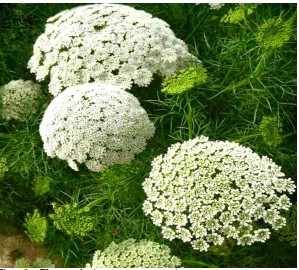
Phytochemical and Pharmacological Profile of Ammi visnaga Plant: A Potent Ethnomedicinal Plant
Rakesh Prajapati, Faculty, Department of Biology, The Radiant International School, Jahangirabad, Surat 395005, Gujarat, India. null, Rakesh Prajapati null
Author Information
Licence:
Attribution-Non-commercial 4.0 International (CC BY-NC 4.0)This license
enables reusers to distribute, remix, adapt, and build upon the material in any
medium or format for noncommercial purposes only, and only so long as
attribution is given to the creator.
Indian Journal of Ancient Medicine and Yoga 15(4):p 169-173, October – December 2022. | DOI: https://doi.org/10.21088/ijamy.0974.6986.15422.5
How Cite This Article:
Rakesh Prajapati/Phytochemical and Pharmacological Profile of Ammi visnaga Plant: A Potent: Ethnomedicinal Plant/Indian
J of Ancient & Yoga. 2022;15(4): 169–173.
Timeline
Received : August 27, 2022
Accepted : September 28, 2022
Published : November 30, 2022
Abstract
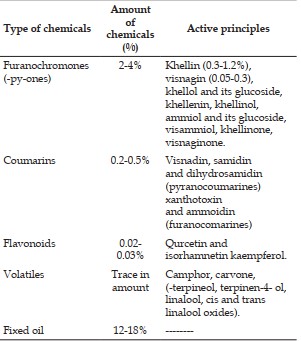
Ammi visnaga L. (Family: Apiaceae or Umbelliferae) is an herbaceous plant with a long history of traditional medicinal uses in many countries in the world. The plant has been known since ancient times for its curative properties and has been utilized for the treatment of circulatory problems, kidney stones, asthma, bronchitis, skin problems, and whooping cough. A wide range of chemical compounds including coumarins (glycosides), flavonoids, and volatile principles have been isolated from this species. Extracts from this plant have been found to possess various pharmacological activities. This contribution provides a comprehensive review of its ethnomedical uses, chemical constituents, and pharmacological profile as a medicinal plant. In this review, particular attention has been given to the anti-anginal, hypoglycemic and diuretic effects of the plant and thus the potential use of this plant in pharmaceutics can be evaluated.
References
- 1. Ghule ST, Patil DK. Kisan World 2001; 28(10): 33-34. www.scholarsresearchlibrary.com/DPL-vol2.
- 2. Khosoo TN. India’s biodiversity: Tasks ahead. Curr Sci 1994; 67: 577-582.
- 3. Vishnukanta, Rana AC. Melia azedarach: A phytopharmacological review. J Pharmacog Rev 2008; 2: 173-179.
- 4. Muller JL, Clauson KA. Pharmaceutical consideration of common herbal medicine, Am J Man Care 1997; 3(11): 1753-1770.
- 5. Hammouda FM, Ismail SI, Abdel-Azim NS, Shams KA. A Guide to Medicinal Plants in North Africa. IUCN Centre for Mediterranean Cooperation, Malaga, Spain 2005.
- 6. Boulos L. Flora of Egypt, 2nd ed., Al Hadara Publishing, Cairo, Egypt 2000.
- 7. Anonymous. Department of Pharmacognostic Sciences, Zyed Complex for Herbal Research and Traditional Medicine (ZCHRTM), Ministry of Health, Iran. Unpublished results 2001.
- 8. Kenner D, Requena Y. Botanical Medicine: A European Professional Perspective, Paradigm Publications, Brookline, Massachusetts, USA 2001, pp: 196.
- 9. Best MM, Coe WS. Effect of khellin on coronary artery insufficiency as evaluated by electrocardiographic tests. Circulation 1952; 2: 344-344.
- 10. Harvengt C, Desager JP. HDL-cholesterol increase in normolipaemic subjects on khellin: A pilot study. Int J Clin Pharmacol Res 1983; 3: 363- 366.
- 11. Rauwald HW, Brehm O, Odenthal KP. The involvement of a Ca2+ channel blocking mode of action in the pharmacology of Ammi visnaga fruits. Planta Med 1994; 60: 101-105.
- 12. Duarte JF, Perez-Vizcaino, Torres AI, Zarzuelo A, Jimenez J, Tamargo J. Vasodilator effects of visnagin in isolated rat vascular smooth muscle. Eur J Pharmacol 1995; 14: 115-122.
- 13. Jouad H, Mohamed M, Eddouks M. Hypoglycemic effect of aqueous extract of Ammi visnaga in normal and streptozotocin-induced diabetic rats. J Herb Pharmacother 2002; 2: 19-29.
- 14. Westendorf J, Vahlensieck W. Spasmolytic and contractile effects of combination product from plants on the smooth muscle of the guinea pigs. Arzneimittelforschung 1981; 31: 40-43.
- 15. Khan UA, Assiri AM, Maghrabi TM, 2001. Inhibition of oxalate nephrolithiasis with Ammi visnaga (AI-Khillah). I Urol Nephro 2001; 33(4): 605-608.
Data Sharing Statement
There are no additional data available. All raw data and code are available upon request.
Funding
This research received no funding
Author Contributions
All authors contributed significantly to the work and approve its publication.
Ethics Declaration
Provide information related to the Ethics Committee approval with approval number OR write, This article does not involve any human or animal subjects, and therefore does not require ethics approval.
Acknowledgements
We would like to express our gratitude to the patients, their families, and all those who have contributed to this study.
Conflicts of Interest
The authors report no conflicts of interest in this work.
About this article

Cite this article
Rakesh Prajapati/Phytochemical and Pharmacological Profile of Ammi visnaga Plant: A Potent: Ethnomedicinal Plant/Indian
J of Ancient & Yoga. 2022;15(4): 169–173.
Licence:
Attribution-Non-commercial 4.0 International (CC BY-NC 4.0)This license
enables reusers to distribute, remix, adapt, and build upon the material in any
medium or format for noncommercial purposes only, and only so long as
attribution is given to the creator.
| Received | Accepted | Published |
|---|---|---|
| August 27, 2022 | September 28, 2022 | November 30, 2022 |
DOI: https://doi.org/10.21088/ijamy.0974.6986.15422.5
Keywords
Coumarins; Curative properties; Flavonoids; Ethnomedical uses; Pharmacological profile; Volatile principles.Search for Similar Articles
Similar Articles
- Efficacy of Katupila Ghrita in the Management of Itartha dagdha Vrana (Burn Woun...
- Clinical Outcomes of Ayurvedic Management in Acute Influenza Like Illness: A Cas...
- Effect of Ayurvedic Drugs on Scalp Psoriasis (Kitibha Kustha)
- Yogic Elements in the Brahma Mahapurana: A Textual and Comparative Study
- Management of Adenoid Hypertrophy: An Ayurvedic Perspective
Article Level Metrics
Last UpdatedWednesday 16 September 2026, 14:40:28 (IST)
4112
Accesses
23
834
00
Citations
NA
NA
NA
Download citation
Article Keywords
Keyword Highlighting
Highlight selected keywords in the article text.
Timeline
| Received | August 27, 2022 |
| Accepted | September 28, 2022 |
| Published | November 30, 2022 |
licence
Attribution-Non-commercial 4.0 International (CC BY-NC 4.0)
This license
enables reusers to distribute, remix, adapt, and build upon the material in any
medium or format for noncommercial purposes only, and only so long as
attribution is given to the creator.