Full Text (PDF)
Journal of Cardiovascular Medicine and Surgery 10(1-2):p 9-13, January – June 2024. | DOI: http://dx.doi.org/10.21088/jcms.2454.7123.10(1-2)24.2
Original Article
Perioperative Management of Patients with Non-Cardiac Tumors Extending to the Cardiac Chambers and Great Vessels
Author Information
Licence:
Attribution-Non-commercial 4.0 International (CC BY-NC 4.0)This license enables reusers to distribute, remix, adapt, and build upon the material in any medium or format for noncommercial purposes only, and only so long as attribution is given to the creator.
Journal of Cardiovascular Medicine and Surgery 10(1-2):p 9-13, January – June 2024. | DOI: http://dx.doi.org/10.21088/jcms.2454.7123.10(1-2)24.2
How Cite This Article:
Das S. Perioperative management of patients with non-cardiac tumors extending to the cardiac chambers and great vessels. J Cardiovasc Med Surg. 2024;10(1-2):9-13.Timeline
Received : April 10, 2024
Accepted : May 26, 2024
Published : June 24, 2024
Abstract
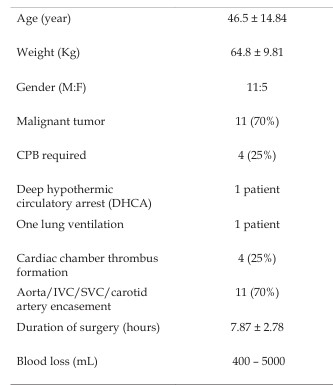
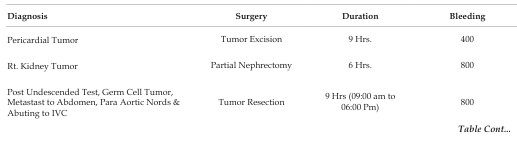
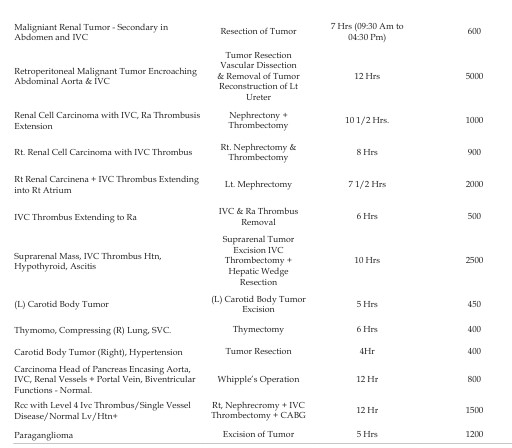
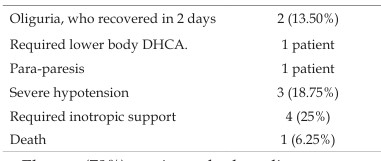
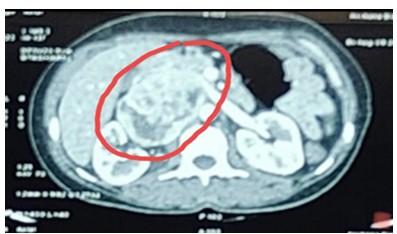
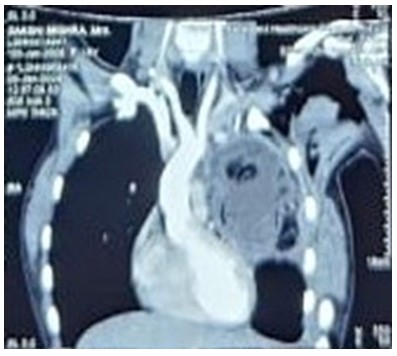
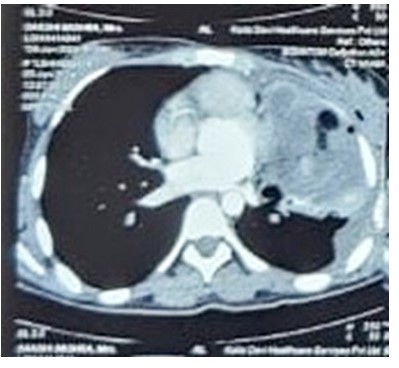
Background: Some tumors arise surrounding the heart, aorta and venacava. Malignant tumors have distant location with metastasis or encroachment to IVC, aorta and heart. Surgical removal requires cardio-vascular-thoracic surgery and anesthesia facilities to overcome the devastating complications. Hence the perioperative anaesthetic management and outcome of the non-cardiac tumors with cardiovascular involvement are studied. Method: Patients operated in CTVS OR for non-cardiac tumors with extension to heart and major vessels were studied. It was a retrospective cohort study. The anesthetic management, techniques, special cardiac supports, complications and outcomes were analysed from the medical records over 2.5yrs. Intraoperative transesophageal echocardiography (TEE) monitoring was used to guide the management. The data was presented in mean ± SD and percentages. Result: Sixteen patients of 46.5 ± 14.84yr age, weight 64.8 ± 9.81kg were evaluated. Four patients required CPB, deep hypothermic circulatory arrest (DHCA)-1 patient, one lung ventilation-1 patient, cardiac chamber thrombus formation-4, aorta-IVC-SVC carotid artery encasement were found in 11. Duration of surgery was 7.87 ± 2.78hrs. Blood loss was from 400-5000ml. Two patients had oliguria, who recovered in 2 days. Eleven patients had malignancy. One patient required lower body DHCA. Para-paresis was observed in 1 patient after 36hrs of surgery and recovered in 7days. Five patients were extubated in the OR. Four patients required inotropic support. One patient died on 8th day from MODS. Conclusion: The perioperative management of non-cardiac tumors with cardiovascular extension is unique and challenging. The facilities of cardiovascular team with CPB, one lung ventilation, DHCA, rapid transfusion and TEE were useful for a perfect outcome.
References
- 1. Fleisher LA, Fleischmann KE, Auerbach AD et al. 2014 ACC/AHA Guideline on Perioperative Cardiovascular Evaluation and Management of Patients Undergoing Noncardiac Surgery. Circulation 2014;130:e278–e333.
- 2. Oh SJ, Yeom SY, Kim KH et al. Clinical implication of surgical resection for the rare cardiac tumors involving heart and great vessels. J Korean Med Sci. 2013;28(5):717-24.
- 3. Liu Z, Zhang Q, Zhao X, et al. Inferior vena cava interruption in renal cell carcinoma with tumor thrombus: surgical strategy and perioperative results. BMC Surg. 2021;21(1):402 -409.
- 4. Campi R, Barzaghi P, Pecoraro A, et al. Contemporary techniques and outcomes of surgery for locally advanced renal cell carcinoma with focus on inferior vena cava thrombectomy: The value of a multidisciplinary team. Asian J Urol. 2022;9(3):272 281.
- 5. Park BJ, Bacchetta M, Bains MS et al. Surgical management of thoracic malignancies invading the heart or great vessels. Ann ThoracSurg 2004;78:1024–30.
- 6. Serban A, Dădârlat-Pop A, Tomoaia R, et al. The Role of Multimodality Imaging in the Diagnosis and Follow-Up of Malignant Primary Cardiac Tumors: Myxofibrosarcoma—A Case Report and Literature Review. Diagnostics. 2023; 13(10):1811- 20.
- 7. Pei X, Lu M, Liu Z et al. The value of enhanced multiparameteric MRI diagnostic model for preoperatively predicting surgical methods of inferior vena cava in patients with renal tumors and inferior vena cava tumor thrombus. BMC Med Imaging. 2023;23(1):86-95.
- 8. Koide Y, Mizoguchi T, Ishii K, Okumura F. Intraoperative management for removal of tumor thrombus in the inferior vena cava or the right atrium with multiplanetransesophageal echocardiography. Journal of Cardiovascular Surgery. 1998;39(5):641.
Data Sharing Statement
There are no additional data available.
Funding
This research received no funding.
Author Contributions
All authors contributed significantly to the work and approve its publication.
Ethics Declaration
This article does not involve any human or animal subjects, and therefore does not require ethics approval
Acknowledgements
Information Not Provided
Conflicts of Interest
No conflicts of interest in this work.
About this article

Cite this article
Das S. Perioperative management of patients with non-cardiac tumors extending to the cardiac chambers and great vessels. J Cardiovasc Med Surg. 2024;10(1-2):9-13.
Licence:
Attribution-Non-commercial 4.0 International (CC BY-NC 4.0)This license enables reusers to distribute, remix, adapt, and build upon the material in any medium or format for noncommercial purposes only, and only so long as attribution is given to the creator.
| Received | Accepted | Published |
|---|---|---|
| April 10, 2024 | May 26, 2024 | June 24, 2024 |
DOI: http://dx.doi.org/10.21088/jcms.2454.7123.10(1-2)24.2
Keywords
PerioperativeCardiac Anaesthesianon-cardiac tumorsCardiopulmonary Bypassone lung ventilationDeep hypothermic circulatory arrestTransesophageal EchocardiographySearch for Similar Articles
Similar Articles
- Giant Intra-cardiac Lipoma in the Right Atrium
- Case Report: Neurophysiological Facilitation of Respiration in an Infant with...
- Left Coronary Artery Fistula Masquerading as Coronary Insufficiency: A Rare Sur...
- Hemodynamic Monitoring by Point-of-Care Ultrasound: A Multiorgan, Physiology-Dri...
- Aortotomy Closure after Cardiac Valve Replacements: Nightmare for Surgeons
Article Level Metrics
Last UpdatedMonday 22 June 2026, 12:31:51 (IST)
681
Accesses
3
121
00
Citations
NA
NA
NA
Download citation
Article Keywords
Keyword Highlighting
Highlight selected keywords in the article text.
Timeline
| Received | April 10, 2024 |
| Accepted | May 26, 2024 |
| Published | June 24, 2024 |
licence
Attribution-Non-commercial 4.0 International (CC BY-NC 4.0)
This license enables reusers to distribute, remix, adapt, and build upon the material in any medium or format for noncommercial purposes only, and only so long as attribution is given to the creator.