Full Text (PDF)
Community and Public Health Nursing 10(3):p 139-143, Sep - Dec. 2025. | DOI: https://doi.org/10.21088/cphn.2455.8621.10325.3
Original Article
Pattern of Sleep and Sleep-Disturbing Factors Among Adults in UAE
Fahad Abdullah Almahry, Khawla Abdullah, Abdulrahman Salem, Thushara Shekhar, Soney M. Varghese
Author Information
Licence:
Attribution-Non-commercial 4.0 International (CC BY-NC 4.0)This license enables reusers to distribute, remix, adapt, and build upon the material in any medium or format for noncommercial purposes only, and only so long as attribution is given to the creator.
Community and Public Health Nursing 10(3):p 139-143, Sep - Dec. 2025. | DOI: https://doi.org/10.21088/cphn.2455.8621.10325.3
How Cite This Article:
Almahry FA, Abdullah K, Salem A, et al. Pattern of Sleep and Sleep-Disturbing Factors Among Adults in UAE. Community Pub Health Nurs. 2025;10(3):139-43.Timeline
Received : May 05, 2025
Accepted : July 10, 2025
Published : December 30, 2025
Abstract
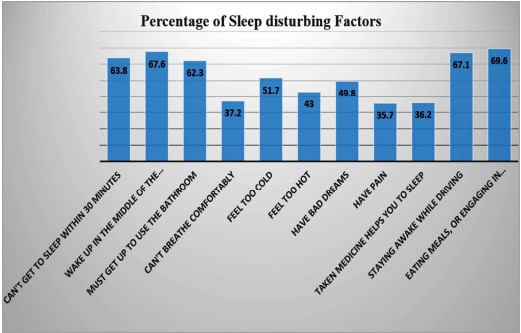
Background: It is commonly thought that the amount of sleep has declined during the past few decades along with the transition to modern 24/7 societies. This has provoked claims of an epidemic of sleep deprivation in the general population. Sleep difficulties are regarded as one of the most distressing aspects of an intensive care stay. Materials and Methods: Quantitative approach with descriptive cross-sectional survey design with convenience sampling was adopted for the study. The Study settings was Among public in UAE and the study duration was 3 weeks. The study instruments were demographic profile with 10 items and to assess the sleep pattern Athen’s insomnia assessment scale was used. A check list with 12 items were used to assess sleep disturbing factors. Results: The data reveals that among participants,44.0% (n = 91) of respondents reported having no problems with sleep. However, 31.9% (n = 66) experienced mild sleep disturbances. Around 24.2% (n = 50) reported moderate sleep problems. The data shows that many respondents face multifactorial sleep disturbances, with issues like pain (64.3%), breathing difficulty (62.8%), temperature discomfort, and use of sleep medication (63.8%) being especially prominent. Additionally, a significant portion experiences daytime sleepiness, affecting daily functioning and posing safety risks. Conclusion and Major Findings of the Study: The study concluded that sleep disturbances are common among adults and are influenced by a combination of socio-cultural, occupational, and health factors. Young adults, particularly those in the healthcare sector and smokers, were at higher risk. There is an urgent need to enhance sleep hygiene awareness, implement early screening for sleep disorders, and promote healthier lifestyle changes. Improving sleep health could lead to better physical and mental health outcomes and enhance the overall quality of life for the population.
References
- 1. Youngstedt S.D., Goff E.E., Reynolds AM et al. Has adult sleep duration declined over the last 50+ years? Sleep Med Rev. 2016; 28: 69–85. [PMC free article] [PubMed] [Google Scholar].
- 2. Al-Khaled, S., Hammoud, R., Al-Nefaie, M., Alturaiki, M., & Alsubaie, A. (2020). Prevalence and factors associated with poor sleep quality among university students in Saudi Arabia. International Journal of Environmental Research and Public Health, 17(15), 5857
- 3. Al-Hariri, M.T., Al-Maskari, F., & Saadi, H. (2017). Sleep habits and patterns among residents of the UAE. Journal of Sleep Research, 26(5), 643-651.
- 4. Viqar Bashrat, MD* Sarah Ibrahim Summan** et. al., Pattern of Sleep and Evaluation of Sleep Quality and Sleep-Disturbing Factors Among Adults, Vol. 45, No. 2, June 2023. Bahrain Medical Bulletin.
- 5. The relationship between sleep duration and health status in Qatar’s population. Al-Thani MA, Khaled SM. Public Health Pract (Oxf) 2020; 1: 100056. - PMC – PubMed
- 6. Kandeel N.A., Hady M.M., Tantawy N. The Effect of Back Massage on Perceived Sleep Quality among Adult Patients in Intensive Care Units. Am J Nurs Res 2019; 7(3): 278-85
- 7. National center for health statistics. QuickStats: percentage of adults who reported an average of ≤ 6 hours of sleep per 24-hour period, by sex and age group—United States, 1985 and 2004. MMWR Morb Mortal Wkly Rep. 2005; 54: 933.
- 8. Statistics Center Abu Dhabi. Statistical yearbook of Abu Dhabi 2020. Abu Dhabi: Statistics Center Abu Dhabi; 2021.
- 9. Cunningham C., O’Sullivan R., Caserotti P, Tully MA. Consequences of physical inactivity in older adults: A systematic review of reviews and meta-analyses. Scand J Med Sci Sports 2020; 30: 816-27.
- 10. Lawson H.J., Wellens-Mensah J.T., Attah Nantogma S. Evaluation of sleep patterns and self-reported academic performance among medical students at the University of Ghana school of medicine and dentistry. Sleep Disorders. 2019; 2019: 8. doi:
- 10. 1155/2019/1278579.1278579 [PMC free article] [PubMed] [CrossRef] [Google Scholar].
- 11. UAE Digital Media Statistics 2020. 2020 May 25. p. 2021. https://www.themedialab.me/uaedigital-media-statistics-2020/ Available from: [Google Scholar]
- 12. Dattani S., Ritchie H., Roser M. Mental Health. don’t cry B.B., MAN B. The Power of One. [updated 2021 Aug, cited 2021]. Available from: https://ourworldindata.org/mentalhealth#depression.
Data Sharing Statement
There are no additional data available. All raw data and code are available upon request.
Funding
This research received no funding.
Author Contributions
All authors contributed significantly to the work and approve its publication.
Ethics Declaration
Provide information related to the Ethics Committee approval with approval number OR write This article does not involve any human or animal subjects, and therefore does not require ethics approval.
Acknowledgements
We would like to express our gratitude to the patients, their families, and all those who have contributed to this study.
Conflicts of Interest
The authors report no conflicts of interest in this work.
About this article

Cite this article
Almahry FA, Abdullah K, Salem A, et al. Pattern of Sleep and Sleep-Disturbing Factors Among Adults in UAE. Community Pub Health Nurs. 2025;10(3):139-43.
Licence:
Attribution-Non-commercial 4.0 International (CC BY-NC 4.0)This license enables reusers to distribute, remix, adapt, and build upon the material in any medium or format for noncommercial purposes only, and only so long as attribution is given to the creator.
| Received | Accepted | Published |
|---|---|---|
| May 05, 2025 | July 10, 2025 | December 30, 2025 |
DOI: https://doi.org/10.21088/cphn.2455.8621.10325.3
Keywords
Sleep patternSleep disturbing factorsAdultsSearch for Similar Articles
Similar Articles
- A Study to assess the Impact of Structured Teaching Programme on Knowledge of Pl...
- Effectiveness of Nurse Led Intervention on Knowledge and Practice of Food Borne...
- Effectiveness of a Structured Teaching Programme on Knowledge, Attitude, and Pra...
- A Study to assess the Effectiveness of Video Assisted Teaching on Knowledge Rega...
- Effectiveness of Planned Teaching Programme on Knowledge and Skill Regarding BLS...
Article Level Metrics
Last UpdatedTuesday 29 September 2026, 13:46:34 (IST)
7593
Accesses
25
1522
00
Citations
NA
NA
NA
Download citation
Article Keywords
Keyword Highlighting
Highlight selected keywords in the article text.
Timeline
| Received | May 05, 2025 |
| Accepted | July 10, 2025 |
| Published | December 30, 2025 |
licence
Attribution-Non-commercial 4.0 International (CC BY-NC 4.0)
This license enables reusers to distribute, remix, adapt, and build upon the material in any medium or format for noncommercial purposes only, and only so long as attribution is given to the creator.