Full Text (PDF)
Indian Journal of Anesthesia and Analgesia 13(2):p 79-85, April-June 2026. | DOI: https://doi.org/10.21088/ijaa.2349.8471.13226.5
Review Article
Nebulized Dexmedetomidine Versus Lignocaine for Attenuation of Hemodynamic Responses to Laryngoscopy and Intubation in Hypertensive Patients
Nazir Nazia, Kumar Devender, Athota Sushma, Khanuja Samiksha, Garima Sinha
Author Information
Licence:
Attribution-Non-commercial 4.0 International (CC BY-NC 4.0)This license
enables reusers to distribute, remix, adapt, and build upon the material in any
medium or format for noncommercial purposes only, and only so long as
attribution is given to the creator.
Indian Journal of Anesthesia and Analgesia 13(2):p 79-85, April-June 2026. | DOI: https://doi.org/10.21088/ijaa.2349.8471.13226.5
How Cite This Article:
Nazir Nazia, Kumar Devender, Athota Sushma. Nebulized Dexmedetomidine Versus Lignocaine for Attenuation of Hemodynamic Responses to Laryngoscopy and Intubation in Hypertensive Patients. Ind J Anesth Analg. 2026; 13(2): 79-85.Timeline
Received : December 17, 2025
Accepted : January 20, 2026
Published : June 30, 2026
Abstract
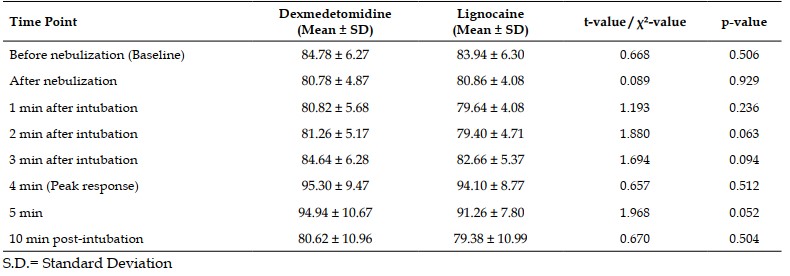
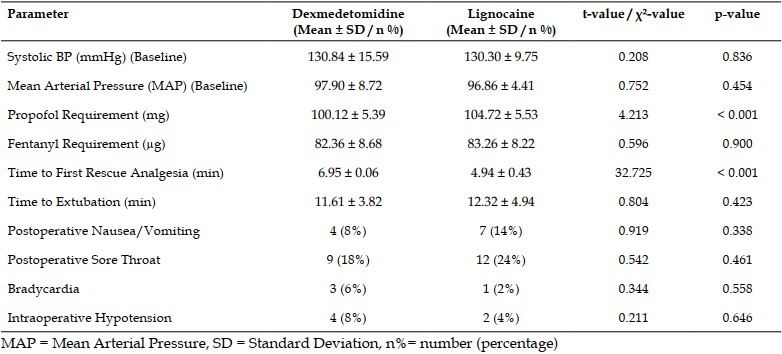
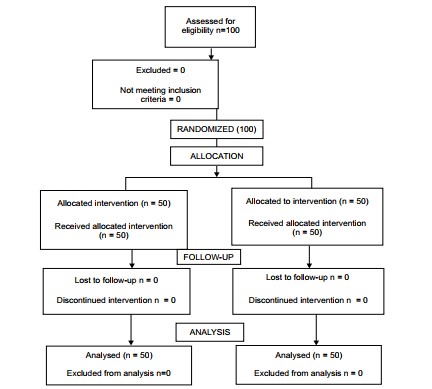
Context: Laryngoscopy and intubation provoke sympathetic surges that can endanger hypertensive patients. Nebulised dexmedetomidine and lignocaine can be used to blunt this response, but their relative effectiveness remains uncertain. Aims: The study aimed to compare the effectiveness of preoperative nebulization with dexmedetomidine versus lignocaine in blunting the hemodynamic response to laryngoscopy and intubation in hypertensive patients undergoing general anaesthesia for elective surgeries. The changes in systolic blood pressure, anaesthetic, and analgesic requirements were also recorded. Settings and Design: Randomised, double-blind study with 100 ASA class II hypertensive patients (18–60 y) scheduled for elective surgery under general anaesthesia were allocated to receive either dexmedetomidine 1 µg/kg (n = 50) or 4 % lignocaine 1 mL (40 mg, n = 50) via jet-nebuliser 15 min before induction. Methods and Material: Heart rate (HR), systolic and diastolic blood pressure (SBP, DBP), mean arterial pressure (MAP) and SpO2 were recorded at baseline, after nebulization and every minute for 10 min post-intubation. Time to first rescue analgesia, intra-operative fentanyl and propofol consumption, time to extubation, and adverse events were documented. Statistical analysis used: Independent t-tests, χ² tests and repeated-measures ANOVA (SPSS v27;p < 0.05 considered significant). Results: Dexmedetomidine significantly prolonged analgesia (6.95 ± 0.06 min vs 4.94 ± 0.43 min) and lowered propofol use (100.1 ± 5.4 mg vs 104.7 ± 5.5 mg; both p < 0.001) without altering fentanyl requirement or time to extubation. HR, SBP, DBP, MAP and SpO2 trajectories did not differ between groups throughout the observation window (p > 0.05), indicating equivalent haemodynamic stability. Lignocaine showed numerically more instances of postoperative nausea, vomiting and sore throat compared to dexmedetomidine. Conclusions: Nebulised dexmedetomidine has an advantage over lignocaine in better haemodynamic stability, postoperative analgesia and anaesthetic needs, with a lower side-effect profile. Key Messages: Preoperative nebulisation with dexmedetomidine provides haemodynamic stability during laryngoscopy and intubation with fewer side effects.
References
- 1. Anandani D.N., Kapdi M.S., Patel A.D., Jain P. Comparison of intravenous lignocaine and dexmedetomidine for attenuation of hemodynamic stress response to laryngoscopy
- 2. Low J.M., Harvey J.T., Roberts C.P., Dagnino J. Studies of anaesthesia in relation to hypertension: Adrenenergic response to laryngoscopy. Br J Anaesth. 1986; 58(5): 471-47.
- 3. Khan F.A., Ullah H. Pharmacological agents for preventing morbidity associated with the haemodynamic response to tracheal intubation. Cochrane Database Syst Rev. 2013;
- 4. Kumar N.R., Jonnavithula N., Padhy S., Sanapala V., Vasram N.V. Evaluation of nebulised dexmedetomidine in blunting haemodynamic response to intubation: A prospective randomised study. Indian J Anaesth. 2020; 64(10): 874-9.
- 5. Kumar S., Kushwaha B., Prakash B., Jafa S., Malik A. Comparative study of effects of dexmedetomidine and clonidine premedication in perioperative hemodynamic stability and postoperative analgesia laparoscopic cholecystectomy. Internet J Anaesth. 2014; 33:1–8.
- 6. Grewal A. Dexmedetomidine: New avenues. J Anaesthesiol Clin Pharmacol. 2011; 27(3): 297–302.
- 7. Zanaty O.M., ElMetainy S.A. A comparative evaluation of nebulized dexmedetomidine, nebulized ketamine, and their combination as premedication for outpatient pediatric dental surgery. Anesth Analg. 2015; 12(1): 167–71.
- 8. Singh V., Pahade A, Mowar A. Comparison of intravenous vs nebulized dexmedetomidine for laryngoscopy and intubation induced sympathoadrenal stress response attenuation. Anaesth Pain Med. 2022; 12(5): e132607.
- 9. Kashyap O.P., Kumar A., Singh D., Srivastava S. Comparison between nebulised versus intravenous lignocaine to suppresss the haemodynamic response to laryngoscopy and tracheal intubation. J Clin and Diag Res. 2021; 15(3): UC10-16.
- 10. Ellatif SE, Mowafy S. Pre-emptive nebulized ketamine versus nebulized lidocaine for endoscopic nasal surgeries. Research and opinion in Anesthesia and intensive care 2019; 6(4): 408-17.
- 11. Misra S., Behera B.K., Mitra J.K., Sahoo A.K., Jena S.S., Srinivasan A. Effect of preoperative dexmedetomidine nebulization on the hemodynamic response to laryngoscopy and intubation: a randomized control trial. Korean J Anesthesiol. 2021; 74(2): 150-7.
- 12. Abdel-Ghaffar H.S., Kamal S.M., Sherif F.E., Mohamed S.A. Comparison of nebulized dexmedetomidine, ketamine, or midazolam for premedication in preschool children
- 13. Bhattacharjee D.P., Nayek S.K., Dawn S., Bandopadhyay G., Gupta K. Effects of dexmedetomidine on hemodynamics in patients undergoing laparoscopic cholecystectomy: A comparative study. J Anaesth Clin Pharmacol. 2010; 26: 45–8.
- 14. Sudheesh K., Harsoor S.S. Dexmedetomidine in anaesthetic practice: A wonder drug? IJA 2011; 55: 323-4.
- 15. El-Shmaa N.S., El-Baradey G.F. The efficacy of labetalol vs dexmedetomidine for attenuation of hemodynamic stress response to laryngoscopy and endotracheal intubation.
Data Sharing Statement
There are no additional data available. All raw data and code are available upon request.
Funding
This research received no funding.
Author Contributions
All authors contributed significantly to the work and approve its publication.
Ethics Declaration
This article does not involve any human or animal subjects, and therefore does not require ethics approval.
Acknowledgements
We would like to express our gratitude to the patients, their families, and all those who have contributed to this study.
Conflicts of Interest
No conflicts of interest in this work.
About this article

Cite this article
Nazir Nazia, Kumar Devender, Athota Sushma. Nebulized Dexmedetomidine Versus Lignocaine for Attenuation of Hemodynamic Responses to Laryngoscopy and Intubation in Hypertensive Patients. Ind J Anesth Analg. 2026; 13(2): 79-85.
Licence:
Attribution-Non-commercial 4.0 International (CC BY-NC 4.0)This license
enables reusers to distribute, remix, adapt, and build upon the material in any
medium or format for noncommercial purposes only, and only so long as
attribution is given to the creator.
| Received | Accepted | Published |
|---|---|---|
| December 17, 2025 | January 20, 2026 | June 30, 2026 |
DOI: https://doi.org/10.21088/ijaa.2349.8471.13226.5
Keywords
DexmedetomidineLignocaineNebulisationLaryngoscopyHaemodynamic responseHypertensionIntubationSearch for Similar Articles
Similar Articles
- Awake Fibreoptic Intubation for Airway Management in Massive Thyroid Enlargement...
- A Case of Thoracotomy with One Lung Ventilation for Carcinoma Oesophagus
- A Case of Empyema for Thoracotomy and Decortication-Anaesthesia Management
- Full Mouth Rehabilitation in a 3-Year-Old Female Child with Repaired Tetralogy o...
- Do Gel Manicures Affect SpO2 Readings ? A Clinical Investigation
Article Level Metrics
Last UpdatedSaturday 05 September 2026, 22:39:58 (IST)
7765
Accesses
45
788
00
Citations
NA
NA
NA
Download citation
Article Keywords
Keyword Highlighting
Highlight selected keywords in the article text.
Timeline
| Received | December 17, 2025 |
| Accepted | January 20, 2026 |
| Published | June 30, 2026 |
licence
Attribution-Non-commercial 4.0 International (CC BY-NC 4.0)
This license
enables reusers to distribute, remix, adapt, and build upon the material in any
medium or format for noncommercial purposes only, and only so long as
attribution is given to the creator.