Full Text (PDF)
Indian Journal of Research in Anthropology 11(1):p 7-17, Jan-June 2025. | DOI: 10.21088/ijra.2454.9118.11125.1
Original Article
My Understanding of Mahatma Gandhi: A Museum Anthropological Study of Gandhi’s Artefacts and their Symbolism, as Represented in Museums
Author Information
Licence:
Attribution-Non-commercial 4.0 International (CC BY-NC 4.0)This license enables reusers to distribute, remix, adapt, and build upon the material in any medium or format for noncommercial purposes only, and only so long as attribution is given to the creator.
Indian Journal of Research in Anthropology 11(1):p 7-17, Jan-June 2025. | DOI: 10.21088/ijra.2454.9118.11125.1
How Cite This Article:
Behera B, Gangadhar MR. My understanding of Mahatma Gandhi: a museum anthropological study of Gandhi’s artefacts and their symbolism, as represented in museums. Ind J Res Anthropol. 2025;11(1):7-17.Timeline
Received : February 24, 2025
Accepted : June 04, 2025
Published : June 18, 2025
Abstract
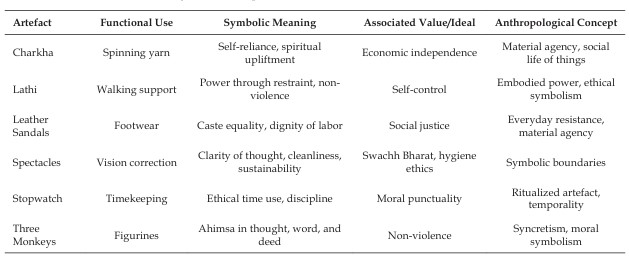
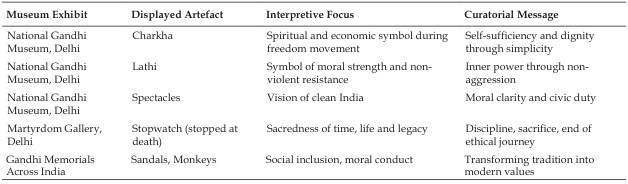
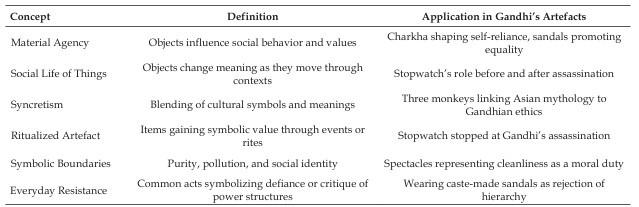
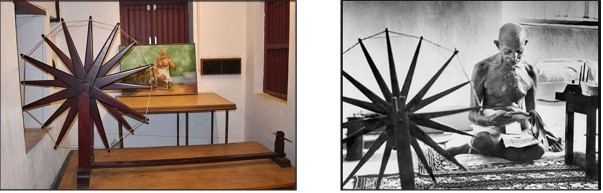
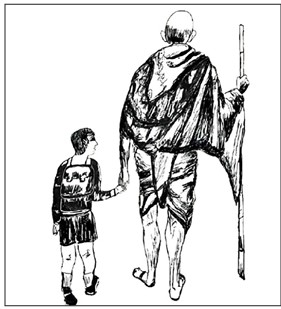
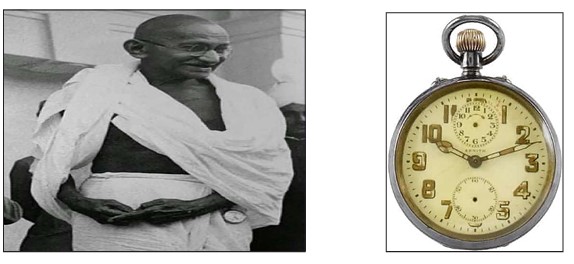
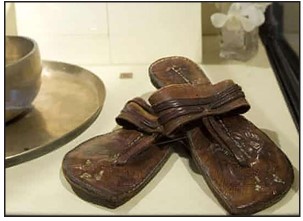
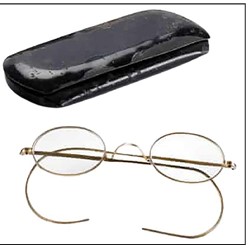
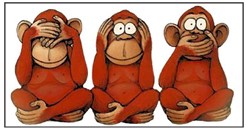
Background: Mahatma Gandhi’s belongings, including the charkha, lathi, sandals, spectacles, stopwatch, and three wise monkeys, have become iconic artefacts representing his ethical worldview. In museum settings, these objects are reimagined as strong symbols that actively communicate ideological meaning beyond their utilitarian origins. Aim: To investigate how Gandhi’s personal items serve as semiotic and ethical tools in museums, transcending their utilitarian beginnings. Objectives: The study aims to investigate the symbolic meanings of Gandhi’s belongings, utilizing Museum Anthropology and Alfred Gell’s object agency theory to study their ideological value, and envies how museums curate and disseminate his ethical legacy to modern audiences. Material: The study tried to examine Gandhi’s charkha (spinning wheel), lathi (walking stick), leather sandals, spectacles, stopwatch, and the three wise monkeys, as well as the practice of fasting, as depicted in museum exhibitions and cultural representations of National Gandhi Museum and Charkha Museum, New Delhi. Results: The study revealed that Gandhi’s personal artefacts had multiple symbolic connotations in museum contexts. The charkha indicates self-reliance, the lathi represents moral fortitude, and the sandals promote anti-caste equality. His spectacles signify an ethical vision, the stopwatch symbolises time discipline, and the three wise monkeys represent pacifism. Fasting is seen as embodied ethics. Collectively, these artefacts provide rich tales that connect visitors to Gandhi’s lived philosophy. Banita Behera1, M.R.Gangadhar et al. My Understanding of Mahatma Gandhi: A Museum Anthropological Study of Gandhi’s Artefacts and their Symbolism, as Represented in Museums. Conclusion: Museums does not only conserve Gandhi’s material legacy; they actively reinterpret and contextualise his ethical visions. These personal things serve as moral artefacts and semiotic instruments, instilling Gandhi’s ideas in public consciousness through carefully chosen iconography and tailored experiences.
References
- 1. Appadurai, Arjun, ed. The Social Life of Things: CommoditiesinCulturalPerspective. Cambridge: Cambridge University Press, 1986.
- 2. Bean, Susan S. 1989. “Gandhi and Khadi: The Fabric of Indian Independence.” Journal of Asian Studies 48 (4): 794–810.
- 3. Breckenridge, Carol A. 1990. “The Three Monkeys of Non-Violence: Gandhi’s Symbols in Asian Culture.” Modern Asian Studies 24 (4): 765–778.
- 4. Breckenridge, Carol A., ed. Consuming Modernity: Public Culture in a South Asian World. Minneapolis: University of Minnesota Press, 1990
- 5. Douglas, Mary. PurityandDanger:AnAnalysis of Concepts of Pollution and Taboo. London: Routledge, 1966.
- 6. Jaju, Shrikrishnadas. The All India Spinners’ Association and Its Work. 1951.
- 7. Kopytoff, Igor. 1986. “The Cultural Biography of Things: Commoditization as Process.” In The Social Life of Things: Commodities in Cultural Perspective, edited by ArjunAppadurai, 64–91. Cambridge: Cambridge University Press.
- 8. Miller, Daniel. Material Culture and Mass Consumption. Oxford: Blackwell, 1987.
- 9. Miller, Daniel. Materiality. Durham: Duke University Press, 2005.
- 10. Narayanaswamy, K.S. Gandhiji’s Concept of Value-Based Living. Ahmedabad: Navajivan Trust, 1997.
- 11. Prabhu, R.K., and U.R. Rao. The Mind of Mahatma Gandhi: Encyclopedia of Gandhi’s Thoughts. Ahmedabad: Navajivan Trust, 1946.
- 12. Srinivas, M.N. CasteinModernIndiaandOther Essays. Bombay: Asia Publishing House, 1962.
- 13. Thakkar, Jayshree, and Mehta. Understanding Gandhi: Gandhians inConversationwith Fred J. Blum. Ahmedabad: Navjivan Publishing House, 2011.
- 14. The Ideology of the Charkha: A Collection of Gandhiji’s Speeches andWritings about Khadi. Ahmedabad: Navajivan Trust.
- 15. Alter, Joseph S. Gandhi’sBody:Sex,Diet,andthe PoliticsofNationalism. Philadelphia: University of Pennsylvania Press, 2001.
Data Sharing Statement
There are no additional data available
Funding
This research received no funding.
Author Contributions
All authors contributed significantly to the work and approve its publication.
Ethics Declaration
None
Acknowledgements
No Information provided
Conflicts of Interest
No conflicts of interest in this work.
About this article

Cite this article
Behera B, Gangadhar MR. My understanding of Mahatma Gandhi: a museum anthropological study of Gandhi’s artefacts and their symbolism, as represented in museums. Ind J Res Anthropol. 2025;11(1):7-17.
Licence:
Attribution-Non-commercial 4.0 International (CC BY-NC 4.0)This license enables reusers to distribute, remix, adapt, and build upon the material in any medium or format for noncommercial purposes only, and only so long as attribution is given to the creator.
| Received | Accepted | Published |
|---|---|---|
| February 24, 2025 | June 04, 2025 | June 18, 2025 |
DOI: 10.21088/ijra.2454.9118.11125.1
Keywords
Mahatma GandhiMuseum anthropologySymbolismMaterial cultureEthical idealsSocial changeNonviolenceSearch for Similar Articles
Similar Articles
- Indigenous Knowledge System in Formal Education
- Contemporary Issues and Challenges in Women’s Weavers in the Varanasi Silk Sare...
- Understanding through Traversing the Corridors of History: Richness of Indian He...
- Challenges and Opportunities in Digital Preservation of Intangible Culture Herit...
- Assessment of Nutritional Indicators: A Comparative Study among Pre-School Child...
Article Level Metrics
Last UpdatedThursday 09 July 2026, 14:33:52 (IST)
821
Accesses
1
223
00
Citations
NA
NA
NA
Download citation
Article Keywords
Keyword Highlighting
Highlight selected keywords in the article text.
Timeline
| Received | February 24, 2025 |
| Accepted | June 04, 2025 |
| Published | June 18, 2025 |
licence
Attribution-Non-commercial 4.0 International (CC BY-NC 4.0)
This license enables reusers to distribute, remix, adapt, and build upon the material in any medium or format for noncommercial purposes only, and only so long as attribution is given to the creator.