Full Text (PDF)
Indian Journal of Agriculture Business 8(2):p 49-52, July-December 2022. | DOI: https://doi.org/10.21088/ijab.2454.7964.8222.1
Original Article
Manpower Utilization in New Born Management Activities in Organized Swine Farm
Mamta, Assistant Professor, Departmet of Livestock Production Managment, College of Veterinary Science and Animal Husbandry, Pandit Deen Dayal Upadhyaya Pashu Chikitsa Vigyan Vishwavidyalaya Evam GoAnusandhan Sansthan, Mathura 281001, Uttar Pradesh, India null, Mamta null, Mukesh Singh null, Manav Singh null, Rajneesh Sirohi null, Deep Narayan Singh null
Author Information
Licence:
Attribution-Non-commercial 4.0 International (CC BY-NC 4.0)Indian Journal of Agriculture Business 8(2):p 49-52, July-December 2022. | DOI: https://doi.org/10.21088/ijab.2454.7964.8222.1
How Cite This Article:
Mamta, Mukesh Singh, Manav Singh, et al./Manpower Utilization in New Born Management Activities in Organized Swine Farm/Indian Journal of Agriculture Business 2022;8(2):49–52.
Timeline
Received : July 02, 2022
Accepted : August 19, 2022
Published : November 11, 2022
Abstract
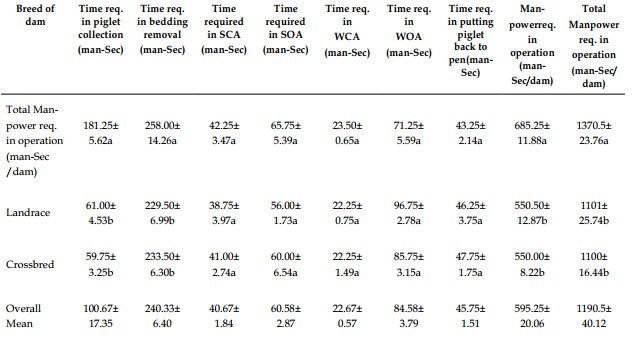
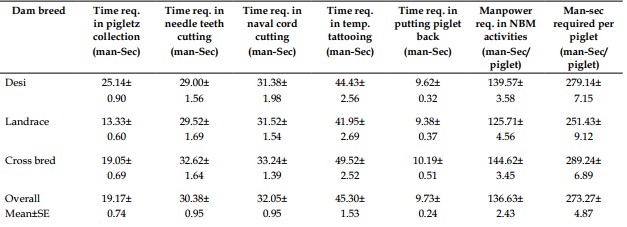
Rearing of pigs in India is predominantly occupied by marginal, small and semi-medium farmers which mostly follow an unorganized system of pig production. Intensive pig production has been grown all around the world and also has quite a potential in India as well. Labor in an organized farm is the most critical resource which influences its profitability of it. Information about manpower utilization for various pig farm operations is essential for the viewpoint of manpower deployment and management. A Time motion study was conducted at Swine Production Farm, IVRI, Izatnagar, Bareilly, Uttar Pradesh to find out the existing manpower utilization in newborn management activities for litters belonging to Desi, Landrace, and Crossbred breed dams. Three litters consisting of 7 piglets each were utilized to record the
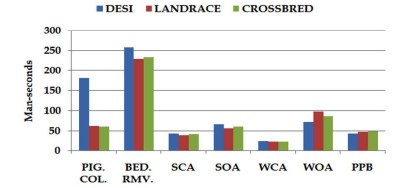
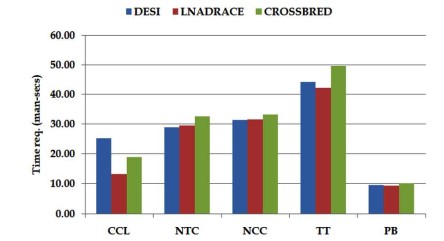
time spent in different management activities in each group of dams. The time spent cleaning the farrowing pen was significantly higher (p<0.05) for the Desi dam than for the landrace and Crossbred dams. Time spent in attending new-borne activities was also significantly higher (p<0.05) for the Desi dam than the landrace and Crossbred dams.
References
- 1. Basic Animal Husbandry Statistics (BAHS) (2010). Department of Animal Husbandry, Dairying and Fisheries, Ministry of Agriculture, Government of India. Retrieved December 21, 2011 (http//www.dahd.nic.in).
- 2. Bhat, P.N., Mohan N.H. and Sukh Deo. (2010). Pig production. Studium Press (India) Pvt. Ltd. Darya Ganj, New Delhi.
- 3. Cameron, R.D.A. (2000). A Review of the Industrialization of Pig Production Worldwide with particular reference to the Asian Region. Animal Health and Area-wide Integration. FAO, Brisbane, Australia.
- 4. Lazarus, W., and Buhr, B. (1994). Minnesota Pork Industry Review. Mankato, Minnesota: Minnesota Pork Producers Association.
- 5. Lazarus,W. (1995). The changing swine industry in structural change in the livestock industry. St. Paul, Minnesota: Minnesota Extension Service, University of Minnesota.
- 6. Snedecor, G.W. and Cochran, W.G. (1989). Statistical Methods, 6th ed. Iowa University Press, Ames, pp: 593
- 7. USDA (2006). Agricultural resource management survey: Economic research service using data from USDA.
Data Sharing Statement
There are no additional data available. All raw data and code are available upon request.
Funding
This research received no funding.
Author Contributions
All authors contributed significantly to the work and approve its publication.
Ethics Declaration
Provide information related to the Ethics Committee approval with approval number OR write, This article does not involve any human or animal subjects, and therefore does not require ethics approval.
Acknowledgements
We would like to express our gratitude to the patients, their families, and all those who have contributed to this study.
Conflicts of Interest
The authors report no conflicts of interest in this work.
About this article

Cite this article
Mamta, Mukesh Singh, Manav Singh, et al./Manpower Utilization in New Born Management Activities in Organized Swine Farm/Indian Journal of Agriculture Business 2022;8(2):49–52.
Licence:
Attribution-Non-commercial 4.0 International (CC BY-NC 4.0)| Received | Accepted | Published |
|---|---|---|
| July 02, 2022 | August 19, 2022 | November 11, 2022 |
DOI: https://doi.org/10.21088/ijab.2454.7964.8222.1
Keywords
pigsmanpowernew born managementDesiLandraceand Crossbred dams.manpowernew born managementDesiLandraceand Crossbred dams.Search for Similar Articles
Similar Articles
- Studies on Bee and Pollination is Changing Environment: A Review
- Importance of Need Assessment for Development of Prog. for Rural Community
- Assessment of Sperm Damage with use of Unconventional Practices for Freeze Thawi...
- Diseases of Pulse Crops and their Management in India
- Expression of Natural Behaviour in Domestic Goats (Capra hircus): Implications f...
Article Level Metrics
Last UpdatedThursday 10 September 2026, 21:38:21 (IST)
2959
Accesses
20
418
00
Citations
NA
NA
NA
Download citation
Article Keywords
Keyword Highlighting
Highlight selected keywords in the article text.
Timeline
| Received | July 02, 2022 |
| Accepted | August 19, 2022 |
| Published | November 11, 2022 |