Full Text (PDF)
Indian Journal of Law and Human Behavior 12(1):p 33-51, January-June 2026. | DOI: https://doi.org/10.21088/ijlhb.2454.7107.12126.4
Review Article
Localising Global Norms: Embedding Human Rights Education in India’s NEP 2020 and the Role of International Legal Commitments
Author Information
Licence:
Attribution-Non-commercial 4.0 International (CC BY-NC 4.0)This license enables reusers to distribute, remix, adapt, and build upon the material in any medium or format for noncommercial purposes only, and only so long as attribution is given to the creator.
Indian Journal of Law and Human Behavior 12(1):p 33-51, January-June 2026. | DOI: https://doi.org/10.21088/ijlhb.2454.7107.12126.4
How Cite This Article:
Aparna Singh. Localising Global Norms: Embedding Human Rights Education in India’s NEP 2020 and the Role of International Legal Commitments. Indian J Law Hum Behav 2026; 12(1): 33-51.Timeline
Received : February 05, 2026
Accepted : March 11, 2026
Published : June 30, 2026
Abstract
The National Education Policy (NEP) 2020 of India represents a transformative vision aimed at creating an inclusive, equitable, and globally competitive education system. Central to this vision is the integration of Human Rights Education (HRE) across all levels of schooling to foster a generation of ethically responsible, socially conscious, and constitutionally aware citizens. This paper critically examines the incorporation of HRE within the NEP 2020 framework, with a specific focus on secondary education in the state of Uttar Pradesh. It evaluates how India’s constitutional commitments and international legal obligations—particularly under the Universal Declaration of Human Rights, the Vienna Declaration and Programme of Action (1993), and the UN Decade for Human Rights Education (1995–2004)—have shaped national educational reforms. Through a combination of doctrinal and empirical analysis, the study assesses curriculum design, teacher training, institutional readiness, and socio-cultural challenges to effective implementation of HRE in schools. Despite its inclusion in national policy, the research identifies gaps in practice—particularly in resourcepoor and socially stratified regions. The paper argues for a contextualized and rights-based approach to curriculum reform that aligns domestic education systems with international human rights standards. It concludes by offering practical recommendations to strengthen the institutionalization of HRE in India, including policy revisions, educator capacity-building, and inclusive pedagogical strategies. By situating NEP 2020 within both national constitutional values and international legal frameworks, this study contributes to the global discourse on education as a tool for social transformation and legal empowerment.
References
- 1. Vision of Policy as mentioned in NEP 2020 on Page 6 of the Policy as retrieved from https:// www.education.gov.in/sites/upload_files/mhrd/files/NEP_Final_English_0.pdf on 20/11/2024
- 2. https://www.ohchr.org/en/what-arehuman-rights, as retrieved on 18/11/2024
- 3. https://www.ohchr.org/en/resources/ educators/human-rights-education-training/ right-human-rights-education, as retrieved on 18/11/2024
- 4. https://sur.conectas.org/en/right-educationhurman-rights-education/
- 5. Vienna Declaration and Programme of Action, para. 78–82, World Conference on Human Rights, June 25, 1993, U.N. Doc. A/CONF.157/23 (1993), available at https://www.ohchr.org/en/instruments-mechanisms/instruments/vienna-declaration-and-programme-action.
- 6. Ibid Para. 82
- 7. https://nhrc.nic.in/press-release/nationalaction-plan
- 8. https://www.ohchr.org/en/resources/e d u c a t o r s / h u m a n - r i g h t s - e d u c a t i o n - training/summary-national-initiativesundertaken-within-decade-human-rightseducation-1995-2004.
- 9. Ministry of Education, Government of India,National Curriculum Framework 2023 (2023), available at https://www.education.gov.in/sites/upload_files/mhrd/files/ncf_2023.pdf. pp. 15-17.
- 10. Ibid pp. 20-22.
- 11. Ibid pp. 15-18.
- 12. Ibid pp. 23-25.
- 13. Ibid pp. 24-27.
- 14. Ibid. p. 61.
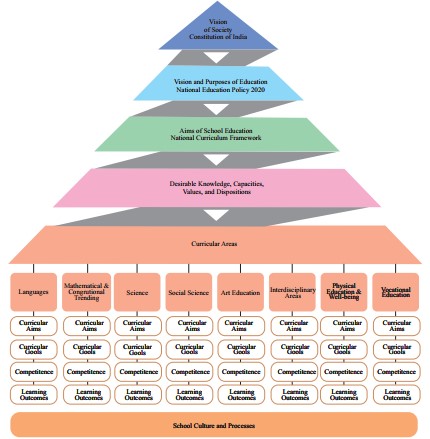
- 15. Figure 1.4i depicts how the NCF — which includes the Curricular Areas (its goals, pedagogy,books, assessment etc.), school culture, and school processes necessary to achieve Aims of SchoolEducation — flow from the vision of society that is envisaged in our Constitution. p. 61.
- 16. National Curriculum Framework for School Education, at p. 179 (2023).
- 17. Ibid, atpg 168
- 18. Section 4.1 Principles of Inclusion, ibid p. 181
- 19. Theirworld, What Has Ban Ki-Moon Done for Education and Child Rights?,Theirworld News (Sept. 22, 2016), https://theirworld.org/news/what-has-ban-ki-moon-done-foreducation-child-rights/.
- 20. h t t p s : / / w w w . i p s o s . c o m / e n / h u m a n - rights-2018
- 21. The Prohibition of Employment as Manual Scavengers and Their Rehabilitation Act, No. 25 of 2013, India Code (2013), available at https://ncsk.nic.in/sites/default/files/manualsca-act19913635738516382444610.pdf.
- 22. Indian Young Lawyers Association v. State of Kerala, SC Observer, https://www.scobserver.in/cases/indian-young-lawyers-associationv-state-of-kerala-sabarimala-temple-entrybackground/.
- 23. 1973 4 SCC 225
- 24. The Prohibition of Child Marriage Act, No. 6 of 2007, India Code (2007), available at https://legislative.gov.in/actsofparliamentfromtheyear/prohibitionchild-marriage-act-2006.
- 25. Indian Society of Probability and Statistics, “Evaluation Summary: Beti Bachao Beti Padhao (2015-2022),” available athttps://www.ispp.org.in/evaluation-summary-betibachao-beti-padhao-2015-2022/
- 26. Quit It! was developed to address teasing and bullying behaviour at the earlier stages of education as a means to prevent later incidents of violence and sexual harassment. The premise is that by starting early to create a respectful school climate that made every child feel safe and welcome, teaching and bullying will be reduced. The Model begins in kindergarten and is school-wide. The programme involves all adults who work with the children in the school environment and also parents. The activity guide revolves around three themes: Creating our Rules, Talking about Teaching and Bullying, and Exploring Courage. Literacybased activities are meant to be integrated into the daily curriculum to help students develop essential skills such as listening, verbalization, reading and writing. Problemsolving strategies are included in every activity. An internal programme evaluation carried out over a two-year period in a New York City school showed a decrease in the number of teasing and bullying incidents, an increased staff involvement in intervention in such cases, and a substitute of verbal for physical responses to teasing or bullying.
- 27. Office of the High Commissioner for Human Rights, Compendium of Human Rights Education: Human Rights Education in the School Systems of Europe, Central Asia and North America 71 (2021), available at https://www.ohchr.org/sites/default/files/Documents/Publications/CompendiumHRE.pdf.
Data Sharing Statement
There are no additional data available. All raw data and code are available upon request.
Funding
This research received no funding.
Author Contributions
All authors contributed significantly to the work and approve its publication.
Ethics Declaration
This article does not involve any human or animal subjects, and therefore does not require ethics approval.
Acknowledgements
We would like to express our gratitude to the patients, their families, and all those who have contributed to this study.
Conflicts of Interest
No conflicts of interest in this work.
About this article

Cite this article
Aparna Singh. Localising Global Norms: Embedding Human Rights Education in India’s NEP 2020 and the Role of International Legal Commitments. Indian J Law Hum Behav 2026; 12(1): 33-51.
Licence:
Attribution-Non-commercial 4.0 International (CC BY-NC 4.0)This license enables reusers to distribute, remix, adapt, and build upon the material in any medium or format for noncommercial purposes only, and only so long as attribution is given to the creator.
| Received | Accepted | Published |
|---|---|---|
| February 05, 2026 | March 11, 2026 | June 30, 2026 |
DOI: https://doi.org/10.21088/ijlhb.2454.7107.12126.4
Keywords
Human Rights Education (HRE)National Education Policy (NEP) 2020National Curriculum Framework (NCF) 2023International Legal CommitmentsUniversal Declaration of Human Rights (UDHR)Social JusticeSearch for Similar Articles
Similar Articles
- Letting Nature Take its Course: The Supreme Court’s Harish Rana Judgment and the...
- Law in Black, Medicine in White: Black Letter Law and White Coat Profession in I...
- Fast-Track Justice for Medical Negligence: Lessons from Summary Trials Condensed...
- A Comparative Constitutional Study of Judicial Review in India, the United State...
- Wage Discrimination on the Basis of Gender: An Analysis of Indian Legal Position
Article Level Metrics
Last UpdatedSunday 18 October 2026, 07:49:22 (IST)
2191
Accesses
27
286
00
Citations
NA
NA
NA
Download citation
Article Keywords
Keyword Highlighting
Highlight selected keywords in the article text.
Timeline
| Received | February 05, 2026 |
| Accepted | March 11, 2026 |
| Published | June 30, 2026 |
licence
Attribution-Non-commercial 4.0 International (CC BY-NC 4.0)
This license enables reusers to distribute, remix, adapt, and build upon the material in any medium or format for noncommercial purposes only, and only so long as attribution is given to the creator.