Full Text (PDF)
Indian Journal of Law and Human Behavior 12(1):p 53-60, January-June 2026. | DOI: https://doi.org/10.21088/ijlhb.2454.7107.12126.5
Review Article
Letting Nature Take its Course: The Supreme Court’s Harish Rana Judgment and the Constitutional Architecture of Passive Euthanasia in India
Vivekanshu Verma, Shri Gopal Kabra, Promod Kumar Kohli
Author Information
Licence:
Attribution-Non-commercial 4.0 International (CC BY-NC 4.0)This license enables reusers to distribute, remix, adapt, and build upon the material in any medium or format for noncommercial purposes only, and only so long as attribution is given to the creator.
Indian Journal of Law and Human Behavior 12(1):p 53-60, January-June 2026. | DOI: https://doi.org/10.21088/ijlhb.2454.7107.12126.5
How Cite This Article:
Vivekanshu Verma, Shri Gopal Kabra, Promod Kumar Kohli. Letting Nature Take its Course: The Supreme Court’s Harish Rana Judgment and the Constitutional Architecture of Passive Euthanasia in India. Indian J Law Hum Behav 2026; 12(1): 53-60.Timeline
Received : March 12, 2026
Accepted : March 30, 2026
Published : June 30, 2026
Abstract
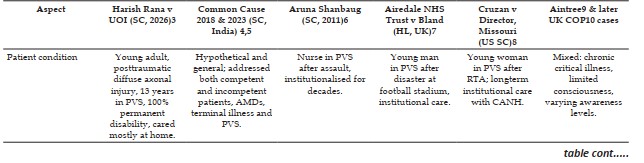
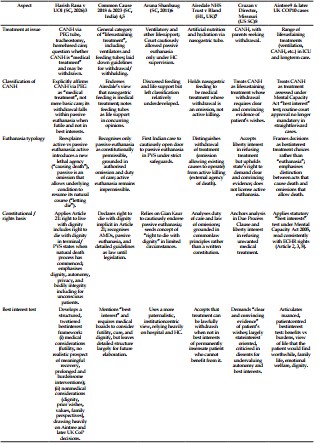
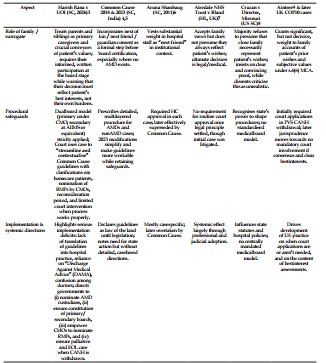
Background: In 2026, the Supreme Court of India in Harish Rana v Union of India & Ors (2026 INSC 222) applied and substantially elaborated the passive euthanasia framework laid down in Common Cause (2018, 2023), in the concrete setting of a young man in a permanent vegetative state (PVS) maintained on Clinically Assisted Nutrition and Hydration (CANH) via PEG tube at home. Objective: To critically analyse the medicolegal reasoning in Harish Rana, with specific focus on: (i) Classification of CANH as “medical treatment”; (ii) Refinement of the “best interest” test; and (iii) Operationalisation and streamlining of the Common Cause guidelines, including implications for clinicians, hospitals and families. Methods: Doctrinal review of the full judgment text, read against prior Indian precedents (Aruna Shanbaug, Common Cause 2018, Common Cause 2023) and comparative jurisprudence from the UK, USA, EU and other jurisdictions expressly relied upon by the Court; thematic extraction of key medicolegal concepts (dignity, autonomy, authorised omission, futility, best interests) and their application to endoflife decisionmaking. Key findings: The Court held that CANH delivered through PEG constitutes “medical treatment” and its withdrawal, when medically futile and not in the patient’s best interests, falls within constitutionally permissible passive euthanasia rather than unlawful killing. It reaffirmed that Article 21’s right to live with dignity includes a right to die with dignity in cases of terminal illness or PVS where the process of natural death has commenced, and clarified that passive euthanasia is an “authorised omission” consistent with the physician’s duty of care. Drawing on UK and US case law (Airedale, Cruzan, Aintree, WvM and others), it adopted a nuanced “best interest” framework integrating medical futility, absence of any realistic prospect of meaningful recovery, and nonmedical factors such as prior wishes, family perspectives and dignity. The judgment also identified gaps in implementation of Common Cause guidelines, particularly for longterm homebased patients, and issued detailed directions for boards, CMOs and governments to create clearer, safer pathways for withdrawal/withholding of treatment and provision of palliative care. Conclusions: Harish Rana operationalises the abstract principles of Common Cause into a practically usable medicolegal template for withdrawing CANH in PVS, while robustly protecting dignity, autonomy and professional security. For treating doctors and forensic experts, it provides authoritative guidance on classifying CANH, documenting futility, engaging families, and navigating liability risks when discontinuing lifesustaining treatment.
References
- 1. Harish Rana v Union of India & Ors, Misc. Appl. No. 2238 of 2025 in SLP (C) No. 18225 of 2024, 2026 INSC 222 (Supreme Court of India). 2026 Supreme(Online)(SC) 418.
- 2. Withdrawal of CANH Permissible if Not in PVS Patient’s Best Interests: Supreme Court - Supreme Today AI https://supremetoday.ai/sc-permits-canh-withdrawal-pvs-bestinterests-principle-20260312008
- 3. Harish Rana Vs UOI 2026 Supreme(Online) (SC) 418
- 4. Common Cause v Union of India, (2018) 5 SCC 1 (Supreme Court of India).
- 5. Common Cause v Union of India, (2023) 14 SCC 131 (Supreme Court of India).
- 6. Aruna Ramachandra Shanbaug v Union of India, (2011) 4 SCC 454 (Supreme Court of India).
- 7. Airedale NHS Trust v Bland, 1 All ER 821 (HL, UK).
- 8. Cruzan v Director, Missouri Department of Health, 497 US 261 (1990) (US Supreme Court).
- 9. Aintree University Hospitals NHS Foundation Trust v James, UKSC 67.
- 10. W v M and Others, EWHC 2443 (COP).
- 11. Gian Kaur v State of Punjab, (1996) 2 SCC 648 (Supreme Court of India).
- 12. Common Cause v Union of India, (2023) 14 SCC 131 (Supreme Court of India).
- 13. Aruna Ramachandra Shanbaug v Union of India, (2011) 4 SCC 454 (Supreme Court of India).
- 14. Cruzan v Director, Missouri Department of Health, 497 US 261 (1990) (US Supreme Court).
- 15. Aintree University Hospitals NHS Foundation Trust v James, UKSC 67.
Data Sharing Statement
There are no additional data available. All raw data and code are available upon request.
Funding
This research received no funding.
Author Contributions
All authors contributed significantly to the work and approve its publication.
Ethics Declaration
This article does not involve any human or animal subjects, and therefore does not require ethics approval.
Acknowledgements
We would like to express our gratitude to the patients, their families, and all those who have contributed to this study.
Conflicts of Interest
No conflicts of interest in this work.
About this article

Cite this article
Vivekanshu Verma, Shri Gopal Kabra, Promod Kumar Kohli. Letting Nature Take its Course: The Supreme Court’s Harish Rana Judgment and the Constitutional Architecture of Passive Euthanasia in India. Indian J Law Hum Behav 2026; 12(1): 53-60.
Licence:
Attribution-Non-commercial 4.0 International (CC BY-NC 4.0)This license enables reusers to distribute, remix, adapt, and build upon the material in any medium or format for noncommercial purposes only, and only so long as attribution is given to the creator.
| Received | Accepted | Published |
|---|---|---|
| March 12, 2026 | March 30, 2026 | June 30, 2026 |
DOI: https://doi.org/10.21088/ijlhb.2454.7107.12126.5
Keywords
Passive euthanasiaClinically Assisted Nutrition and Hydration (CANH)PEG tubePermanent vegetative state (PVS)Best interestsRight to die with dignityArticle 21Common Cause guidelinesEndoflife careMedical futilitySearch for Similar Articles
Similar Articles
- Localising Global Norms: Embedding Human Rights Education in India’s NEP 2020 an...
- Law in Black, Medicine in White: Black Letter Law and White Coat Profession in I...
- Fast-Track Justice for Medical Negligence: Lessons from Summary Trials Condensed...
- A Comparative Constitutional Study of Judicial Review in India, the United State...
- Wage Discrimination on the Basis of Gender: An Analysis of Indian Legal Position
Article Level Metrics
Last UpdatedSunday 18 October 2026, 07:49:22 (IST)
2191
Accesses
47
286
00
Citations
NA
NA
NA
Download citation
Article Keywords
Keyword Highlighting
Highlight selected keywords in the article text.
Timeline
| Received | March 12, 2026 |
| Accepted | March 30, 2026 |
| Published | June 30, 2026 |
licence
Attribution-Non-commercial 4.0 International (CC BY-NC 4.0)
This license enables reusers to distribute, remix, adapt, and build upon the material in any medium or format for noncommercial purposes only, and only so long as attribution is given to the creator.