Full Text (PDF)
Community and Public Health Nursing 3(3):p 91-98, Sep-Dec 2018. | DOI: http://dx.doi.org/10.21088/cphn.2455.8621.3318.3
Original Article
Knowledge Regarding the Menstrual Hygiene among Adolescent Girls in Selected Rural and Urban Schools
Hemlata Salve, Associate Professor, VSPM College of Nursing and Research Centre, Nagpur, Maharashtra 440016, India. , Sarah R. Budhe1 , Hemlata Salve2
Author Information
Licence:
Community and Public Health Nursing 3(3):p 91-98, Sep-Dec 2018. | DOI: http://dx.doi.org/10.21088/cphn.2455.8621.3318.3
How Cite This Article:
Timeline
Received : N/A
Accepted : N/A
Published : N/A
Abstract
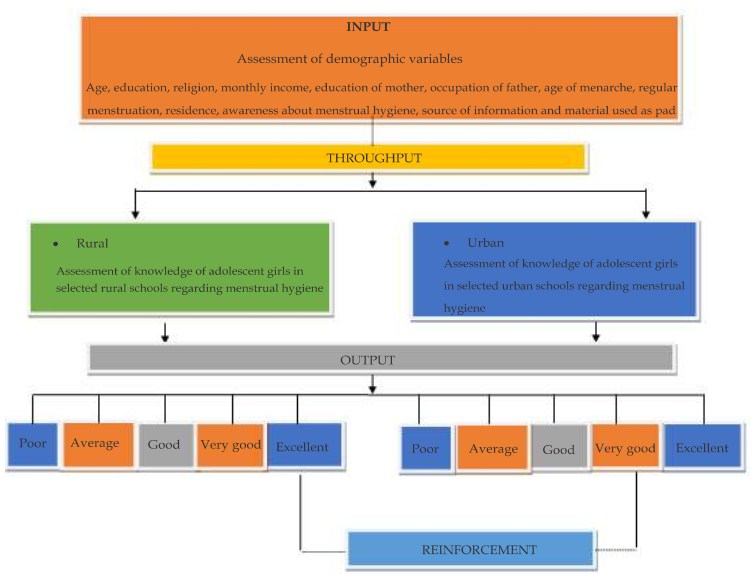
Background: Cleanliness is one of the most important practice for a clean and healthy environment. It may be related to public hygiene and personal hygiene. Menstruation is monthly uterine bleeding for 4-5 days coming regularly every 28 days from puberty till menopause in a woman’s reproductive life. Menstrual hygiene is neglected and people do not wish to explore this subject as it is still considered a social taboo. Good menstrual hygiene is crucial for the health, education and dignity of girls and women. Objectives: To assess the knowledge related to menstrual hygiene among adolescent girls in selected rural schools. To assess the knowledge related to menstrual hygiene among adolescent girls in selected urban schools. To compare the knowledge score related to menstrual hygiene among adolescent girls in selected rural and urban area. To find out the association between knowledge score with their demographic variables. Methodology: This study aims to assess and compare the knowledge related to menstrual hygiene among adolescent girls in selected rural and urban schools of the city. Total number of sample are 100 (50 rural and 50 urban) with the age group 13-16 years. A non experimental comparative descriptive research design is used with the quantitative approach. A non-probability convenient sampling technique used. Result: The present study showed that, in rural schools most of the samples i.e. 46% of the adolescent girls had average level of knowledge score, 52% had good and only 2% had very good level of knowledge score. The minimum score was 7 and the maximum score was 198, the mean score was 12.84±2.87 with a mean percentage score of 42.80±9.57. Similarly in urban schools 26% of the adolescent girls had average level of knowledge score, 62% had good and 12% had very good level of knowledge score. The minimum score was 7 and the maximum score was 20, the mean score for the was14.18±3.07 with a mean percentage score of 47.26±10.25. Conclusion: The present study shows that the adolescent girls belongs to rural schools has less knowledge than
adolescent girls belongs to urban schools.
References
No records found.
About this article

Cite this article
Licence:
| Received | Accepted | Published |
|---|---|---|
| N/A | N/A | N/A |
DOI: http://dx.doi.org/10.21088/cphn.2455.8621.3318.3
Keywords
Adolescent; Compare; Knowledge; Menstruation; Rural; UrbanÂSearch for Similar Articles
Similar Articles
- A Study to assess the Impact of Structured Teaching Programme on Knowledge of Pl...
- Effectiveness of Nurse Led Intervention on Knowledge and Practice of Food Borne...
- Effectiveness of a Structured Teaching Programme on Knowledge, Attitude, and Pra...
- A Study to assess the Effectiveness of Video Assisted Teaching on Knowledge Rega...
- Effectiveness of Planned Teaching Programme on Knowledge and Skill Regarding BLS...
Article Level Metrics
Last UpdatedWednesday 30 September 2026, 14:45:56 (IST)
7608
Accesses
5
1522
00
Citations
NA
NA
NA
Download citation
Article Keywords
Keyword Highlighting
Highlight selected keywords in the article text.
Timeline
| Received | N/A |
| Accepted | N/A |
| Published | N/A |