Full Text (PDF)
International Journal of Pediatric Nursing 10(3):p 105-110, September - December 2024. | DOI: https://doi.org/1021088/ijpen.2454.9126.10324.2
Original Article
Knowledge of Staff Nurses Regarding Prevention of Perineal Tear
Author Information
Licence:
Attribution-Non-commercial 4.0 International (CC BY-NC 4.0)This license enables reusers to distribute, remix, adapt, and build upon the material in any medium or format for noncommercial purposes only, and only so long as attribution is given to the creator.
International Journal of Pediatric Nursing 10(3):p 105-110, September - December 2024. | DOI: https://doi.org/1021088/ijpen.2454.9126.10324.2
How Cite This Article:
Suhasini Vinayak Sanas, Knowledge of Staff Nurses Regarding Prevention of Perineal Tear. Int J Pediatr Nurs. 2024;10(3):105-110Timeline
Received : November 11, 2024
Accepted : December 12, 2024
Published : December 30, 2024
Abstract
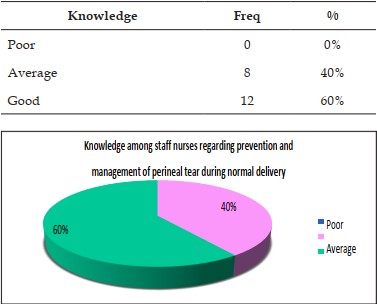
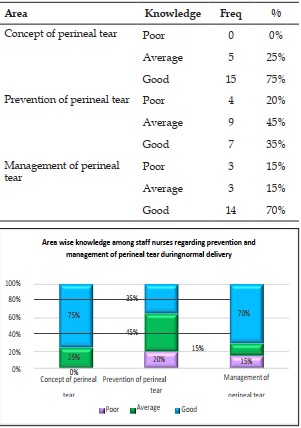
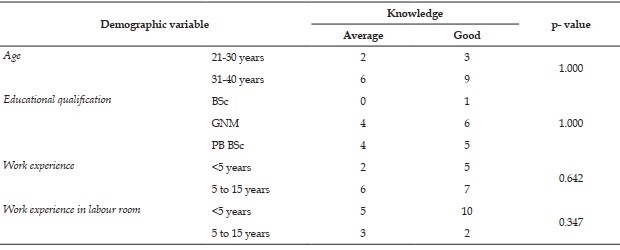
The present study was ssess the knowledge of staff Nurses regarding prevention of perineal tear. Objectives: To assess knowledge of Staff Nurses regarding Prevention & Management of perineal tear during normal delivery. Methodology: Research, Design - Non-experimental descriptive design, sampling technique - Convenient sampling, Research Setting - selected Hospital of City Result: Here we can discuss about the level of knowledge of staff nurse as per set the criteria for poor, average and good. With regard to scores, 0 (0%) staff nurses had poor knowledge, 8 (40%) staff nurses had average knowledge and 12 (60%) staff nurses had good knowledge regarding prevention and management of perineal tear. 25% percentage of staff nurses had average knowledge and 75% of them had good knowledge regarding concept of perineal tear. 20% of them had poor knowledge, 45% of them had average knowledge and 35% of them had good knowledge regarding Prevention of perineal tear. 15% of them had poor knowledge, 15% of them had average knowledge and 70% of them had good knowledge regarding Management of perineal tear. Conclusion: On the basis of results, it is concluded that maximum number of staff nurses were had average knowledge and minimum had good knowledge regarding prevention and management of perineal tear. On the basis of results, it is can also conclude that the knowledge level of staff nurses was no significant associated with demographic variables like educational qualification, work experience, experience in labour room and previous knowledge.
References
- 1. Devi SK. ssessing the TBA’s knowledge of safe delivery. Nightingale Nursing Times. 2014 Dec; 6 (9): p. 33.
- 2. Reeder, Martin, Konaik G. Maternity nursing, Family Newborn and Womeris Health Care. 18th ed. Philadelphia: Lippincot Publication; pp. 566-7.
- 3. Reeder, Martin, Konaik G. Maternity nursing. 18th ed. Philadelphia: Lippincot Publication, pp. 566-7.
- 4. Dutta D. C. “Text book of obstetrics including perinatology and contraception”, 3rd edition, 1997, New Central Book Agency (p) LTD, Calcutta, India, pp. 437-439.
- 5. Dutta D.C. “Text book of obstetrics including perinatology and contraception”, 6th edition, 2004, New Central Book Agency (p) LTD, Calcutta, India. pp. 423-424.
- 6. Annamma Jacob “a Comprehensive Text book of Midwifery, 2nd edition, 2008, Jaypee Brothers Medical Publishers, New Delhi, India. pp. 466- 468.
- 7. Myles Textbook for midwives, 14th edition, 2003, Churchill Livingstone, New Delhi. pp. 502-503.
- 8. Albers LL, Selder KD, Bedrick EJ, Teaf D. Peralta P. Midwifery care measures in the second stage of labor and reduction of genital tract trauma at birth: a randamised trial. Midwifery Womens Health [serial online]; 2005. Sep[cited2008 Nov17]:50(3):158-64: Available from URL:www.http// Pubmed.com
- 9. Pilliteri A. Maternal and child health nursing 4th ed. Philadelphia: Lippincot Publication, 2004, pp. 470,518.
- 10. Elharmeel, Suzan MA; Chaudhary, Yasmin, Tan, Stephanie: Scheermeyer, Elly, Hanafy, Ashraf, van Driel, Micke L (2011-08-10). Cochrane Pregnancy and Childbirth Group (ed.). “Surgical repair of spontaneous perineal tears that occur during childbirth versus no intervention” (PDF). Cochrane Database of Systematic Reviews (8): CD008534
- 11. Caroline, Nancy L. (1977-01-03). “Medical Care in the Streets”, JAMA: The Journal of the American Medical Association. 237 (1): 43. doc10.1001/jama. 1977.03270280045020. ISSN 0098-7484.
- 12. Frankman, Elizabeth A.; Wang, Li Bunker, Clareann H.; Lowder, Jerry L. (May 2009). “Episiotomy in the United States: has anything changed?”. American Journal of Obstetrics and Gynecology. 200 (5): 573. el- 573.07.
- 13. Jiang Hong Qian, Xu, Carroli, Guillermo; Garner, Paul (2017-02-08). Cochrane Pregnancy and Childbirth Group (ed.). “Selective versus routine use of episiotomy for vaginal birth”. Cochrane Database of Systematic
- 14. World Health Organization. International Classification of Diseases (ICD). Geneva (CG): WHO; 2015.
- 15. Management of obstetric anal sphincter injury: systematic review and national practice survey. BMC Health Services Res 2015; 13.
Data Sharing Statement
There are no additional data available. All raw data and code are available upon request.
Funding
This research received no funding.
Author Contributions
All authors contributed significantly to the work and approve its publication.
Ethics Declaration
This article does not involve any human or animal subjects, and therefore does not require ethics approval.
Acknowledgements
We would like to express our gratitude to the patients, their families, and all those who have contributed to this study.
Conflicts of Interest
No conflicts of interest in this work.
About this article

Cite this article
Suhasini Vinayak Sanas, Knowledge of Staff Nurses Regarding Prevention of Perineal Tear. Int J Pediatr Nurs. 2024;10(3):105-110
Licence:
Attribution-Non-commercial 4.0 International (CC BY-NC 4.0)This license enables reusers to distribute, remix, adapt, and build upon the material in any medium or format for noncommercial purposes only, and only so long as attribution is given to the creator.
| Received | Accepted | Published |
|---|---|---|
| November 11, 2024 | December 12, 2024 | December 30, 2024 |
DOI: https://doi.org/1021088/ijpen.2454.9126.10324.2
Keywords
Perineal tearPreventionDeliveryStaff NursesSearch for Similar Articles
Similar Articles
- Craniosynostosis with Midfacial Hypoplasia and Bilateral Choanal Atresia Present...
- Pediatric Bone Disorders: Interpretation Challenges of Vitamin D and Calcium
- Care of Neonates Under Phototherapy: A Narrative Review on the Impact of Phototh...
- Effectiveness of Structured Teaching Program on Knowledge Regarding Text Neck Sy...
- Hemostatic Testing in Critically Ill Infants and Children
Article Level Metrics
Last UpdatedTuesday 29 September 2026, 12:55:28 (IST)
1498
Accesses
9
286
00
Citations
NA
NA
NA
Download citation
Article Keywords
Keyword Highlighting
Highlight selected keywords in the article text.
Timeline
| Received | November 11, 2024 |
| Accepted | December 12, 2024 |
| Published | December 30, 2024 |
licence
Attribution-Non-commercial 4.0 International (CC BY-NC 4.0)
This license enables reusers to distribute, remix, adapt, and build upon the material in any medium or format for noncommercial purposes only, and only so long as attribution is given to the creator.