Full Text (PDF)
Indian Journal of Anesthesia and Analgesia 9(2):p 75-79, March-April 2022. | DOI: https://doi.org/10.21088/ijaa.2349.8471.9222.10
Original Article
Intraperitoneal Instillation of Ropivacaine 0.375% with Dexmedetomidine vs Ropivacaine 0.375% with Clonidine for Postoperative Analgesia in Laproscopic Cholecystectomy: A Comparative Study
Nazma Jabeen null, Nazma Jabeen1 null, K Yugandhar2 null, S Kiran Kumar3 null
Author Information
Licence:
Attribution-Non-commercial 4.0 International (CC BY-NC 4.0)This license enables reusers to
distribute, remix, adapt, and build upon the material in any medium or format
for noncommercial purposes only, and only so long as attribution is given to
the creator.
Indian Journal of Anesthesia and Analgesia 9(2):p 75-79, March-April 2022. | DOI: https://doi.org/10.21088/ijaa.2349.8471.9222.10
How Cite This Article:
Nazma Jabeen, K Yugandhar, S Kiran Kumar/Intraperitoneal Instillation of Ropivacaine 0.375% with Dexmedetomidine vs Ropivacaine 0.375% with Clonidine for Postoperative Analgesia in Laparoscopic Cholecystectomy: A Comparative Study/Indian J Anesth Analg. 2022; 9(2): 75-79
Timeline
Received : January 13, 2022
Accepted : January 22, 2022
Published : April 20, 2022
Abstract
Introduction: Laproscopic Cholecystectomy is a standard technique for symptomatic cholelithiasis. It is most commonly performed day care surgery. On the day of surgery pt experiences vague abdominal and shoulder pain. As the discharge is delayed due to lack of adequate analgesia, provision of adequate analgesia is of utmost importance. Objective: To compare the efficacy of postoperative analgesia after intraperitoneal instillation of 0.375% Ropivacaine with Dexmedetomidine vs 0.375% Ropivacaine with Clonidine
Materials and Methods: 40 patients posted for laproscopic cholecystectomy were randomly divided into two groups A and B. Group A received 20 ml of 0.375% Ropivacaine with 1mcg/ kg of Dexmedetomididne and Group B received 0.375% Ropivacaine with 1mcg/Kg Clonidine intraperitoneally through the 10mm supraumbilical port before closure. Pain was recorded on Visual Analog Scale at frequent intervals for 24 hrs postoperatively and categorised as either mild, moderate or severe. Inj. Diclofenac 75mg iv was administered as rescue analgesic in pts with moderate to severe pain.
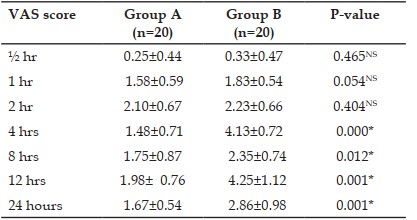
Results: PostoperativeVAS score showed a statistically significant difference between both groups with lower values in Group A compared to Group B. (P< 0.05 ). The amount of rescue analgesia used was also less with dexmedetomidine as adjuvant.
Conclusion: Ropivacaine 0.375% with 1mcg/kg Dexmedetomidine provided better postoperative analgesia and significantly less requirement of rescue analgesia as compared to 0.375% Ropivacaine with 1mcg/kg clonidine.
References
- 1. Schirmer BD, Edge SB, Dix JA, Hyser MJ, Hanks JB, Jones RS. Laparoscopic cholecystectomy. Treatment of choice for symptomatic cholelithiasis. Annals of surgery. 1991 Jun;213(6):665.
- 2. Barazanchi AW, MacFater WS, Rahiri JL, Tutone S, Hill AG, Joshi GP, Kehlet H, Schug S, Van de Velde M, Vercauteren M, Lirk P. Evidencebased management of pain after laparoscopic cholecystectomy: a PROSPECT review update. British journal of anesthesia. 2018 Oct 1;121(4):787-803.
- 3. Cha SM, Kang H, Baek CW, Jung YH, Koo GH, Kim BG, Choi YS, Cha S Cha YJ. Peritrocal and intraperitoneal ropivacaine for laparoscopic cholecystectomy: a prospective, randomised, doubleblind controlled trial. Journal of Surgical
- 4. Kucuk C, Kadiogullari N, Canoler O, Savli S. A placebo-controlled comparison of bupivacaine and ropivacaine instillation for preventing postoperative pain after laparoscopic cholecystectomy. Surg Today 2007;37(5):396-40.
- 5. Kholi AV, Ishaq S, Bhadral N, Gulati S, Manhas R. Comparison of Efficacy of Clonidine Vs Dexmedetomidine on Hemodynamic Changes in Laproscopic Cholecystectomy. JK Science. 2017 Apr 1;19(2):70-5.
- 6. Kim TH, Kang H, Park JS, Chang IT, Park SG. Intraperitoneal ropivacaine instillation for postoperative pain relief after laparoscopic cholecystectomy. J Korean Surg Soc 2010;79:130-6.
- 7. Møiniche S, Jørgensen H, Wetterslev J, Dahl JB. Local anesthetic infiltration for postoperative pain relief after laparoscopy: A qualitative and quantitative systematic review of intraperitoneal, port-site infiltration and mesosalpinx block. Anesth Analg 2000;90(4):899-9.
- 8. Moller R, Covino BG. Cardiac electrophysiologic properties of bupivacaine and lidocaine compared with those of ropivacaine, a new amide local anesthetic. Anesthesiology 1990;72(2):322-9.
- 9. Kamibayashi T, Maze M. Clinical uses of alpha2 - Adrenergic agonists. Anesthesiology 2000;93(5):1345-9.
- 10. Kanazi GE, Aouad MT, Jabbour-Khoury SI, Al Jazzar MD, Alameddine MM, Al-Yaman R, et al. Effect of low-dose dexmedetomidine or clonidine on the characteristics of bupivacaine spinal block. Acta Anaesthesiol Scand 2006;50(2):222-7.
- 11. Memis D, Turan A, Karamanlioglu B, Tükenmez B, Pamukçu Z. The effect of tramadol or clonidine added to intraperitoneal bupivacaine onpostoperative pain in total abdominal hysterectomy. J Opioid Manag 2005;1(2):77-82.
- 12. Ahmed B, Elmawgoud AA, Dosa R. Antinociceptive effect of (a-2 adrenoceptor agonist) dexmedetomidine vs meperidine, topically, after laproscopic gynecologic surgery. J Med Sci 2008;8:400-4.
- 13. Shukla U, Prabhakar T, Malhotra K, Srivastava D, Malhotra K. Intraperitoneal bupivacaine alone or with dexmedetomidine or tramadolfor postoperative analgesia following laparoscopic cholecystectomy: A comparative evaluation. Indian J Anaesth 2015;59(4):234-9.
- 14. Memis D, Turan A, Karamanlioglu B, Tükenmez B, Pamukçu Z. The effect of tramadol or clonidine added to intraperitoneal bupivacaine on postoperative pain in total abdominal hysterectomy. J Opioid Manag 2005;1(2):77-82
- 15. Ahmed B, Elmawgoud AA, Dosa R. Antinociceptive effect of (a-2 adrenoceptor agonist) dexmedetomidine vs meperidine, topically, after laproscopic gynecologic surgery. J Med Sci 2008;8:400-4.
Data Sharing Statement
There are no additional data available. All raw data and code are available upon request.
Funding
This research received no funding.
Author Contributions
All authors contributed significantly to the work and approve its publication.
Ethics Declaration
This article does not involve any human or animal subjects, and therefore does not require ethics approval.
Acknowledgements
We would like to express our gratitude to the patients, their families, and all those who have contributed to this study.
Conflicts of Interest
No conflicts of interest in this work.
About this article

Cite this article
Nazma Jabeen, K Yugandhar, S Kiran Kumar/Intraperitoneal Instillation of Ropivacaine 0.375% with Dexmedetomidine vs Ropivacaine 0.375% with Clonidine for Postoperative Analgesia in Laparoscopic Cholecystectomy: A Comparative Study/Indian J Anesth Analg. 2022; 9(2): 75-79
Licence:
Attribution-Non-commercial 4.0 International (CC BY-NC 4.0)This license enables reusers to
distribute, remix, adapt, and build upon the material in any medium or format
for noncommercial purposes only, and only so long as attribution is given to
the creator.
| Received | Accepted | Published |
|---|---|---|
| January 13, 2022 | January 22, 2022 | April 20, 2022 |
DOI: https://doi.org/10.21088/ijaa.2349.8471.9222.10
Keywords
Ropivacaine; Intraperitoneal instillation; Laproscopic cholecystectomy; Dexmedetomidine; Clonidine.Search for Similar Articles
Similar Articles
- Awake Fibreoptic Intubation for Airway Management in Massive Thyroid Enlargement...
- A Case of Thoracotomy with One Lung Ventilation for Carcinoma Oesophagus
- A Case of Empyema for Thoracotomy and Decortication-Anaesthesia Management
- Full Mouth Rehabilitation in a 3-Year-Old Female Child with Repaired Tetralogy o...
- Do Gel Manicures Affect SpO2 Readings ? A Clinical Investigation
Article Level Metrics
Last UpdatedTuesday 14 July 2026, 10:01:45 (IST)
5690
Accesses
5
679
00
Citations
NA
NA
NA
Download citation
Article Keywords
Keyword Highlighting
Highlight selected keywords in the article text.
Timeline
| Received | January 13, 2022 |
| Accepted | January 22, 2022 |
| Published | April 20, 2022 |
licence
Attribution-Non-commercial 4.0 International (CC BY-NC 4.0)
This license enables reusers to
distribute, remix, adapt, and build upon the material in any medium or format
for noncommercial purposes only, and only so long as attribution is given to
the creator.